
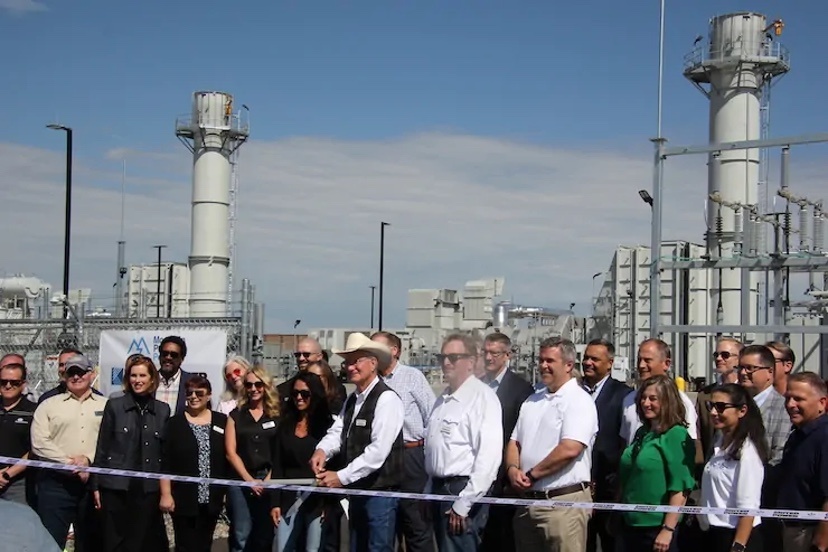
Photo: Directors of United Power 20 months ago pulled the trigger on what CEO Mark Gabriel described on a $250 million risk. By July, it was producing power even as demand soared on the hot days. Photo/Allen Best
This story by Allen Best appeared on BigPivots.com on September 3, 2025. We are sharing it in three parts.
Might nuclear someday become cost competitive (and with solutions for wastes)? Maybe…
In the near term, Colorado utilities have been placing bets on renewables shored up with natural gas. Notably, La Plata Electric in Durango, now led by Chris Hansen, one of the architects of Colorado’s energy transition, left open the door for natural gas in its recent solicitation.
Brighton-based United Power was first out of the chute. Independent of wholesale power provider Tri-State since May 2024, it managed to get a 162-megawatt power plant called Mountain Peak Power constructed in just 20 months. That just might be a record.
“I have been in this business for more than three decades, and I can tell you, I have never seen a project get done so quickly,” said Gabriel, the chief executive, at a ribbon-snipping ceremony on August 28.
Power production from Mountain Peak Power began in July, just in time to meet new peak demands for power from members of United, an electrical cooperative unregulated by the PUC. The cooperative last year invested in 11 megawatts of new battery storage, and they paid for themselves almost instantly in meeting peak summer demand, said Gabriel.
Mountain Peak Power, which Gabriel described as a $250 million bet, he believes will prove equally good as an investment.
No words of sorrow about the loss of coal were spoken in the remarks preceding the ribbon-snipping on August 28, although several times “clean burning natural gas” was mentioned. U.S. Rep. Lauren Boebert, in whose district the new gas plant is located, gave a three-minute talk that complained of “regulations from the top that really regulates us into poverty.”
Colorado’s problem, however, has not been of poverty, but affluence — and supply chains.
United Power has been rapidly growing. Its service territory extends from the foothills to the oil and gas operations of the Wattenberg Field, but most importantly the fast-growing commercial sector of the Interstate 76 corridor northeast of Denver.
Might more growth come from data centers? Gabriel acknowledges getting inquiries, but his board of directors months ago adopted a policy that essentially says larger users need to put skin in the game. They want lots more power? They need to put money up front.
That’s essentially what the PUC last Thursday decided. It wasn’t a snap decision. That had been the fundamental question in front of the commissioners since last October. How much of this vast increase in demand would be real?
“There is a real risk that if these new, uncommitted loads don’t materialize, it will likely substantially raise existing customer rates,” said Blank in his opening statement on the final day of deliberations. ” Xcel, he added, has been unwilling to share any “material amount” of this risk. “We need to be cautious about acquiring new generation resources before the new load is contractually committed.”
Environmental groups had suggested that rates could conceivably rise by 50% by 2031 if the demand does not arrive to pay for the new generation.
Blank’s colleagues were on the same page. It was, said Commissioner Tom Plant, a matter of getting the cart before the horse. Commitments needed to arrive before investment in new generation. He estimates that somewhere between 50% and 90% of the inquiries will be “more style than substance,” he predicted. “‘Eighty percent still haven’t signed anything.”
Megan Gilman, the third commissioner, said it is inappropriate to put all the risk on Xcel’s ratepayers if Xcel itself is not willing to shoulder risk.
“I think we have crafted a fair outcome here to ensure that we protect other ratepayers but are ready, willing and able to respond quickly to real loads that are coming.”
The solution adopted by the PUC — to be detailed in a written order that might well run 100 pages or more — lays out the specifics in thresholds of 20 megawatts and 50 megawatts for demands from data centers and other prospective large load customers. This is to be done through agreements called electric service agreements, or ESAs. At the PUC, they do love their acronyms.
Less time during the PUC commissioners’ final deliberations was devoted to the accuracy of Xcel’s growth in demand for electricity from building electrification and electric vehicles. If Xcel builds in expectation of demand from these sectors that fails to arrive as projected, that will result in higher rates. Those higher electric rates could then have the effect of discouraging people to invest in these new technologies. Plant thought that Xcel needs to get more incentive in devising rate structures to encourage EV charging when electricity is plentiful.
Even as the commissioners talked about the need to be nimble, lawyers — including former PUC commissioner Frances Koncilia — were assembling filings in response to a proposal by Xcel for something called a near-term procurement. This is the filing that provoked Koncilja’s rant about Pueblo.
Xcel, along with the PUC staff, the Colorado Energy Office and the Office of the Utility Consumer Advocate, asked the PUC commissioners to initiate a near-term procurement — henceforth reduced to the acronym NTP.
The basic thrust is that H.R. 1, otherwise known as the ‘One Big Beautiful Bill’ and passed by Congress in July, should hurry the process of Xcel getting bids. “Time is of the essence,” says the filing. Developers and the company need rapid project approvals to get projects under construction by July 2026.
This NTP would create a platform to evaluate projects — including some anticipated by the PUC commissioners in the just transition case — of up to 400 megawatts of renewable and hybrid projects, 200 megawatts of thermal generation, i.e. gas, plus 300 megawatts of gas or energy storage.
Industry groups such as the Colorado Solar and Storage Association, in their filings on Aug. 29, echoed the language of the Xcel filing from the week before, which in turn had echoes of a letter on Aug. 1 released by Gov. Jared Polis. It spoke to the “critical, time-limited window for renewable energy projects to qualify for federal tax credits.” This proposed process that would get projects out to bid by February 2026 will send a “clear message to the investment and development communities that Colorado is open for business.”
Environmental groups tersely noted that Xcel will most certainly need new resources and that the majority of that added electricity will come from wind and solar. Any projects that do not begin construction by July 4, 2026, and placed into service by the end of 2026 will become more expensive without federal tax credits.Holy Cross Energy, which still depends greatly on the electricity sold to it by Xcel Energy, applauded the “quick actions to pivot in the face of challenging Federal policy changes related to tax incentives for renewables energy resources. The electrical cooperative has minority ownership of Comanche 3, and these resources would replace that generation.” CORE Electric Cooperative was more reserved in its endorsement.
As for Pueblo, the city, it said that it intended to continue working to “create a high-tech clean energy hub,” and reminded the PUC commissioners to review the previous record regarding the just transition for the community.
The question now becomes whether anybody will want to build a gas plant in Pueblo or otherwise create a new tax base and jobs for the community and in what form. Xcel has land there and existing transmission lines.
Furthermore, the PUC is adopting a formula that seeks to give extra weight to a generating source proposed in the Pueblo and Hayden areas. One example — from a source in the solar industry — is that if Xcel got a bid for $39 for a project in Yuma County, and one for $41 in Pueblo County, and a $3 just transition “adder” was created for projects in just transition communities — the Pueblo County project would win.
One idea — discarded as impractical by Koncilja as an idea from “out of town environmental ‘experts’ — is of an energy park using various new technologies. It remains a vague idea. But then, as one of the PUC commissioners noted, it’s hard to know now exactly what technologies will be relevant in 2050. Consider that Comanche 3, when approved in 2004, was supposed to keep burning coal until 2070.
Exactly how this might look won’t become clear for several months. Knowing what projects might end up in Pueblo as a result of that added weighting, that’s likely a story for next year… and conceivably beyond.
Allen Best publishes the e-journal Big Pivots, which chronicles the energy transition in Colorado and beyond.