
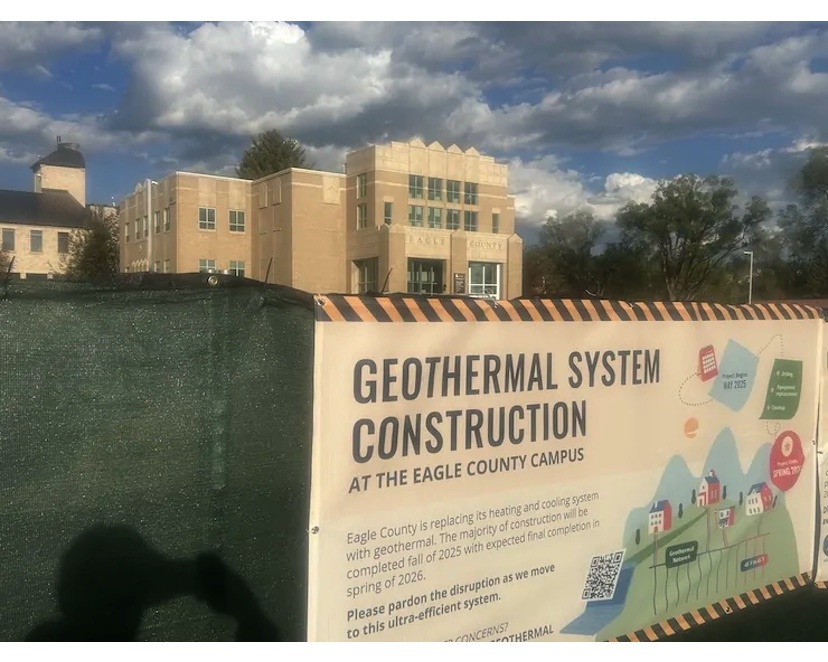
Photo: The drilling of wells in a field adjacent to the Eagle County courthouse and associated buildings began in June. The work is expected to be wrapped up in October. Photo/June 7, 2025 Allen Best
This story by Allen Best was published on BigPivots.com on August 29, 2025, and was written in consultation with Aspen Journalism. We are sharing it in two parts.
Winters in Aspen, at 8,000 feet, last longer and more heat is commonly needed than in Denver or Grand Junction. Given these longer winters and greater heating needs, might a potential thermal energy network on the Aspen schools campus also draw energy from other sources in the area?
For example, can exhaust heat produced in making ice at the nearby Aspen Recreation Center be sequestered in the geothermal well field? Similarly, a sewer pipeline runs relatively proximate to the schools campus. Might the heat be extracted for use in the campus network? GreyEdge examined various alternatives in its June report.
These ideas are not novel. For example, in Denver, heat is drawn from a 72-inch pipeline that transports sewage from downtown to a treatment plant. The extracted heat provides 90% of what is needed for buildings on the 250-acre campus of the National Western Complex, site of the annual stock show.
In Vail, the town government has been working on a smaller-scale application of the same concept, using heat from sewage to melt snow at Lionshead Village, which sits at the base of Vail Mountain.
Holy Cross Energy, the electrical provider for Vail and parts of Aspen, including the schools campus, hopes to see thermal energy networks succeed. It expects to deliver 80% emissions free electricity in 2025. For 2030, it has a goal of 100%.
To achieve that ambitious goal, it needs to figure out ways to lower peak demand and improve overall efficiency. The utility sees geothermal energy networks as part of that strategy.
“At times of oversupply, the excess electricity would power a boiler or a chiller, raising or lowering the water temperature in the thermal loop,” Holy Cross Energy CEO Bryan Hannegan wrote in an email.
“This reduces the need for electricity use later by the building’s heat pump,” Hannegan added. “The net effect is to consume excess electricity, store it, and then use it to reduce future electricity demand — basically a thermal version of battery storage. This helps us match our electricity demand to our electricity supply in a more cost-effective way.”
Lauren Suhrbier, who is with Carbondale-based Clean Energy Economy for the Region (CLEER), describes the work at the schools campus as being in an early stage of investigation. CLEER, which has been developing expertise in geothermal since 2023, has taken on the role of project manager for the Aspen schools’ geothermal exploration and has been paid $10,000 by the school district as of mid-August.
Suhrbier said the district hopes the geo-exchange network can be accomplished for less than $20 million. One possibility is to transfer the risk to an outside financier through an energy performance contract. There is a high probability that this could be part of a future bond election, said Waneka.
A bigger, deeper idea
Another idea involving the campus has even more ambition. This idea — presented to the school district by GreyEdge — would be to drill deep to create a reservoir of energy thousands of feet below the surface and under an impervious layer of rock. Energy in the form of pressure could be stored and then tapped to produce electricity.
Long-duration storage will be crucial for the decarbonization of electricity by all electrical utilities. Existing battery technologies come up short. Pumped-storage hydro, an old technology, has been used near Georgetown and in reservoirs near Leadville for decades. Water from a higher reservoir is released as needed to produce electricity then pumped back to the upper reservoir when electricity is plentiful. Several more such pumped-storage ideas are being pursued along the Yampa River west of Steamboat Springs.
GreyEdge has partnered with two other companies — Pure-Green Colorado and Sage Geosystems — to propose a 8,000- to 10,000-foot well at the Aspen campus. Excess renewable energy could be stored in that underground reservoir.
This reservoir might be compared to a balloon. The rock at that depth would be fractured to create a place where energy can be stored under pressure. Just as air is exhaled into a balloon and then released, energy could be stored in this underground balloon then released to generate electricity.
GreyEdge estimates a potential capacity for 5 megawatts of generation. That’s about the same capacity as the 35-acre solar farm that opened in 2021 near Woody Creek. The difference is that the solar farm produces electricity only when the sun is shining. The underground reservoir would produce electricity at crucial times as well as provide heat as needed for the school district campus.
Drilling deep holes is a surmountable challenge, as oil and gas drillers in the Piceance Basin, north of Rifle, have routinely drilled wells 8,000 to 10,000 feet deep.
But does a geologic lid exist to prevent energy from escaping that “balloon”? GreyEdge has assembled geological reports that suggest that such a lid exists in the area of the Aspen campus.
GreyEdge believes that this idea of underground storage has been deployed only in Iceland.
The idea was delivered to the Aspen School District, but no formal discussion has been held nor commitments made. It is, at this point, just an idea.
Cost matters
Cost matters everywhere. In new buildings, the greater cost of geothermal as compared to conventional heating and cooling is negligible, according to study for a new public building in Fort Collins.
Retrofitting buildings, however, always costs more. The question is how much in utility bills projects recoup and how quickly. In Fort Collins, utility costs for that first school building with geothermal declined 50% in the first decade. However, Aaron Tilden, of Millig Design Build, said that retrofits commonly need grants to pencil out in less than a 20- to 25-year time frame.
Grants were crucial to the decision by school board members at Liberty School District J-4, which has 78 students and is located amid farms and ranches 130 miles east of Denver. The school board members were aware that the geo-exchange system would reduce emissions, but that was not the motivation.
In Fort Collins, though, Poudre School District has energy goals of being good community stewards and protective of natural resources while being fiscally prudent. “The two go hand in hand,” Trudy Trimbath, the district’s energy and sustainability manager, said of the geo-exchange systems.
Eagle County needed to replace a natural gas system but also has a goal of setting an example with its $14.5 million geo-exchange system now being installed at the county courthouse campus in Eagle. The network of 66 wells will provide heat and cooling for 75,657 square feet for three buildings beginning in October.
County officials say they can justify the expense not only in cost savings over time but in the external costs. Eagle County Commissioner Matt Scherr said the existing natural-gas-burning system needed to be replaced but part of the calculation was recognition of the need to reduce greenhouse gases.
As for the Aspen School District, results of the test bore will inform whether any ideas around geothermal become a formal proposal. If the results are favorable, it’s possible that a project could get underway in 2027.
Allen Best publishes energy and water transitions stories at BigPivots.com. This story was written in consultation with Aspen Journalism.
Aspen Journalism is a nonprofit, investigative news organization covering water, environment, social justice and more. Visit http://aspenjournalism.org.
Allen Best publishes the e-journal Big Pivots, which chronicles the energy transition in Colorado and beyond.