
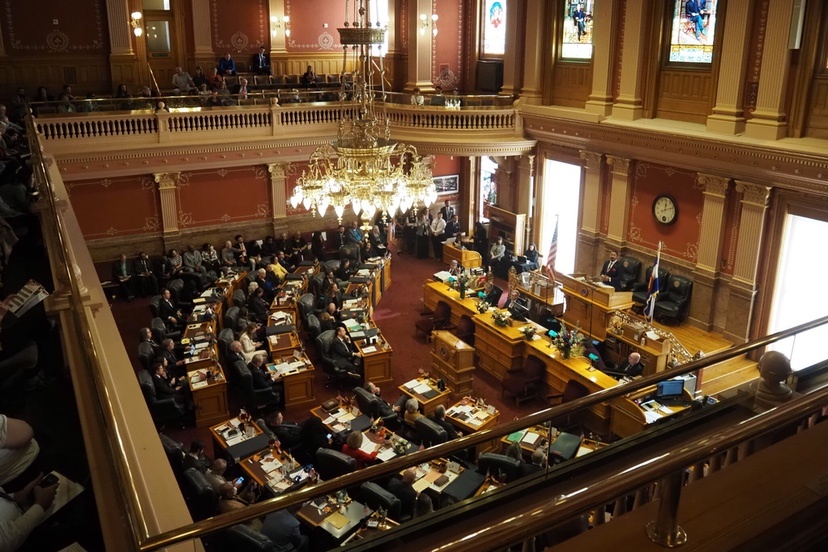
Colorado state senators listen as Colorado Senate President James Coleman, a Denver Democrat, delivers opening remarks on the first day of the 2025 session of the Colorado Legislature on January 8, 2025, at the Colorado Capitol. (Lindsey Toomer/Colorado Newsline)
This story by Sara Wilson, Delilah Brumer and Newsline staff appeared on Colorado Newsline on August 21, 2025.
The Colorado Legislature is meeting in a special session to address a nearly $800 million hole in the state budget. Work began on Thursday morning and is expected to last through the weekend.
After Republicans in Congress passed the federal tax cut and spending bill in July, Colorado’s estimated tax revenue collections shrunk by about $1.2 billion for the current fiscal year, which began July 1. Most of that is a loss of corporate income taxes.
Colorado is legally required to have a balanced state budget, so lawmakers must figure out a way to get backed to a balanced bottom line. The Democratic majority in both chambers, alongside Governor Jared Polis, plan to do that by dipping into the state’s reserves, cutting program spending and passing an array of tax laws to eliminate some deductions and loopholes.
In his call for the special session, Polis also allowed bills on health insurance premiums and artificial intelligence regulations. A controversial AI law is set to go into effect next February and it has been a longtime goal of Polis and moderates to tweak it before then.
Legislative action is live-streamed and archived on the General Assembly’s website.
By the end of Thursday, the Colorado Legislature made it through the bulk of their committee work for the special session and the Senate gave its initial approval to four bills. Friday morning, the Senate will have formal votes on those bills and the House will begin floor debate on its own set of bills.
The bills the Senate considered on second reading were:
Senate Bill 25B-1: This bill sets a process for the governor to notify and consult with the Joint Budget Committee on mid-year spending cuts needed to overcome a revenue shortfall, like the ones he is poised to do soon after this special session. The governor would be able to suspend and cut state funding, and therefore need to meet with the JBC, if the reserve needs to be tapped by up to 2% of the General Fund budget, or if that reserve is projected to dip below $1 billion.
Senate Bill 25B-2: This would allow the state to pay for Medicaid services from organizations that provide reproductive health care, namely Planned Parenthood, that the federal government has withheld Medicaid money from.
Senate Bill 25B-3: This changes a referred ballot measure in November to ask voters if the state can use extra money collected for universal school meals to also cover costs related to the Supplemental Nutrition Assistance Program.
Senate Bill 25B-5: This bill would reallocate about $260,000 from the wolf reintroduction program to the state health insurance fund. It was amended in committee to still allow the capture and release of wolves this winter.
The Senate still needs to take up Senate Bill 25B-4, the artificial intelligence bill focused on transparency and disclosure. That bill, backed by progressive lawmakers and consumer advocates, would require notification when people interact with AI and allow people to request information about how AI influences important decisions related to things like employment or school admissions. It awaits a hearing in the Appropriations Committee.
Over in the House, committees gave approval to the series of Democrat-backed tax policies. The chamber will start debate on them tomorrow. Those were:
House Bill 25B-1001: This would permanently extend a requirement that high-income taxpayers add back their qualified business income federal tax deductions when calculating their Colorado taxable income.
House Bill 25B-1002: This bill would expand the list of countries that the state considers to be tax havens.
House Bill 25B-1003: This would repeal a tax incentive for insurance companies that have at least 2.5% of their domestic employees in Colorado.
House Bill 25B-1004: This would allow qualifying companies to pay certain state taxes early at a discount.
House Bill 25B-1005: This bill would repeal a provision in state law that allows retailers to keep 4% of their sales tax collections, as a way for the businesses to cover the cost of collecting the taxes.
A House committee also signed off on House Bill 25B-1006, which would loan $100 million from the Unclaimed Property Trust Fund to prevent major health insurance premium increases.
House Bill 25B-1008, the dueling AI bill, also cleared its committee even with some Democrats voting against it. That bill would require companies to tell consumers when they are interacting with AI, and fold the technology into the state’s existing anti-discrimination and consumer-protection laws. Bill sponsors removed a provisions that would have allowed only the attorney general, not consumers, from suing developers and deployers that violate consumer-protection laws.
Both HB25-1008 and HB25B-1006 need to pass the Appropriations Committee.
Democrats, who make up a majority in both chambers, also killed Republican-backed bills in committee on Thursday. The entire House State, Civic, Military and Veterans Affairs Committee agenda, for example, consisted of Republican bills that died.
Colorado Newsline is part of States Newsroom, a nonprofit news network supported by grants and a coalition of donors as a 501c(3) public charity. Colorado Newsline maintains editorial independence. Contact Editor Quentin Young for questions: info@coloradonewsline.com.