
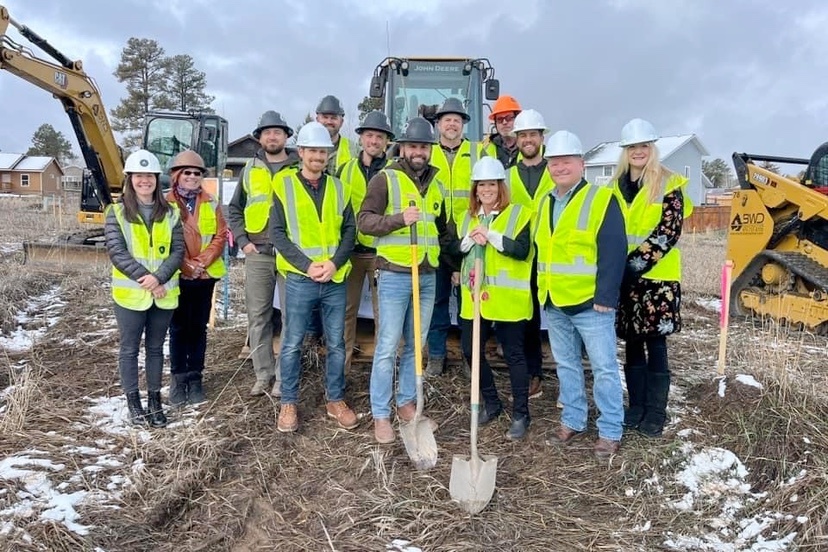
Photo: Ground-breaking ceremony for ten new ‘workforce’ housing units in the Trails/Chris Mountain subdivisions, March 2024.
The Board-authorized waivers of water and wastewater Capital Investment Fees (CIF), paid by new construction to the Pagosa Area Water and Sanitation District (PAWSD), used to be a relatively minor form of financial help for workforce housing projects in Archuleta County.
In 2023, those waived CIF fees totaled $6,532 per home.
Then the CIF fees were greatly increased — in 2024 and again in 2025. The fees now total $25,395 for a new home in the areas of the PAWSD district served by both water and wastewater.
Habitat for Humanity Executive Director Leah Ballard appeared at the August 14 PAWSD Board meeting, fully expecting (I presume) that PAWSD would once again waive the CIF fees for Habitat’s three new 2025 homes, as PAWSD had done for previous Habitat homes. These three 2025 homes, currently being finished largely with volunteer labor, will serve households earning 80% or less of the Area Median Income (AMI).
A recent Housing Needs Assessment adopted by Archuleta County specifically called out the need for housing in this price range.
From that report:
Archuleta County has supported affordable housing through land donations, fee waivers, and tax incentives for deed-restricted housing. It also allows employer-provided housing at higher densities and has eased development regulations to unlock new housing options.
But local policies alone won’t close the gap. The analysis shows that Archuleta County as a region (Unincorporated Archuleta County and Town of Pagosa Springs) needs at least 1,316 new housing units by 2035 to meet current shortages and support future workforce growth. This translates to an average of 132 housing units needed annually in the next 10 years.
The report states that our community needs about 434 new dwelling units in the “50% to 80% AMI” price range. Currently, only non-profits and federal-tax-credit beneficiaries are attempting to build in this price range in Archuleta County. A total of eight such workforce homes might be built in 2025…
…assuming PAWSD is still willing to offer CIF waivers to these projects, as the district has done over the past five years.
Working with that assumption, Habitat Archuleta had paid $75,000 in CIF fees to PAWSD, so they could obtain their construction loans for their three 2025 homes. They apparently believed that PAWSD would refund those CIF fees following the PAWSD Board election in May and they built that refund into their financing assumptions this year.
When Ms. Ballard appeared before the Board on August 14 to request the $75,000 refund, she met with an unexpected response.
When Board member Bill Hudson (me) made a motion to refund Habitat’s CIF fees, only one other Board member — Glenn Walsh — voted in favor of the refund.
Two Board members — Alex Boehmer and Gene Tautges — voted against the motion. Mr. Boehmer argued that PAWSD is a “water and wastewater” district and thus has no business subsidizing housing. Mr. Tautges argued that the Affordable Housing Surcharges have not yet produced enough revenue to cover the waivers given out in 2024.
The potential tie-breaking vote could have come from newly-elected Board member Bruce “BJ” Jones, but Mr. Jones apologized that he didn’t fully understand — yet — the existing waiver policy and the Affordable Housing Surcharges. He told Ms. Ballard and the packed meeting room that he would be doing additional research into the issues involved… and he asked if Ms. Ballard would be willing to return for the September PAWSD meeting?
Although he abstained from voting on August 14, he promised he would have a definite “yea” or “nay” at that future meeting. Ms. Ballard agreed to return in September.
Next up at the podium requesting CIF waivers was Pagosa Springs Community Development Corporation (PSCDC) Executive Director Emily Lashbrooke. PSCDC received PAWSD waivers last year for 10 new homes to serve households making less than 80% AMI or, for two of the homes, making less than 100% AMI. Those homes were completed last year, but five of the homes have yet to find qualifying buyers.
Ms. Lashbrooke’s request was for five waivers for 2025, to cover the next round of PSCDC workforce homes.
She was also asked to return in September for a final answer, and agreed to do so.
Next up was Peter Hurley, a private developer who last year completed an eight-unit apartment downtown on 7th Street, aimed at workforce households. Mr. Hurley benefited from fee waivers and other help from the Town of Pagosa Springs, and had been under the impression, since last year, that PAWSD would also be willing to refund certain development fees.
Once again, Mr. Hurley was advised to bring his request back to the Board, in September.
As I mentioned in Part One, it’s not unusual for members of a government board to disagree on policy decisions and financial decisions. Disagreement is part of the democratic process.
So is compromise, although you wouldn’t know it, watching the current dysfunction at the federal level.
What is less common is for a government board to create an official policy — for example, to grant waivers for qualifying workforce housing projects — and then unexpectedly pull the rug out from under the people who were relying on that policy to help make their projects ‘pencil’.
We’ll report more on this issue in September. Or even sooner?