

Photo: Joint meeting of the Pagosa Springs Area Tourism Board, Pagosa Town Council and Archuleta County Commissioners, August 6, 2025.
A lively discussion took place at the joint meeting on August 6, between the volunteer Pagosa Springs Area Tourism Board and our elected leaders from the Town and County governments.
But the central question was totally ignored.
That central question being, “Have the people living in Pagosa Springs benefited from the expenditure of millions of dollars spent over the past decade, promoting a tourist economy?”
It’s obvious, judging by the number of tubers flowing in the San Juan River… and by the ambitious expansion of the Springs Resort… and by the wait times to get served at local restaurants… that we’re getting more tourists during the summer than we were ten years ago.
What not at all obvious is whether millions of dollars spent subsidizing one particular industry has benefited our residents, in general.
Has all that money actually caused the increase in tourism? Or would that increase have taken place regardless, simply because Pagosa is one of the more affordable resort communities in Colorado… and because it’s the resort community closest to Texas?
We have no idea.
Has the growth of the Short Term Rental (STR) industry resulted in hundreds of homes being removed from our very limited, available residential housing stock, and thus helped to drive up cost of housing in general? Yes.
Did the Pagosa Springs Area Tourism Board help cause this problem? Possibly, but we have no data to prove it, directly. We
Have our elected and appointed leaders been subsidizing one of the lowest-wage industries in America since 2007? Yes.
We’ve been throwing money at tourism, while at the same time, we’ve watched our local economy slowly spiral into dysfunction.
Insanity? Stupidity?
Or brilliant government policy?
Here are some comments from the 2025 Housing Needs Assessment, recently adopted by the Town and County governments:
The assessment draws on extensive federal, state, and local data, including input from over 600 residents and nearly 100 employers. Their message is consistent: the shortage of affordable housing is hurting families and holding back the local economy.
- Sixty percent of businesses said housing shortages make it harder to attract and keep employees.
- Over 80% of businesses identify housing availability as a major or severe issue in the county.
- About 86% of households view housing availability as a major or severe issue in the county.
- Over half of renter households in Archuleta County spend more than 30% of their income on housing, classifying them as housing ‘cost burdened.’ While 15% of county renter households spend more than 50% of their income on housing, classifying them as ‘severely cost burdened.’
- Rental availability is critically low, with a vacancy rate of just 0.5%, far below the healthy standard of 5%.
The Tourism Board spends tens of thousands of dollars each year generating data, in a effort to prove that their tourism marketing efforts are benefiting multi-million-dollar businesses like the Springs Resort, as well as STR owners, restaurants, gift shops and tube rental companies.

Meanwhile, the Town and County governments contract with consultants to produce “Housing Needs” reports, that document the ugly conditions of our current economy. But no one seems to notice the connection between subsidized tourism and a housing crisis.
Our local governments are currently considering their budgets for 2026. In a very real sense, a government defines its values and beliefs by how it proposes to use our tax revenues. I assume the elected Pagosa Springs Town Council and Archuleta Board of County Commissioners will mainly preserve the status quo, in terms of addressing the overall needs of the community.
Part of the status quo is subsidizing tourism.
The status quo has been good for the tourism industry. Here’s a graph showing the quarterly amounts of Archuleta County Lodging Tax revenues collected from motels, vacation rentals and B&Bs located within the unincorporated county, outside the town limits, where the County government collects a 1.9% Lodging Tax. (The Town collects a 4.9% tax within the town limits, but this graph includes only the County tax.)
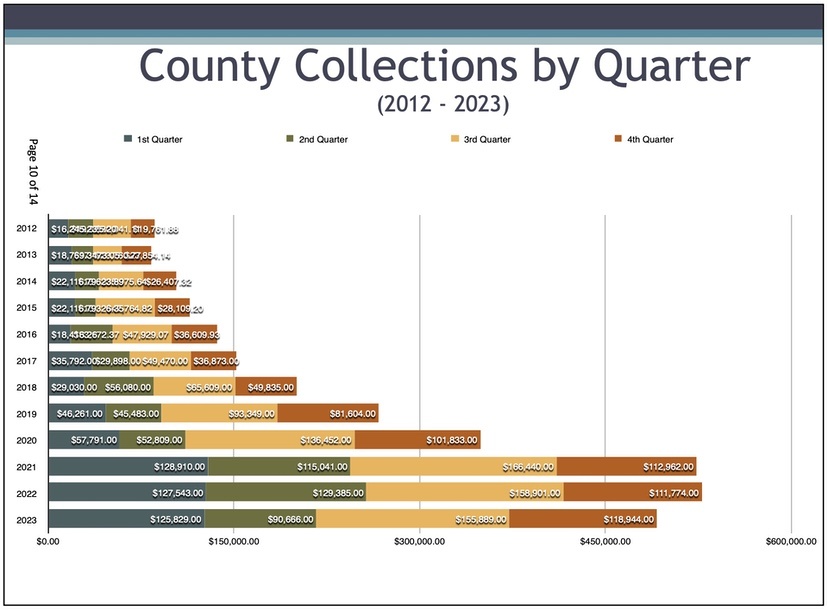
We might notice that the tax paid by tourists in the third quarter of 2023 was more than was paid in during the entire year of 2017.
The lodging industry collected and submitted about $$152,000 in County Lodgers Tax in 2017. At a rate of 1.9%, this implies a total income of about $7.9 million dollars in room and vacation home rentals paid to the lodging industry, outside the town limits.
Six years later, in 2023, the lodging industry collected more than three times the 2017 amount, totaling $494,322. At a rate of 1.9%, that implies a total income to the lodging industry of $25.7 million during 2023.
That’s a 300% increase in income to the lodging industry.
Is this really an industry that needs government subsidies?
Is there any other industry in Pagosa Springs that has increased its overall revenues by even 25% over the past 6 years?
None of the above numbers — which are easy to find, if you’re looking for them — were discussed during the August 6 joint meeting. No one asked the question, “Do we need to keep subsidizing this industry?”
No one asked the question, “How about taking some of these revenues and subsidizing the industry that struggles the most in Archuleta County… the affordable housing industry?”
Council members Mat deGraaf and Brooks Lindner suggested that a portion of the 2026 Lodging Taxes could help the Town with the upgrades and beautification efforts along Highway 160, in coordination with the ongoing highway reconstruction.
That makes some common sense, because the upgrades and beautification would be much harder to do after the reconstruction is completed in late 2026.
What doesn’t make much common sense is to keep increasing the subsidies provided to the tourism industry, year after year, when other aspects of our community have so many more serious financial challenges.