
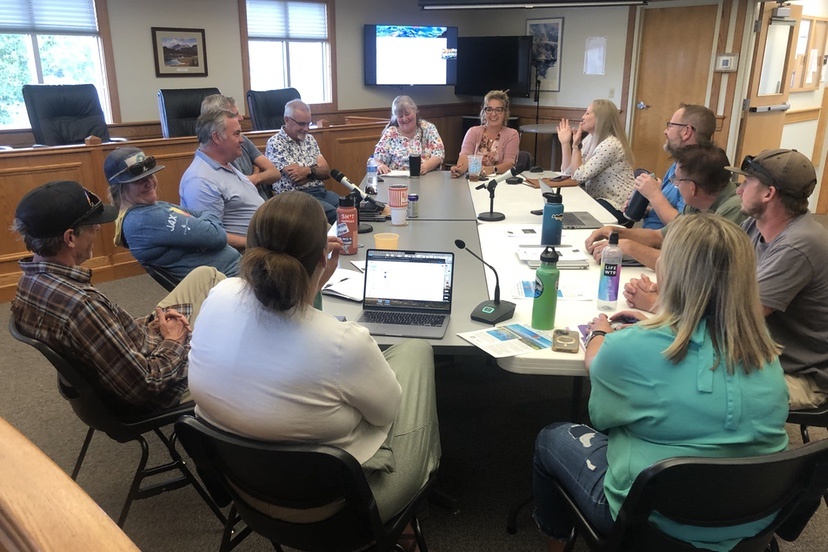
Photo: A joint meeting of the Pagosa Springs Area Tourism Board with the Pagosa Springs Town Council and the Archuleta Board of County Commissioners, August 6, 2025, during a humorous moment.
Every art and every kind of inquiry, and likewise every act and purpose, seems to aim at some good: and so it has been well said that the good is that at which everything aims…
— The Nicomachean Ethics, by Aristotle
I mentioned in Part One that’s I’ve been reading a book by philosopher Alasdair MacIntyre, Dependent Rational Animals, which bears the subtitle “Why Human Beings Need the Virtues”.
Unlike Mr. MacIntyre, I wasn’t raised Catholic, so I’m not as familiar with ‘Virtues’ as I might be. I understand the Roman Catholic Church recognizes three (3) Theological Virtues, four (4) Cardinal Virtues, and seven (7) Lively Virtues which, if universally valued and practiced, could theoretically produce a harmonious, peaceful, and fruitful world.
A “good” world, to use Mr. MacIntyre’s terminology.
We can find the idea of “the good” and “the virtues” in an earlier version of moral philosophy, as presented in around 350 BC by Greek philosopher Aristotle.
But it’s quite obvious that, here in Pagosa Springs in 2025, we disagree about the definition of “good”.
I’m talking specifically about “good government” and a “good community.”
Incidentally, I cannot recall the word “good” being used by anyone at last week’s joint meeting of the Pagosa Springs Area Tourism Board, the Pagosa Springs Town Council, and the Archuleta Board of County Commissioners.
Rather, the central idea during the conversation was “more”…
…as in, “more tourism”. The shared assumption being, apparently, that “more” is the same as “good”.

As mentioned in Part One, the membership of Pagosa Springs Area Tourism Board does not represent Pagosa Springs. The Board represents the tourism industry. There is no one on the Board that represents non-tourist industries such as construction, manufacturing, communications, education, health care, agriculture, retail, arts & culture, youth activities, information services, churches, caretakers, retirees, nonprofits, road maintenance, disaster mitigation, bookkeeping, legal services, automotive services…
So we might not be surprised that the $1.5 million in revenues provided annually to the Tourism Board has been allocated, based almost exclusively on the idea that “more tourism” will benefit the people living in Archuleta County.
The allocation of Lodging Taxes has nearly tripled since 2013, indicating that the lodging industry, as a whole, is taking in three times as much money as they were a dozen years ago, thanks to Town and County subsidies far exceeding that provided to any other segment of our economy.
Much of the conversation last week focused on “data”. The Tourism Board staff works with a consulting firm called Blue Room Research to track the success of the Board’s marketing effort and tourism-oriented programs, to try and determine which efforts are generating the best ROI: Return on Investment. The “Return” being “More Tourists”.
We’ve heard fairly constant complaining from certain lodging operators about the effectiveness of the Tourism Board’s efforts, dating back to at least 2023, when a group of lodging businesses sent an official letter of complaint to the Town Council and the BOCC, demanding more tourism industry control of the Tourism Board, and better use of “data” and “benchmarks” to ensure the consistent growth of the tourism industry.
The Town Council and BOCC responded to the letter by giving the tourism industry more complete control of the Tourism Board.
The Tourism Board, meanwhile, has consistently complained that the Pagosa Springs lodging industry has steadfastly refused to provide the occupancy data and average daily rate data necessary to properly analyze the success of Tourism Board efforts. This crucial “data” is happily provided by lodging operators in other Colorado resort communities, we have been told. But not here in Pagosa.
At last week’s joint meeting, Springs Resort Marketing Director Jesse Hensle reported on behalf of the new Pagosa Lodgers Association, and shared a couple of interesting bits of information. He noted that, although the Pagosa Lodgers Association has been officially assigned a seat on the Tourism Board, the Association continues to refuse to release a list of its members. He also argued that the Tourism Board doesn’t need, nor would it benefit from, occupancy data and average daily rate data from local lodging operations, despite the fact that this type of data is “industry standard” on other communities.
Here’s some sample “data” in a graphic form. First, the growth of the Pagosa tourism industry, as measured in Lodgers Tax collections, 2007 through 2022:
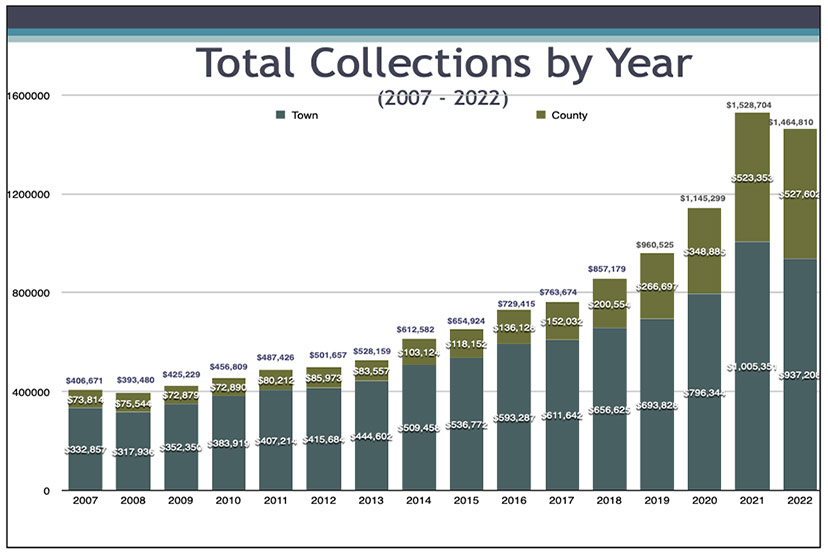
This graph, above, has been shared with the Town Council and with the BOCC on a regular basis, presumably to confirm that the Tourism Board is fulfilling their mission of increasing the number of tourists in Pagosa Springs.
And here’s a graph showing the cost of a typical three-bedroom house on a 1/4 acre lot in Pagosa Lakes, from 2010 through 2021.
From 2010 through 2021. A different data set.
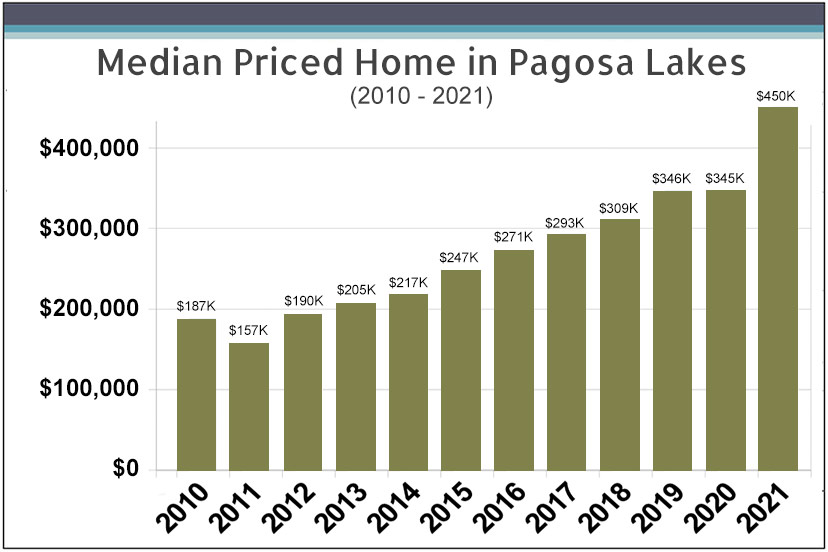
To my knowledge, this graph, above, has never been shared with the Town Council or the BOCC by the Tourism Board.
So while tourism continues to grow, so has the cost of housing in Pagosa Springs. The median listing price for a home here, in June 2025, was $713,000, according to Zillow.com. ‘Median’ means half of the homes offered for sale are priced higher than $713,000.
Here’s that photo again, of last Wednesday’s joint meeting, where nearly every one at the table seemed convinced that “more tourism” is one of the best things that could possibly happen in Pagosa Springs. (I happened to catch a moment when people were laughing, but most of the conversation was more serious.)
“Data” is not the same as “reality”. Especially when you’re looking at only one type of data.