
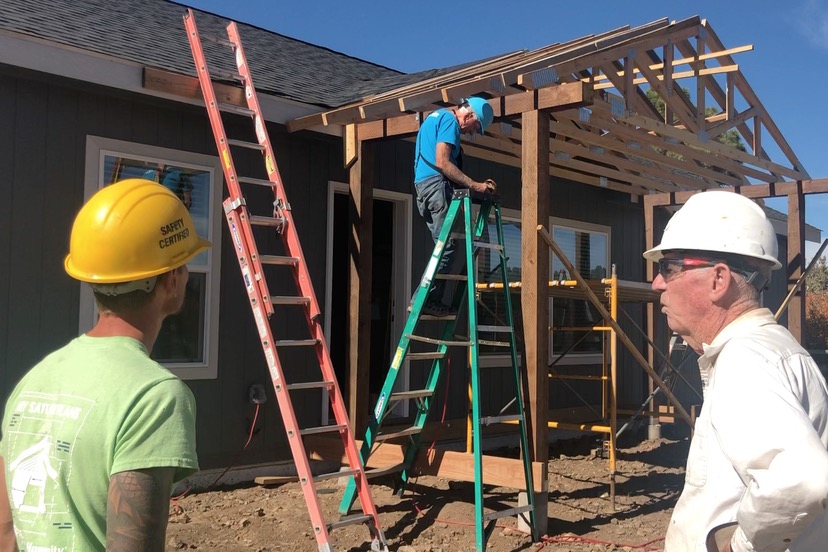
Photo: Volunteers working on a Habitat for Humanity house in the Pagosa Trails subdivision, October 2023.
Although actor Harrison Ford has been featured in this editorial series, the “leading actor” in this editorial is actually the Pagosa Area Water and Sanitation District (PAWSD), which provides drinking water to perhaps 80% of the households in Archuleta County, either directly through its waterlines, or from three community ‘fill stations’ where residents and water delivery companies can purchase drinking water in 100 gallon increments.
A somewhat smaller number of customers — households and businesses mainly located in Pagosa Lakes or downtown — use PAWSD to treat their sewage.
Disclosure: I serve as a volunteer on the PAWSD board, but this editorial reflects only my own opinions and not necessarily the opinions of the PAWSD board or staff.
A few months back, the consulting firm that helps calculate PAWSD customer fees — Stantec — recommended a 30% increase in PAWSD’s monthly sewer fees, to prevent the Wastewater Fund from operating at a deficit.
Instead, the board voted to increase the fees by only 10%, hoping that the District can find ways to keep its head above water, so to speak, through grants and operational efficiencies.
The price increase is partially due to an unfunded mandate from the Colorado Department of Public Health and Environment (CDPHE). PAWSD is currently constructing a $10 million upgrade to the Vista Wastewater Treatment Plant, as required by CDPHE, to reduce the nitrogen and phosphorus in the community’s sewage effluent.
It’s a long-standing PAWSD policy that “growth must pay for growth.” That is to say, new developments — whether they be new single homes, new commercial buildings, or new subdivisions — will not be subsidized by existing customers, but must pay for any new infrastructure they require, and must also ‘buy into’ the existing system. Additionally, vacant land that is made more valuable by being proximate to PAWSD pipelines pays a monthly ‘availability fee’ to help maintain the system.
The ‘Wastewater Capital Investment Fee’ (CIF) for a new home hooking into the PAWSD sewer system is currently $15,697… an increase from $1,179 in 2023.
This rather enormous increase resulted from a decision by the PAWSD board to cover a pending ‘shortfall’ in the sewer enterprise — due to the Vista upgrades and other rising costs — by splitting the financial shortfall between all existing customers and all new development, on a 50/50 basis. The result was a 10% increase in monthly fees charged to existing customers… and a 1,300% increase in CIF fees charged for a new house, based on the number of new homes typically built per year.
After the new Wastewater CIF was announced, the PAWSD board was approached by several organizations that were building ‘workforce housing’, requesting that the CIF be waived for their projects. An existing PAWSD policy allowed those fees to be waived for affordable housing, as permitted by Colorado law, and the resulting ‘loss’ in CIF revenue, to PAWSD, was calculated to be more than $800,000 in 2024.
Rather than hold a bake sale to cover the lost revenue, the PAWSD board increased the monthly Wastewater Surcharge from 77 cents per month to $3.57 per month.
This decision was not made lightly, and some board members pushed back on the idea of requiring existing customers and new ‘non-affordable’ development to subsidize workforce housing. In the end, the board agreed that housing for local families was a District priority, and the surcharge was increased.
The PAWSD board understands, meanwhile, that each of these newly subsidized households will soon be paying sewer fees of about $46 a month, or about $550 a year… a fee that will surely increase in the future. So, not a total financial loss to the District.
And surely, a total financial benefit the the community, if our working families can afford a place to live.
The photo at the top of this page shows Habitat for Humanity volunteers adding a front porch to a modular house in the Pagosa Trails subdivision. Pagosa Trails is within the Pagosa Lakes planned unit development, and is required, by PLPOA covenants, to have a front porch, and a garage — neither of which is necessary, of course, to human habitation. But required, nevertheless.
When developers from Arizona arrived in Pagosa in 1970 to begin subdividing 21 square miles of former ranch property into quarter-acre suburban parcels, they thoughtfully protected most of the neighborhoods from ever allowing truly affordable housing by establishing CC&Rs — Covenants, Conditions, and Restrictions. The goal was not a functional community — the goal was the protection of property values, to ensure the highest possible price for the new subdivision parcels.
In spite of these limitations, Habitat for Humanity has been able to construct homes that middle class families can afford, because much of the construction work is handled by volunteers. We might call that a “sweat subsidy”. But our local governments, including PAWSD and Archuleta County, have also contributed to the success of the Habitat project.
Habitat expects to finish three more subsidized homes this year, again with the help of volunteer “sweat subsidies”.
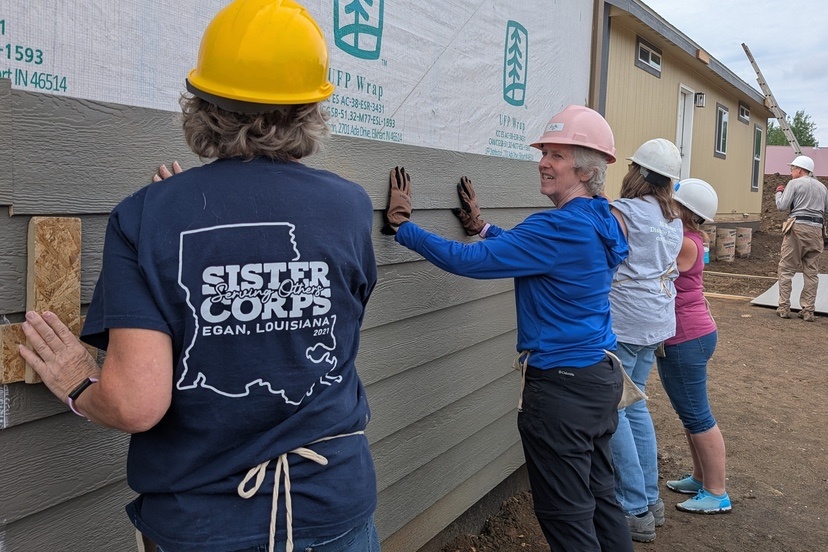
Nearby, in the same neighborhood, the Pagosa Springs Community Development Corporation hired a professional construction company last year to build ‘workforce housing’ — 10 new homes priced at $325,000 and up — on parcels donated by the Archuleta Board of County Commissioners. The CDC has struggled, however, to find families that can qualify for the subsidized mortgages, and has thus far been able to sell only 6 of the 10 homes, in spite of making considerable effort to find qualified buyers.
One set of subsidies for the CDC project came from PAWSD, in the form of waived Capital Investment Fees. Even with PAWSD fee waivers of about $25,000 per house, and donated land, the homes ended up costing $325,000 or more.
Here’s that comment, once more, from the Variety magazine interview with Harrison Ford:
…But currently the issue is not who we are, but that we’re not who we used to be, because we’ve been purposefully disaggregated into serviceable political units. And that has caused the middle to become frayed and tenuous, and the middle is where we belong. Not because it’s banal and safe, but because it’s fair. Compromise is fair and honest.

Life isn’t fair. We all know that. Some actors have long and highly profitable careers. Other actors, equally talented, never get a break and end up selling cars in a used car lot.
Life isn’t fair — on the level of the individual. But a social system can be fair, and honest.
A society can be fair, and honest.
That’s how I think Mr. Ford is using the word, “fair”.