
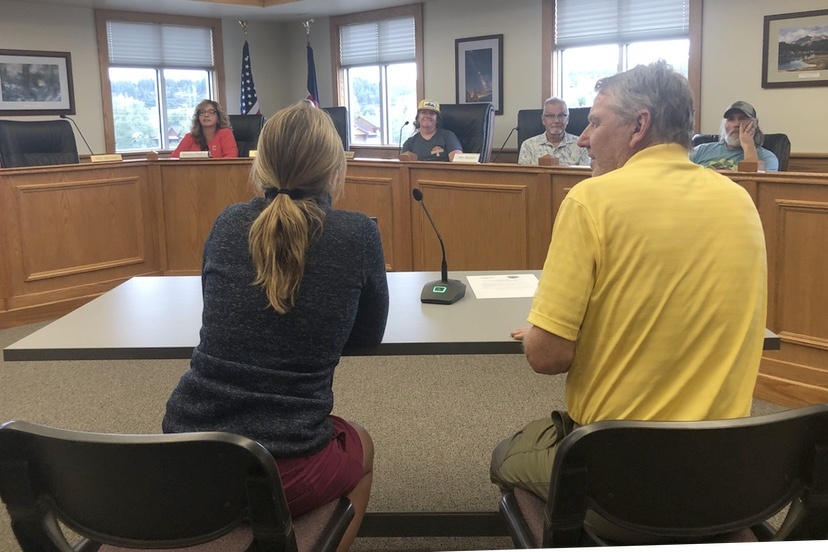
Photo: Town of Pagosa Springs Recreation Supervisor Amanda Gadomski and PARC President Bob Milford present some survey results to a joint meeting of the Town Council and the Archuleta County commissioners.
Several items of local interest were discussed at the July 28 joint Town-County work session, held at the Pagosa Springs Town Hall. The gathered elected leaders and staff members heard briefly from the newly-formed Pagosa Lodgers Association — a group of motel owners who hope to help bring more tourists to Pagosa. The Town Council members and County commissioners also got a report from Town Manager David Harris, about a proposed 1% sale tax measure that might appear on the upcoming November ballot, to support sewer repairs and upgrades within the Town’s sanitation district. His presentation included some survey results.
Another presentation was delivered by Pagosa Area Recreation Coalition (PARC) members Amanda Gadomski and Bob Milford, who shared the result of a recent recreational survey. I am using the word “recreational” in a couple of senses.
I need to state that I endorse both of these efforts. The Town sewer system reportedly needs millions of dollars in repairs, and a voter-approved sales tax is the most reasonable approach to funding that need. And unlike some other groups who argue that endless, unchecked growth of tourism and recreation will benefit Pagosa Springs, the PARC coalition seems to have a well-rounded understanding of both the positive and negative effects of more recreation… on wildlife, the environment, and the community.
Still, I view the data from both surveys as a casual recreational effort — not as ‘authentic’ information.
First, a bit of history.
Back in the 1700s, the term “statistics” referred to the systematic collection of demographic and economic data by governments — mainly tabulations of human and material resources that might be taxed, or put to military use.
By the early 19th century, statisticians had become more emboldened, and the meaning of “statistics” grew to include a discipline concerned with the collection, summary, and analysis of data. People gradually came to believe that collections of data points revealed a particular type of ‘truth’ about populations or economic activities, while the design and implementation of these surveys and analyses were left to the statisticians.
Fast forward to 2025, and we find data being collected and analyzed by people who are not, by any stretch of the imagination, statisticians. Typically, these amateur surveys, of this or that population, are conducted online and the data is consolidated and made into graphs by computer applications. Such an amateur survey might then be used to promote a certain political agenda, with the implication that the survey accurately reflects the opinions or desires of a certain group of people.
We need to remember that surveys come in two distinct flavors, however. The scientific survey, and the non-scientific survey.
A scientific survey is designed with the intention of representing the various demographic groups within the surveyed population, grouped by age, gender, economic situation, race, place of residence, political party, or other criteria deemed important by the designing statistician. The participants in such a survey are specifically chosen to represent those demographic groups. A scientific survey, if properly conducted, is considered to be a reasonably accurate reflection of whatever population it includes.
Hence the word, “scientific”.
Then we have the amateur, non-scientific surveys that have become commonplace in modern America. These surveys appear to reflect the opinions of a certain population, but in fact, they do not. They are, as a practical matter, relatively meaningless in terms of reflecting reality.
We heard about two such non-scientific surveys at the July 28 joint meeting. One survey was conducted by the Town of Pagosa Springs, and it pretended to reflect how the community feels about a potential 1% sales tax. Only 113 people participated in the survey — in a town of 14,500 people — and during his presentation, Town Manager Harris correctly noted that, “The survey, first and foremost, is not statistically valid.”
In other words, the survey has no honest statistical value. Nor, in my humble opinion, did it deserve to be presented to government leaders and the general public as if it reflected some aspect of reality. Mr. Harris nevertheless spent 10 minutes sharing the data as if it were meaningful content. He also noted it has been shared online and in advertising. I have no doubt that some people — perhaps many people — viewed the graphs and illustrations and believed they were viewing valid information.
I don’t mean to suggest that the Town is trying to deceive or mislead anyone. Rather, I honestly believe we modern Americans do not understand the difference between a relatively meaningful (scientific) survey and a relatively meaningless (non-scientific) survey, but instead, we treat them as both having a similar value.
The Pagosa Area Recreation Coalition (PARC), represented by Bob Milford and Amanda Gadomski, also gave a lengthy presentation based on a non-scientific survey that purported to tell an accurate story about local opinions.
Unlike Mr. Harris, the PARC representatives made no mention of the fact that their survey was not statistically valid — although it had attracted considerably more participants than the 113 people who responded to the Town sewer survey. In this case, nearly 1,300 respondents who had submitted their answers to PARC. We all understand that when a voluntary survey is announced as a “Community Recreation Survey”, the type of people who will take the time to participate are typically those deeply interested in Pagosa as a recreational wonderland — and those who don’t view Pagosa through that lens are less likely to participate. So the survey was probably destined to be skewed from the start.
We also know that the Community Recreation Survey, according to its own data, over-represented people age 41 and older.
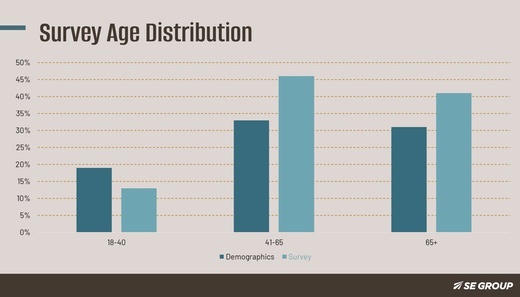
This graph above represents some of the only “scientifically valid” data in the recreation survey, making it clear to us that the survey was skewed to older residents, and thus making the rest of the data unreliable as a true representation of community opinions. The PARC representatives nevertheless shared over 30 pages of non-scientific data with our elected leaders, with the apparent goal of encouraging government support for their projects.
Once again, I am not suggesting that the PARC team and their survey consultants, SE Group, intentionally tried to mislead us, or deceive us. But many Americans — including some government policy makers — do not understand how surveys are conducted and what they mean — or don’t mean — if they’re conducted in a non-scientific manner. Even the people responsible for initiating the survey might not understand the actual value of the data.
Unfortunately, I don’t have any reliable survey data to back me up, when I make that claim.
I will repeat my earlier comments — that I personally support the overall intentions of the Town sanitation district and the PARC coalition. Even so, I question the presentation of non-valid, non-scientific data to our elected leaders.