
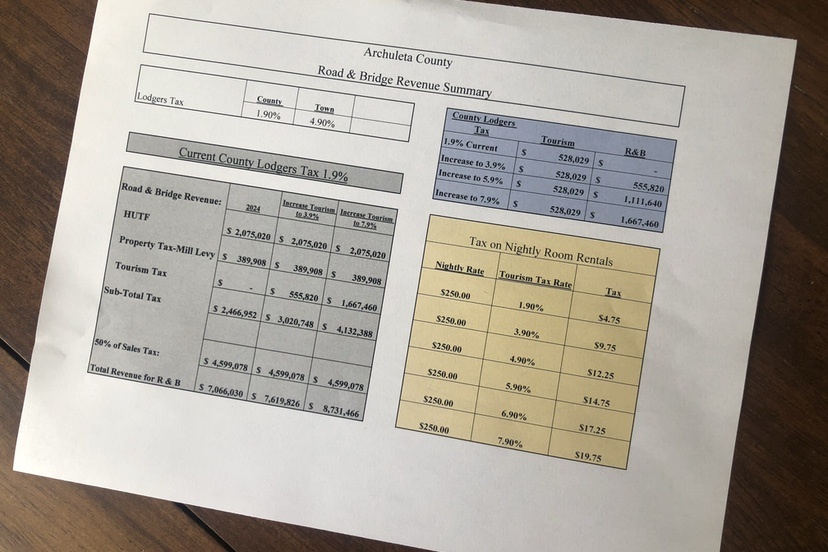
Photo: Estimates generated by Archuleta County Commissioner John Ranson, distributed at the July 23 ‘Lodging Tax listening session’.
Archuleta County Commissioner John Ranson has described himself on more than one occasion — in public meetings and in my private conversations with him — as a “numbers person”. As a person who cares about, and pays attention to, numbers. Especially, financial numbers. That’s his professional background.
I’m also interested in numbers, including financial numbers. But that’s not my professional background.
Not everyone has a strong interest in numbers, so I suppose it’s a good thing that certain people are paying attention to the numbers.
Commissioner Ranson had prepared a sheet of numbers for the public ‘listening session’ held at the Springs Resort, on July 23. The Board of County Commissioners — Veronica Medina, Warren Brown and John Ranson — had invited the general public to share their thoughts on a potential future increase in the County Lodging Tax.
The Colorado legislature, this year, passed a new law — HB25-1247 — that allows county governments to increase their Lodging Tax to a maximum of 6%, subject to voter approval. The tax is paid by visitors staying in hotels, motels, vacation rentals, bed & breakfast establishments, and RV parks.
Archuleta County currently collects 1.9%, and uses all of the collected revenues for tourism marketing. HB25-1247 allows the revenues to be used for other purposes, subject to voter approval. From the law:
(1.5) (a) Subject to the limitation set forth in subsection (1.5)(b) of this section, a county board of commissioners may levy the tax specified in subsection (1) of this section for the purpose of:
(II) Housing and childcare for the tourism-related workforce, including seasonal workers, and for other workers in the community;
(IV) Public infrastructure maintenance or improvements; or
(V) Enhancing public safety measures by funding local law enforcement, fire protection services, and emergency medical services.
At the ‘listening session’, BOCC chair Veronica Medina allowed a free-ranging conversation among the audience.
Unfortunately,in spite of 36 chairs being arranged for the public, the audience consisted of only five people. A handful of others were observing the conversation via Zoom.
Five people, from a community of 14,500 full-time residents. A disappointing number.
Another disappointment: a sheet of numbers that Commissioner Ranson had prepared… which contained numerous incorrect or misleading numbers.
On one hand, we can appreciate the effort to provide real numbers. But maybe it’s less appreciated when the numbers are misleading.
Here’s one set of incorrect numbers:
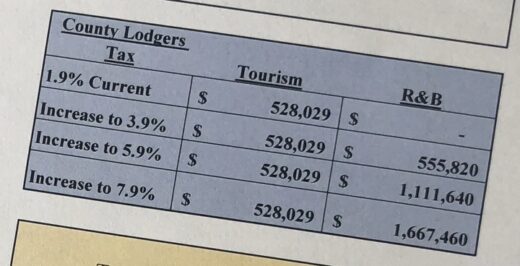
As we see, Commissioner Ranson has given us estimates for the amount of additional Lodging Tax revenues that could potentially be provided to Road & Bridge, if the Lodging Tax was increased from 1.9% to “3.9%” or “5.9%” or “7.9%”.
Except that the County cannot increase the Lodging Tax to “7.9%”. The maximum allowed under state law is 6%.
As the session began, Commissioner Medina corrected her fellow commissioner, and Commissioner Ranson apologized for his incorrect estimates, saying that he thought the existing Lodging Tax could be increased by 6%. (Which would result in a 7.9% tax in Archuleta County.)
Commissioner Ranson had failed to understand the language of an important new law, and had distributed incorrect information at a public meeting. Fortunately, a fellow commissioner pointed out the error.
But that was not the only problem with Commissioner Ranson’s numbers.
As we see, he had assumed that the BOCC will continue to fund tourism marketing at more than a half-million dollars per year. But a careful reading of HB25-1247 suggests that the BOCC is required to spend only 10% of the Lodging Tax on marketing. The rest can be used for many other important community needs, with voter approval.
But that is not the only other problem with Commissioner Ranson’s numbers.
Although Archuleta County’s current (and serious) housing crisis was discussed during the listening session, and although “Housing” is one of the items specifically called out in HB25-1247 as an allowable use for Lodging Tax, it became pretty clear from comments made by Commissioner Brown and Commissioner Ranson, that they would want to spend any added Lodging Tax on road maintenance. And maybe also on “public safety”.
Not to address the housing crisis.
In the sheet presented by Commissioner Ranson, the only use indicated for additional revenues was for “Road & Bridge”.
Again, the numbers were problematic. We again saw the impossible increase to “7.9%”. But that wasn’t the only misleading number.
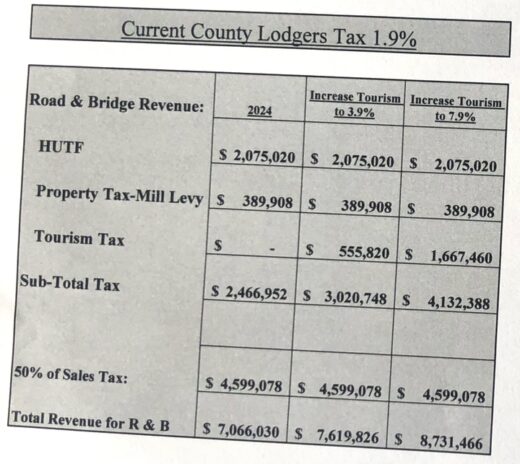
We see here four possible sources for road maintenance. Commissioner Ranson’s numbers suggest that three of the four sources are “fixed”. His chart suggests that only Lodgers Tax would be a source of additional revenue in the future.
HUTF funding comes from the state of Colorado, based on gas taxes. As more cars arrive in Colorado, presumably the HUTF will increase, as has been the historical pattern. Ten years ago, Archuleta County received $1.5 million in HUTF funding. As we see, above, the number for 2024 was more than $2 million.
Then we have Sales Tax. Archuleta County dedicates 50% of its Sales Tax to Road & Bridge. In 2015, R&B’s 50% share of County Sales Tax was $2.1 million. Today it’s $4.6 million.
We have a different kind of change, however, regarding Property Tax dedicated by the BOCC to Road & Bridge. Perhaps a rather uncomfortable change.
In 2015, the BOCC budgeted $1.4 million from County Property Taxes to Road & Bridge.
Property taxes in Archuleta County have increased substantially since 2015. As some taxpayers may have noticed.
In 2024 — as we see above in Commissioner Ranson’s chart — the BOCC budgeted only $389,908 from Property Taxes to Road & Bridge.
Ouch.