
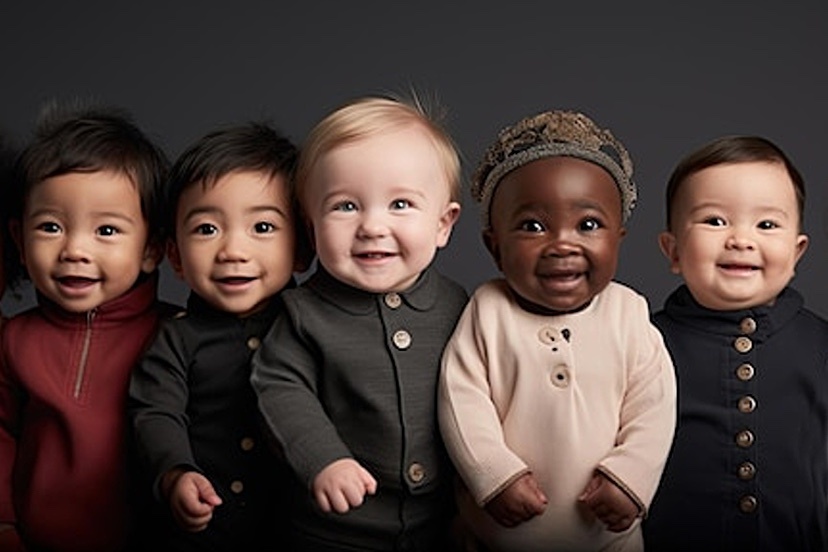
I’ve written previously — and successfully, I think — about the politicians and influencers promoting that idea that Americans need to have more babies.
Back in March, President Trump honored himself a new title — “the fertilization president” — while speaking at a White House event celebrating Women’s History Month.
“Fertilization. I’m still very proud of it. I don’t care. I’ll be known as the ‘fertilization president,’ and that’s not bad. I’ve been called much worse and actually, I like it. I like it.”
The President might have been referencing the controversy around in vitro fertilization (IVF) but he was more likely alluding to his own personal ability to father children… a total of five to which he lays claim, but who knows, really, how many?
Of course, five is a fairly impressive number, nowadays.
But it doesn’t compare to U.S. President John Tyler, who fathered 15 children. And Uganda’s former dictator, Idi Amin, who reportedly had 43 children. Who, exactly, will go down in history is “the fertilization president”… we’ll have to wait and see.
Apparently, a few demographers are making the argument that the biggest challenge facing us, in 2025, is not ‘overpopulation’ but rather ‘depopluation.’
In a new book titled After the Spike: Population, Progress, and the Case for People, demographers Dean Spears and Michael Geruso point out that most people on Earth today live in countries where birth rates are too low to stabilize the population: fewer than two children for every two adults.
Anyone who has tried raising two or more children can easily understand the reasons.
The “Spike” presumably referring to a sharp rise in the global population between 1950 and 2025, when we grew from 2 billion to over 8 billion. But there are other meanings to the word “spike”, which we will ignore in this column.
The highest number of births the planet ever experienced was in 2012, when 146 million children were born. But now, 13 years later, people are having smaller families, and at the rate things are going — and in spite of President Trump’s noble efforts — it’s likely that, someday soon, death rates will exceed birth rates. And once the population starts dropping… well, the After the Spike authors seem to be worried it’s a downward spiral.
Speaking for myself, I’m not worried, nor do I feel guilty. My ex-wife Darlene and I did our duty by pumping out three kids — with Darlene doing most of the heavy lifting — and although none of our kids have yet produced any offspring, I remain hopeful.
Authors Spears and Geruso seem hopeful, but also anxious. They were interviewed last week by TIME magazine editor Belinda Luscombe, to allow them to talk about their anxiety-producing book. Mr. Spears and Mr. Geruso look at the way things are headed and predict a declining population at some point in the future, partly because people are unlike kangaroos.
One of editor Luscombe’s questions:
During drought conditions, kangaroos don’t breed, but when conditions improve, they start again. Why do you think that people will not start having more children again?
Spears: People are unlike kangaroos in that they make decisions in response to their societies, their cultures, their families, their economies…
There are other ways that people are unlike kangaroos. Like, we don’t have tails, or long ears. Also, we don’t normally refer to a human baby as a “joey”, unless the baby’s name is actually “Joey”. But that’s a rather rare occurrence these days. More likely, the baby’s name will be a popular one, like Olivia, Noah, Amelia, or Liam, according to BabyCenter.com
The authors note that the push to have more babies, at least here in the U.S., seems to be coming mainly from Republicans. They’re hopeful that Democrats and progressives will eventually see the light, and maybe elect a “fertility president” of their own someday. Why should Republicans have all the fun?
At the end of the TIME interview, editor Luscombe, hit the two authors with the $64,000 question.
You’re both fathers. How many children do you each have?
Geruso: I have one kid — an 11-year-old.
Spears: I’ve got two kiddos…
Easy to write a 320-page book, advising the rest of us to have more babies, and market the book on Amazon.
Not so easy, however, when it comes down to actually performing your duty to re-populate a dying world.
Underrated writer Louis Cannon grew up in the vast American West, although his ex-wife, given the slightest opportunity, will deny that he ever grew up at all. You can read more stories on his Substack account.