
The challenge of balancing individual freedoms with the common good of the community is often evident here in Pagosa Springs.
A hard look at history can be instructive.
During the creation of the U.S. Constitution in 1787, the Federalists and Anti-Federalists were working to hammer out a compromise in Philadelphia in 1787, to design a federal system powerful enough to protect the citizens, but limited in its ability to oppress the taxpayers.
Not an easy task.
Naturally, the Revolutionary War and its causes were fresh in everyone’s mind. But so was the Shays’ Rebellion that began in 1786. Shays’ Rebellion was an armed uprising in Western Massachusetts in response to a debt crisis among the farmers, in opposition to increased state government efforts to collect taxes, leading to foreclosure of numerous family farms. The newly-formed U.S. government didn’t have the capacity to put down the rebellion, so the state government funded a private militia.
The fighting took place in the areas around Springfield during 1786 and 1787, and could be viewed as a contest between the ‘big city’ merchant class and the debt-burdened rural farmers.
The rebellion prompted Thomas Jefferson to write:
The tree of liberty must be refreshed from time to time with the blood of patriots and tyrants. It is its natural manure.
Not everyone agreed with this perspective. Fellow Virginia plantation owner George Washington wrote of the Massachusetts rebels:
They exhibit a melancholy proof of what our trans atlantic foe have predicted; and of another thing perhaps, which is still more to be regretted, and is yet more unaccountable; that mankind left to themselves are unfit for their own government…
To be more exposed in the eyes of the world and more contemptible than we already are, is hardly possible…
During the Constitutional Convention, the Federalists argued for a system that encouraged division among the citizenry; that rebellion and uprisings could be discouraged by keeping the populace focused on personal, individual concerns rather than shared, common interests.
Divide and conquer. Not only should the Federal government be split into separate, competing branches — two houses of Congress, an executive branch and a judicial branch — but the Constitution should guarantee that all state governments would have a similar ‘republican’ composition.
The general assumption being: bad things will happen if The People are allowed to cooperate.
The Anti-Federalists argued that education, freedom of speech, freedom of the press, and transparent government would ultimately lead the citizens to better understand their shared interest in peace and cooperation. Thus, The People, well-informed and aware of their common needs, would naturally come together, working side by side, to improve their own welfare.
The general assumption being: good things will happen if The People are encouraged to cooperate.
Both ideas are evident in the U.S. Constitution. But as it turns out, cooperation is messy and takes time, especially when each participant is focused on his or her subjective ‘individual rights and interests’. Actual cooperation cannot take place unless everyone is willing to walk a mile in the other person’s shoes… or, at the very least, to try to understand the other person’s point of view.
Generally speaking, we don’t often want to listen to the other person’s point of view, and work towards a compromise. We generally just want to win the argument.
So our governments created bureaucracies and books of regulations, to facilitate decisions. Our rights are written down in black and white. But of course, one size doesn’t fit all, so we hardly ever end up with a ‘win-win’ situation.
Fast forward to 2025. As government decisions are made by elected or appointed officials, certain types of decisions require an allowance for public input, such as public hearings or voter approval. We sometimes refer to these types of public participation as ‘due process’.
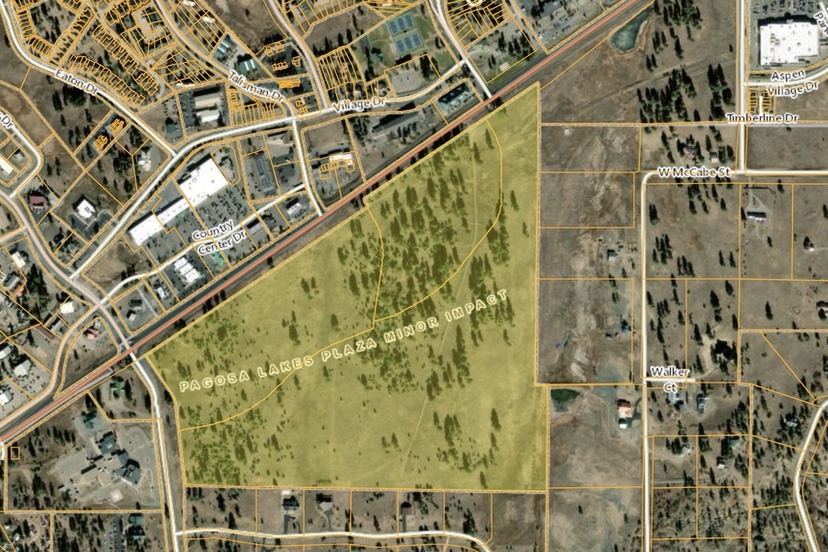
Recently, the Town of Pagosa Springs has been dealing with a subdivision proposal from a company called ArenaLabs LLC, a development company owned by the Montrose-based Dragoo family. The Dragoos are proposing to develop 100 acres near the Pagosa Springs Medical Center into a mixed commercial and residential neighborhood — similar, in terms of the planning documents, to the nearby mixed-use developments Aspen Village and Harman Park that were developed 20 years ago and still sit largely vacant.
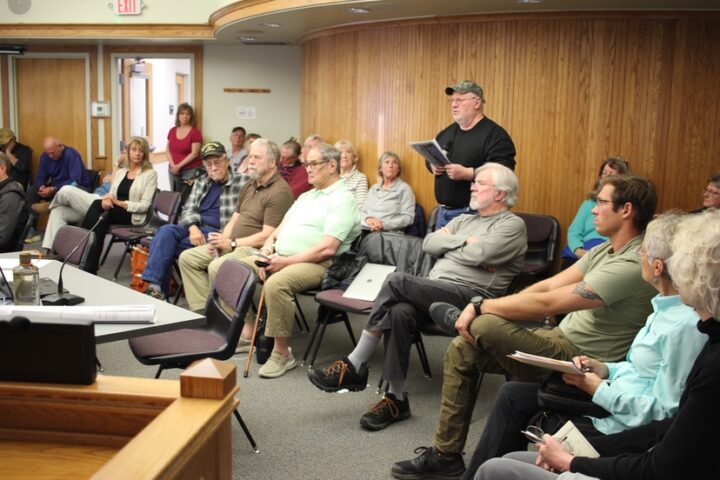
The Town has a ‘process’ by which elected and appointed officials schedule ‘public hearings’ to get input from the voters and taxpayers. Typically, prior to the ‘public hearing’, the developer has spent weeks and perhaps months working with the Town planners to develop their plan — without any public participation. Then, when the ‘bugs’ have been worked out in the planning offices, the plan is presented to the public, and each interested member of the public is allotted three minutes to share any concerns about the proposal.
At a recent public hearing concerning the Pagosa West subdivision, every member of the public — other than the realtor who was marketing the property — protested the proposal as presented. But the Town Planning Director indicated that the proposal generally met the requirements of the Land Use and Development Code.
So perhaps it didn’t really matter how the voters and taxpayers felt about the proposal?
This is referred to as “due process”. But it’s a process that typically has a ‘winner’ and a ‘loser’. Often, the ‘loser’ is the broader community, and the ‘winner’ is the developer.
Of course, this is not the only type of ‘process’ that can lead to a decision. Rather, it’s the ‘process’ that governments have put in place for the sake of efficiency. It moves things forward, whether we like it or not.
Other types of decision-making processes — not often used by American governments — are less ‘efficient’…
…But maybe more likely to produce liberty and justice, for all?