
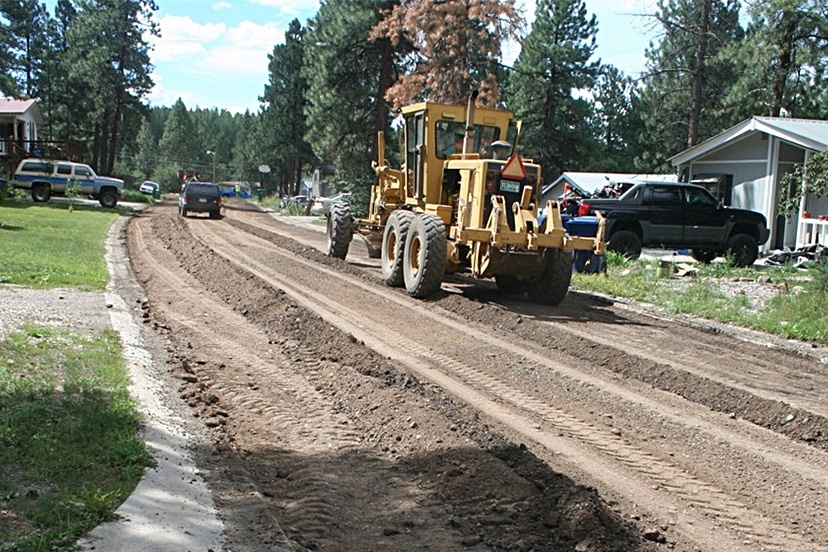
In Archuleta County, where rural roads wind across tribal lands and rugged terrain, an unsettling pattern is coming into focus—one that reveals the quiet misuse of public funds, legal inconsistencies, and what may be one of the most underreported governance failures in recent memory.
At the heart of it is Old Gallegos Road—and the county’s own admission that it may be maintaining over 100 miles of roads that legally aren’t even theirs.
It began with a simple act: speedbumps.
Installed by a private landowner on Old Gallegos Road, the speedbumps were meant to slow traffic near her home after she claimed neighbors had nearly hit her grandchild and had actually struck her dog. She states she was initially told by Archuleta County Road & Bridge personnel that they wouldn’t be out to bother her again after neighbors complained and she showed the County representatives her private easement agreement with the Ute Tribe. She stated the County employees acknowledged the road was private. But weeks later, in the summer of 2024, County crews returned — after notifying her earlier in the morning on the same day — and removed the speedbumps using public labor and equipment, leaving her with no recourse.
During the process, she also received letters from the County attorney telling her to stop “interfering” with what the County now claimed was a public road.
The landowner attempted multiple times to get the County to stop. She was eventually forced to hire an attorney, who conducted extensive research into the legal history of the road. Public hearings placed Old Gallegos on the BOCC agendas throughout 2024, and in January 2025 the County introduced a resolution declaring it a County road.
However, a statement from a Ute tribal representative later that day clarified that the road belonged to the Ute Tribe and that no agreement existed with the County. She clarified that the landowner had a private easement with the tribe and that there may be an agreement with the County in the future. That statement alone rendered the County’s resolution legally void. Landowners on the road hold permanent easements from the tribe… not from the County, not via subdivision plats, and not through any formal dedication.
Colorado law sets clear requirements for a county to adopt a road. Under C.R.S. § 43-2-201, a county may only assume legal maintenance responsibilities if a road has been dedicated through deed, plat, or easement, and then formally accepted via resolution by the Board of County Commissioners. That never happened here. The road was never deeded to the County, nor did the County follow the statutory process for adoption.
Even more glaring: the road does not serve any verified public facility.
So how did the County justify its actions?
“There’s a church on the road,” officials said.
During a November 12, 2024 BOCC meeting, then-Commissioner Ronnie Maez responded, “Which is open to the public. I’ll probably push back on this one,” when Old Gallegos was discussed in the context of bridge maintenance and road abandonment — implying that the presence of a church created a public access mandate.
To call that legally dubious is generous.
The First Amendment draws a hard line between church and state. A church is not a public facility under law, it is inherently private and religiously so. It, therefore, cannot confer public domain status to surrounding infrastructure, and it cannot authorize county jurisdiction over tribal or private land. Yet that was the stated rationale: access to a private church built in 1917.
In fact, a January 8, 2025 article in the Pagosa Springs SUN confirms the Board of County Commissioners considered vacating Old Gallegos Road and its bridge under Resolution 2025-8. However, after public comment citing church access as the primary reason to maintain the road, the BOCC declined to adopt the resolution.
One commenter claimed the church was a public facility and that the road had been used for over 100 years. But these arguments are irrelevant to the law. No record exists of the church being public, or the road being formally adopted. Longevity of use due to proximity to a church does not override the statutory requirements for legal jurisdiction or road adoption.
Private land and buildings do not convey public use.
Meanwhile, neighbors who had opposed the landowner’s speedbumps filed complaints with the County. The commissioners never cited those complaints publicly; instead they leaned on the church-based justification.
Commissioner Maez insisted, “The Gallegos [family and/or road] needs to be protected simply because of public access to the church.”
The landowner’s attorney eventually issued a formal cease and desist, affirming that the church is privately owned, that tribal easements are sovereign, and that the County’s interference was unlawful. But by that point, the harassment, reversal of prior assurances, and the physical destruction of private improvements by County crews had created such hostility that the landowner sold her home and moved on to greener pastures.
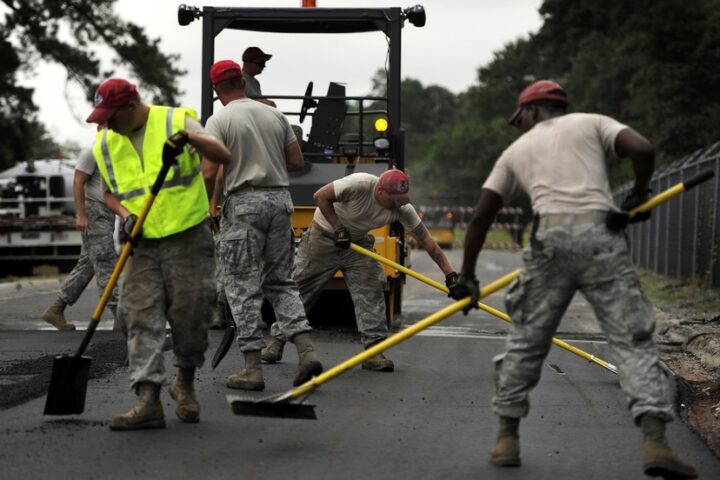
Simultaneously while the speedbump dispute was happening, Commissioner Veronica Medina expressed open resistance to any internal investigation into road legitimacy down in Arboles. During the same November 2024 BOCC meeting, she said:
“It may not be wise for the County to expend so many resources to figure out what is a County road or not.”
This was in response to internal reports revealing that nearly 100 miles of roads — a third of the entire road system — may never have been legally adopted, potentially costing taxpayers over $3 million to maintain every year.
The November SUN article also reported that Public Works Director Mike Torres confirmed $2,000 in County funds had already been spent on a bridge on Old Gallegos Road, with much higher costs expected to bring it to DOT standards. When asked why the County was spending money on the bridge, the justification again was the privately owned Catholic church — so private that the land parcel is not listed in County property records search. The bridge was built in 1968 and the maintenance in the 1990s was to put up guard rails, which were subsequently removed. Though grant money may have helped with the guardrails for the bridge in the 1990s, former County Attorney Todd Weaver admitted the County had not signed agreement for jurisdiction. Only a rough draft exists, and a 1996 resolution merely mentions Old Gallegos; it does not formally adopt it.
However, instead of launching an audit or investigation into publicly funded maintenance of private roads in Arboles, County officials have turned to blaming subdivisions and budget constraints. Now, in June of 2025, the narrative has shifted from Arboles to in-town subdivisions — suggesting that abandonment discussions for subdivision roads stem from a 1998 resolution.
But that initiative was rejected by voters, and Old Gallegos is not in a subdivision. Nor are many of the roads in question.
The 1998 resolution being referenced specifically required a public vote to authorize abandonment of subdivision roads… and that vote failed. The legal consequence is clear: without voter approval, the roads remain formally adopted and the County’s maintenance obligation remains intact.
If the subdivision roads are already formally adopted and maintained, then a new question emerges: Where are the remaining funds being spent?
Real public funds were used to dispatch a County crew to remove private speedbumps on Old Gallegos Road — despite the county having no legal jurisdiction over the tribal easement. At the same time, the County has acknowledged a growing list of roads in Arboles that may not have been legally adopted either. The November 13 SUN article references this, stating:
“Maez went on to mention that the county could have 100 miles of roads that it has been maintaining, that may not actually be County roads. ‘There’s a good list in Arboles,’ McRae said, noting his department has been compiling a list of roads.”
These are the very roads Commissioner Medina has expressed reluctance to investigate, even as the County continues allocating annual maintenance funds. This pattern suggests a misalignment between where road funds are supposed to go… and where they’re actually going.
This isn’t just administrative oversight. This is ghost maintenance… public money spent where there is no legal mandate, no jurisdiction, and no transparency. It is silent, undocumented, and insulated from accountability.
And it’s costing real money.
The Road & Bridge budget exceeds $10 million annually. If the County has over 300 miles of County roads to maintain and 100 miles of the roads are not legally adopted, the public may be losing over $3 million per year on ghost maintenance alone. That figure does not include legal costs, equipment use, labor hours, or future liabilities if these practices are legally challenged.
Adding to the opacity is the recent arson at the Clerk and Recorder’s Office, which could have destroyed or damaged road records that could help prove (or disprove) ownership and maintenance authority.
Whether this stems from negligence, favoritism, or a willful disregard for the law, the public deserves answers:
Who authorized the use of public funds to remove speedbumps on a tribal easement?
Why is the County citing a private church as justification for jurisdiction?
Why has no internal or external investigation been initiated?
And most urgently: How many more Old Gallegos Roads are out there… quietly absorbing taxpayer dollars, without oversight, without legal standing, and without public consent?
Because where there’s one, there are likely dozens.
And the taxpayers are footing the bill for every mile and every twist and turn the Commissioners make while funding private maintenance with public dollars.