
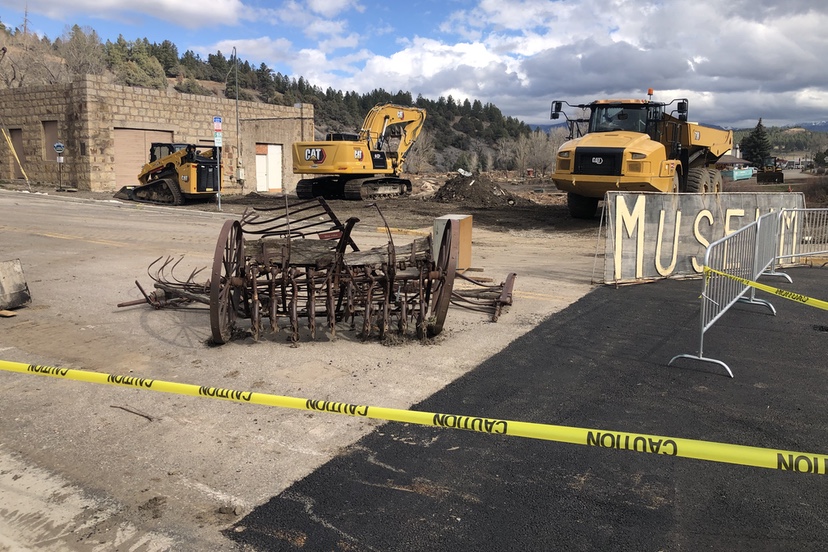
The former site of the Pagosa Springs History Museum near the 1st Street Bridge in downtown Pagosa Springs. The two flood events in October and November undermined the building and necessitated its removal this past weekend.
Before we get too far into this story, let’s begin with some good news. Despite everything, the Town Parks & Recreation staff still plans to install Christmas lights in some locations.
So, there’s that.
Now then, here’s Pagosa Springs Town Manager David Harris, addressing the Town Council last night, Tuesday, November 17, about the flood recovery efforts following two recent “100-year flood” events.
“As much as we want that recovery to happen fast, it’s going to be years…
“It’s going to take time. A lot of the projects we’re doing will likely take a few decades. So I just want to say that.”
He then described ongoing government processes aimed at justifying funding assistance from state and federal agencies. Some of that disaster funding might come from the Federal Emergency Management Administration (FEMA) if the appeal is approved by the White House.
Mr. Harris:
“The White House phone number is 202-456-1414. That’s 202-456-1414.”
He said the Colorado Department of Local Affairs has offered to help fund a “Disaster Recovery Manager” position for up to three years. Not “a few decades”, unfortunately, but I guess “three years” is better than nothing.
Possibly, he said, the Town and County can jointly contract with a consultant who specializes in obtaining money for disaster recovery. “Because, simply, we don’t know what we don’t know.”
“We did demolish the History Museum. That was an order given, so we had to take care of that…”
“It should be noted that — if anyone is needing assistance — there are multiple avenues out there, and for you to be aware, if you had damage, we really want you to make sure that gets listed in ‘Crisis Track’.
NOTE: We are publishing a Town press release today, here in the Daily Post, that lists useful resources.
The Council then received recovery effort reports from numerous government employees, including Public Works Director Nick Freelen, Tourism Director Jennie Green, Parks & Rec Director Darren Lewis, Development Director James Dickhoff, CDOT representative Meredith Greene, and Housing Coordinator Jeff Sams.
We will summarize some of those reports later in this editorial series. But first, I’d like to share a bit of interesting history, as reported in the collectable 1984 book by John M. Motter, Pagosa Country: The First Fifty Years.
The recent flood events in Archuleta County are not unique. Pagosa Springs previously experienced dramatic flooding in 1911, and in 1927.
From Mr. Motter’s report on the 1911 Flood:
“San Juan Breaks Record … Gets On Rampage and Leaves Death, Devastation and Ruin in its Path.”
The preceding headline appeared in the Pagosa Springs Sun in October of 1911. On Thursday, October 5, occurred the worst natural disaster in Pagosa Country history. The Sun reported: “Tuesday morning the sun rose in all its glory and the day was an ideal one. Wednesday morning a drizzling rain set in and kept up until the torrents caused the San Juan to change from a pleasant, smiling stream to an angry, raging, terrific river.
Early yesterday morning the citizens became aware that dire calamity was about to prevail on Hermosa Street and in the park vicinity. Business, for the time being, was suspended and all rushed to the aid of those in the doomed district. All teams available were brought into action, and all goods that could be were hauled out.”
Every bridge in Archuleta County washed out. The city jail was carried away and did not stop until it reached Trujillo…
Every stream in the county flooded; in fact, every steam in the San Juans flooded. The town water works and
electrical plant were destroyed. Telephone and telegraph lines were down and railroad tracks and bridges washed out. Pagosa Country was isolated from the outside world…
Mr. Motter goes on to describe the flood impacts, and the townspeople rallying to restore the town to its previous (rustic?) condition. The bridge over McCabe Creek was restored within a couple of weeks, and a “new water works was started on First Street where the museum is today.”
(Of course, as of last weekend, the Museum is no longer there.)
A flume was built to provide a temporary source of water for townspeople. A mill levy of 32 mills was assessed to pay for replacing damaged town property, including the water works. In a few months the town was back to normal.
We don’t know how accurate this report may be. Mr. Motter was relying, for his information, mainly on newspaper coverage — and we all know about the accuracy of newspaper coverage. Was Pagosa Springs really “back to normal” in a few months? If so, “normal” was very different in 1911. (Which we must assume it was.)
According to Town Manager David Harris on Tuesday, the recovery from the 2026 floods will “likely take a few decades” to address.
As an aside, I found the very next paragraph in Mr. Motter’s book to be quite interesting, giving an indication of the political influence, in 1911, of the Women’s Christian Temperance Union.
The W.C.T.U. remained active and increased its influence. When Charlie Schaad’s liquor license was renewed in May of 1912, he was restricted to “five small lunch tables and 15 stools in his saloon in place of a bar.” Bostwick Brothers and J.B. Martinez Jr. were allowed one pool table, one desk chair, and seven other chairs each.
By February of 1916, the town adopted Ordinance 109, “An ordinance prohibiting the manufacture, selling, bartending, exchanging, or giving away of intoxicating liquors within the town of Pagosa Springs, Colorado.” The vote was unanimous.
Obviously, these were different times in Pagosa Springs.
Early in yesterday’s Council meeting, CDOT representative Meredith Greene noted that the Highway 160 reconstruction project, originally scheduled to be completed in 2026, is winding down and will not be completed this year and will resume (perhaps next April?) for several more months.
On the bright side — and Lord knows we can use some bright sides right about now — the highway work is complete between 1st Street and the 400 block and people will be allowed to park on both sides of the highway, in time for holiday shopping.
Read Part Two,,, tomorrow…
Bill Hudson began sharing his opinions in the Pagosa Daily Post in 2004 and can't seem to break the habit. He claims that, in Pagosa Springs, opinions are like pickup trucks: everybody has one.