

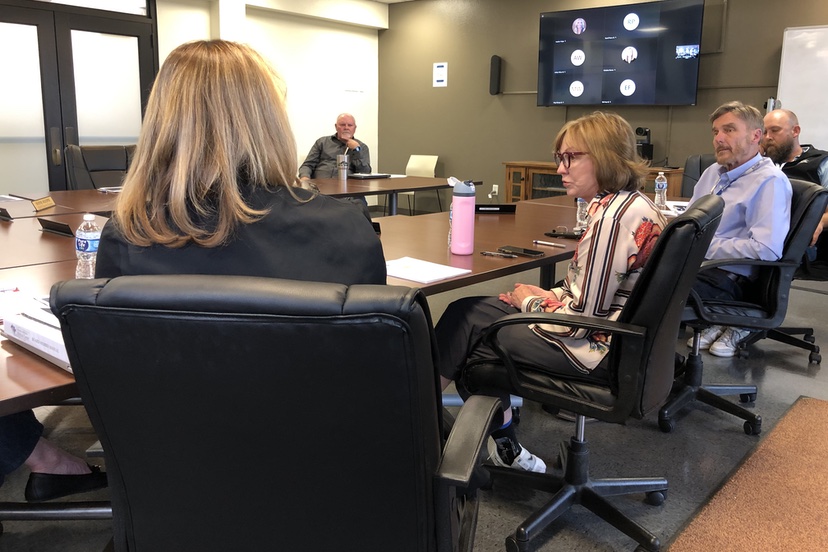
Photo by Jeff Laydon, Pagosa Photography.
I had come across the acronym “RHTP” in various news articles lately, but hadn’t paid it much attention.
Last month, Governor Jared Polis and the Colorado Department of Health Care Policy & Financing announced that Colorado is directing $170 million in Rural Health Transformation Program (RHTP) grants to rural healthcare providers across Colorado. According to the press release, “this significant investment, funded by the Centers for Medicare & Medicaid Services, will help protect access to care and support better health outcomes in Colorado’s rural and frontier communities.”
I knew that Pagosa Springs qualified as a “rural community”. But maybe we’re also a “frontier community”?
The Upper San Juan Health Service District (USJHSD) board of directors met last week to discuss the financial frontier faced by the Pagosa Springs Medical Center — the tax-supported medical center located on South Pagosa Boulevard — and by the EMS ambulance service in Pagosa.
Both operations appear to be bleeding cash, and possibly in need of a transfusion.
Local voters will have a chance to support PSMC and EMS by voting “Yes”, this November, on ballot measure 7B, at the very bottom of your ballot. A “Yes” vote will allow USJHSD to continue retaining tax revenues in excess of Colorado Taxpayer Bill of Rights (TABOR) limits. It will not increase your tax rate.
Some of the conversation at Thursday’s USJHSD board meeting centered on a preliminary draft 2027 budget (which you can download here.)
The financial picture is not a pretty one for rural Colorado, in spite of $170 million in RHTP funding awarded statewide for next year.
To give some perspective to $170 million, spread across rural Colorado — the Pagosa Springs Medical Center draft budget for 2027 projects $56 million in expenditures. Unfortunately, the RHTP money would not help PSMC meet those existing expenses — the funds would only create new, additional work.
The Rural Health Transformation Program is a five-year federal initiative “designed to strengthen healthcare access, and improve health outcomes in rural and frontier communities”, administered by the Centers for Medicare & Medicaid Services (CMS). The program supports investments in workforce development, innovative care models, technology-enabled services, and health system sustainability. But the devil is in the details.
In 2025, Congress passed the “One Big Beautiful Bill” that set federal spending through 2030. Designed to cut costs and reduce debt, the legislation came under fire in May 2025 for its impact on rural healthcare. The legislation cut federal Medicaid spending by nearly $1 trillion, with rural healthcare systems facing up to $155 billion in Medicaid cuts over a decade, according to an analysis by the Kaiser Family Foundation.
To address those concerns, Congress proposed the $50 billion Rural Health Transformation Program, to be disbursed in $10 billion increments over five years, starting in 2027.
According to the White House, “The Rural Health Transformation Program will provide new funding to states for a range of uses designed to make rural healthcare more effective and sustainable for the long term…”
A key problem with the program became apparent during the USJHSD board meeting discussion. Basically, RHTP funding might make rural healthcare “more effective”… but it’s not designed to make rural healthcare “more sustainable.”
And sustainability appears to be a central challenge at Pagosa Springs Medical Center, where Medicare and Medicaid reimbursements have historically supplied the lion’s share of the hospital’s revenue, as is the case with many rural healthcare systems.
Proposed government budgets in Colorado are required to include comparisons with two previous years financial data. Looking at the preliminary draft budget discussed last week, it appears that for 2025, USJHSD had $50.0 million in operating revenue and $49.4 million in expenses, for a net operating gain of $619,000 — and a net gain of $5.5 million, once the bottom line was augmented by donations, tax revenues, and other non-operating revenue sources.
But the financial landscape for rural America’s healthcare systems has changed somewhat since 2025.
For 2026, USJHSD is projecting $47.5 million in revenue, and $52.6 in expenses, for a net operating loss of $5.0 million, that will be covered by donations, tax revenues, and by pulling $1.5 million out of the hospital’s fund balance reserves.
Governments cannot pull from their fund balance reserves indefinitely, year after year. Soon enough, the fund balance gets depleted.
But the draft budget for 2027 shows USJHSD pulling another $553,000 from fund balance reserves in order to balance the bottom line.
One big change to rural healthcare has been the increase in ‘Travel Nursing’… nurses and other healthcare professionals that fill vacant positions on a temporary basis, placed by large ‘travel nursing’ companies such as Aya Healthcare and AMN Healthcare. These traveling nurses and other professionals end up being much more expensive than a salaried employee, in part because the placing company charges a substantial fee for placing the temporary employee.
Medical center CEO Rhonda Webb:
“This unprecedented use of travelers in this industry — it’s never been like this. And part of it is a culture shift. I mean, there have been nursing shortages since I’ve been a doctor, back when I was 24. But a lot more people are wanting to take these travel assignments; they do make more money, but the company makes the most money. And then, they are not committed to a place; they move on, and with the extra money they make, they may not have to work for a month or so…
“I think we’re always going to see more travelers, no matter what. But it can’t stay at this level. We need to get back down, closer to where the budget was in the past…”
So… how about that RHTP funding?
Read Part Two… tomorrow…