
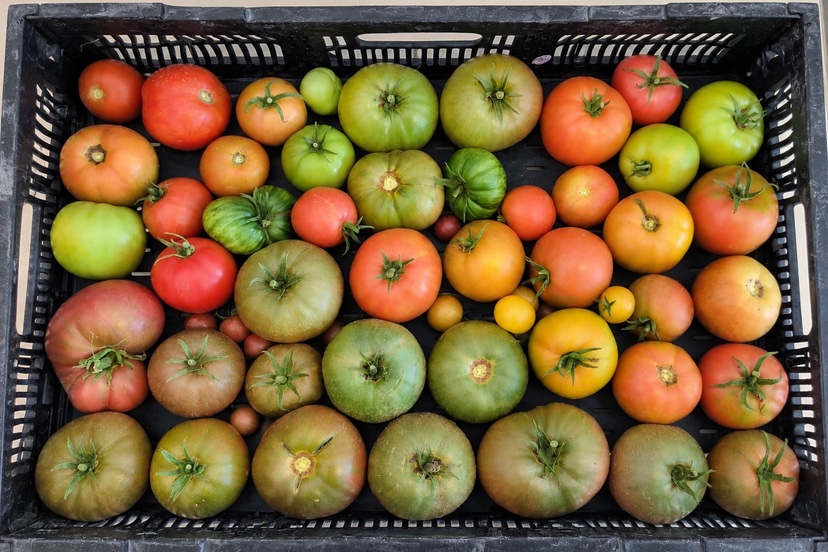
For my birthday, I got the chance to visit a favorite, Café Pasqual’s near the Santa Fe Plaza. In the window stood a carved St. Pasqual, bowl in one hand, spoon in the other. The patron saint of the kitchen looked ready to feed somebody.
I appreciated his priorities.
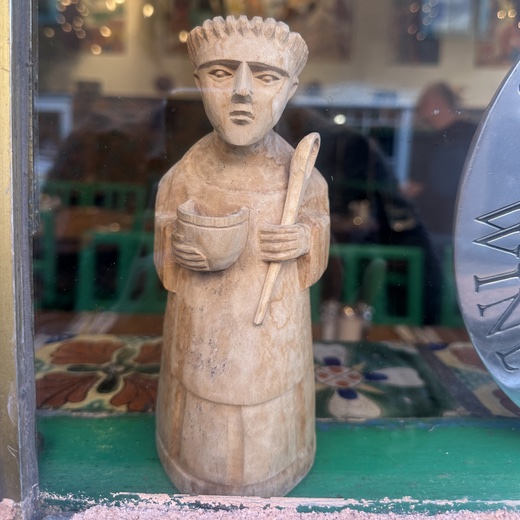
My birthday falls just before the autumn equinox. Pagosa’s riverbanks turn gold. Late-season tomatoes celebrate, too: red, yellow, striped, uneven.
I admire them. Then I want lunch.
Pumpkin spice is divine. So are roasted chile, tamales and a pot of posole warming the kitchen. Autumn has room for all of them, and for the histories they carry.
This season draws my attention to what I have inherited and what I am still learning. Indigenous Peoples’ Day, October 12, brings that reflection to the Ute homelands where I grew up, and to living communities and distinct sovereign nations.
In my kitchen, inheritance becomes personal. I baked an apple cake inspired by Mama’s cinnamon apple muffins. Their aroma would float through the kitchen as we arrived to eat before school. I swear she must have been up at five. At six, NPR’s Morning Edition was turned up to let us know it was time to get out of bed.
World news and warm muffins. Mama covered a lot of ground before breakfast. She still gives me plenty to learn.
In August’s tribute for her 85th birthday, I wrote about her open door and extra place at the table. I keep returning to that welcome: someone notices who is missing, and why. What would it mean for a community to practice that attention?
As autumn moves toward November, I think of those I can no longer sit beside. Día de los Muertos falls November 1–2, alongside the distinct Christian observances of All Saints’ Day, November 1, and All Souls’ Day, November 2.
My ofrenda — a remembrance altar for Día de los Muertos — is still taking shape. Photographs stand among candles and offerings; marigolds, pumpkins and squash bring color. My dad, my grandma, relatives and friends each have a place. I say their names and remember their company, their wisdom, their lives beyond the photographs.
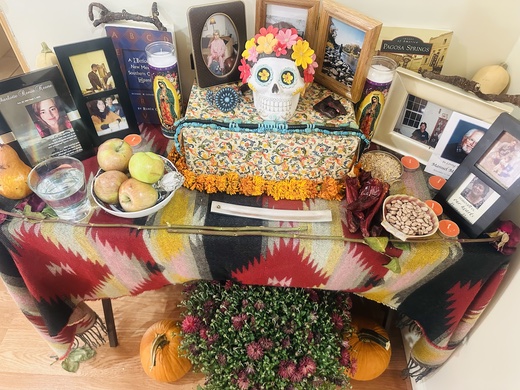
I’m gathering papel picado and personal offerings: a meaningful object, a recipe, a handwritten memory. Small things that help others know them.
As I learn about the Mexican traditions and Indigenous histories shaping Día de los Muertos, I approach them with care. Cultures are not costumes. This is a personal practice of remembrance, still growing.
Making room for memory draws my attention beyond my family. I remember lives lost to human rights abuses, genocide and war, and reckon with violence my government commits or supports, here and abroad. I honor those we have lost who fought for civil rights and the dignity of workers, women and people of color. Remembering them asks how I will care for the living.
That question returns me to everyday acts, including the meals I make and share.
A dish can recall the person who wanted seconds, or the hands that knew how much flour to add. Writing down the recipe means learning what “a little more” means.
It rarely fits neatly on an index card.
My ‘toast two ways’ carries familiar flavors into something of my own. I bought the chile and tomatoes at the Santa Fe Farmers Market, supporting growers. Use what you have; sturdy bread will do.
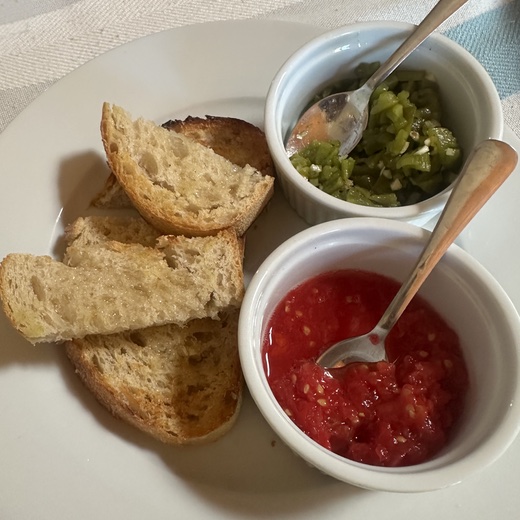
Toast Two Ways: Pan con Tomate and Roasted Green Chile con Ajo
Makes eight half-slices, four with each topping; serves two to four.
Ingredients
Four sturdy slices of sourdough or artisanal bread, about three-quarters of an inch thick
One peeled garlic clove, halved, for rubbing
One to two tablespoons olive oil
One or two ripe medium tomatoes, locally grown if available
½–1 cup roasted green chile, peeled, stemmed and chopped; remove seeds as you prefer
One small garlic clove, finely minced; adjust to taste
Salt; flaky sea salt for finishing, if you have it
Method
Prepare two bowls. For pan con tomate, halve and grate the tomatoes, stopping at the skin. Salt the pulp. In another bowl, combine the chile, minced garlic and salt.
Toast first. Toast the four bread slices until golden and crisp at the edges.
Then garlic and oil. While the bread is warm, lightly rub the toasted surface with the cut garlic clove, then drizzle with olive oil.
Halve and top. Cut each slice in half. Spoon tomato onto four pieces and chile onto four. Finish with a drizzle of oil if desired and flaky sea salt if you have it; serve immediately.
I won’t fight you over Mirasol green chile from Pueblo, Colorado. I favor heirloom Chimayó from northern New Mexico. Like wine, chile reflects variety, soil, climate and care. Think terroir, with a little more heat.
Making both versions honors my family’s Spanish, Mexican and Indigenous ancestry. That is my family story; ancestry does not establish tribal citizenship.
My roots span southern Colorado and New Mexico. Among my gente, the saying resonates: “The border crossed us, we didn’t cross the border.” That history reaches beyond a state-line chile rivalry.
Pass the chile; I brought enough bread.
Sharing food brings those histories into conversation. Tomorrow, Saturday October 10, CSU Extension Archuleta County and the Pagosa Springs Chamber of Commerce, with community partners, will host a free ‘Longer Table’ dinner. Bringing something is optional; seating is limited, and registration is requested.
Nobody has to earn their seat.
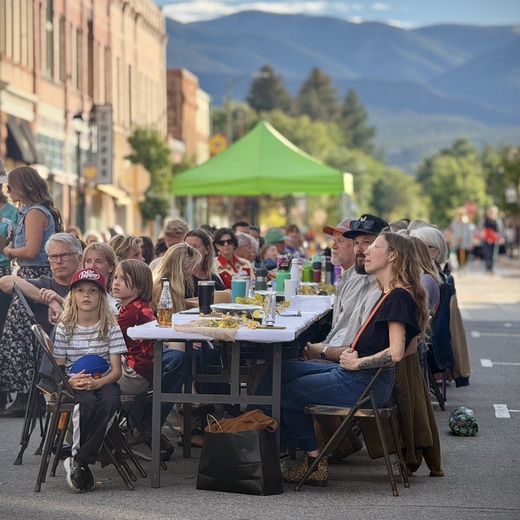
My friend Tim Jones’s nonprofit, ‘Longer Tables’, celebrates Colorado’s 150th anniversary through shared meals. The idea for a similar Pagosa Lewis Street community meal inspired by Buena Vista’s “BV Strong” community drew enthusiasm during my Main Street Board term. This gathering has its own organizers, and I’m grateful for their work bringing neighbors together.
I picture someone arriving alone and finding conversation. Posole beside pumpkin bread. A familiar face learning the name of someone living down the road.
For any community meal, my public health question is how “You are welcome” becomes “We’ve made room for you.” A ride, accessible seating or time away from work may make the difference. Workers and residents know what helps them take part.
That attention extends to everyone behind the meal: growers, farmworkers, drivers, cooks, servers and dishwashers. Sean Sherman’s Chefs Against Fascism Everywhere campaign calls for solidarity. I stand with that call. Pagosa’s gathering is independent of the campaign. For me, the responsibility remains: people’s dignity does not depend on what they serve us.
A supper cannot resolve access to healthcare, low wages, unaffordable housing, nutrition insecurity or unsafe working conditions. Those require attention in workplaces and public decisions. The people feeding others need time to sit down and be heard.
Still, I hope guests leave with someone to greet, a reason to return, someone to call. Asking what felt welcoming or made attending difficult could guide another gathering. Listening matters most when it changes something.
Perhaps freely offered recipes and memories could become a community cookbook. Nobody needs to speak for a culture or share something private. The stories belong to the people telling them.
From New Mexico, I’m cheering on this gathering and those building its next chapter locally.
My humanity and my faith ask me to love my neighbor in ordinary choices. I am still learning how, albeit imperfectly. This autumn, I can make myself toast, invite someone to supper, record a recipe or listen to an unfamiliar story.
I am grateful for another birthday, for the chance to begin again, for the people beside me, and for those whose names I speak at the altar. What we carry forward matters to the people who come after us.
For now, I am putting two bowls on the table: tomato and chile.
Take a piece of toast. Tell me what you grew up eating.