
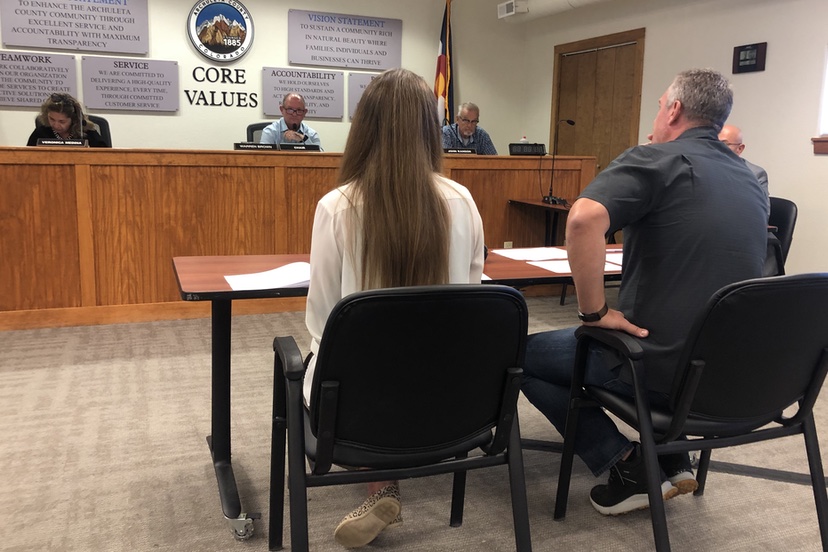
Photo: Local lodging owners Kelly Spence and John Harper address the Archuleta Board of County Commissioners on September 22, 2026.
At yesterday’s Archuleta Board of County Commissioners’ work session, we were treated to several interesting reports and presentations, including a chance to hear a somewhat controversial proposal from the Pagosa Lodgers Association. The presenters were local lodging owners Kelly Spence (Mountain Landing) and John Harper (Fireside Cabins).
County Commissioner John Ranson reacted positively to the presentation. Commissioner Veronica Medina, on the other hand, was quite critical of the proposal, as will be discussed later.
I couldn’t honestly tell, from his comments, what Commissioner Warren Brown thought of the whole thing.
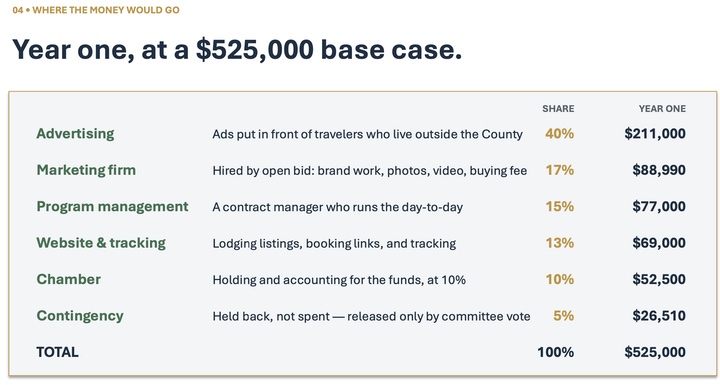
The basic proposal? Redirect all of the County’s Lodging Tax revenues — $525,000 — away from the publicly-appointed Pagosa Springs Area Tourism Board, and hand it over to the privately-owned Lodgers Association.
This is not exactly a new idea. I’ve written several editorials about the ongoing discord between the Tourism Board and the Pagosa Lodgers Association LLC.
Many, many years ago, the Colorado legislature determined that the state’s economy would see a positive benefit from marketing the state’s recreational amenities to tourists, and they passed a law allowing local jurisdictions to collect ‘Lodging Taxes’ from visitors, to be used for advertising.
I’m not sure what year Archuleta County voters approved a 2% Lodging Tax — as I recall, it was around 1987. Subsequently, the County hired the Pagosa Springs Chamber of Commerce to market Archuleta County as a great place to book a motel room, shop in our quaint downtown, and take a relaxing hike in the national forest, followed by a dip on the hot springs. Because the Town of Pagosa Springs didn’t yet have a municipal Lodging Tax, the County collected revenues from all the motels in the community. It wasn’t a lot of money, but it helped keep the Chamber of Commerce busy, and solvent.
In 2005, the Town voters approved a municipal Lodging Tax of 3%. This meant that the County could no longer collect revenues from the motels located within the town limits.
Which was nearly all the motels.
In 2006, the Town voters increased the Town Lodging Tax to 4.9%. (As a Town voter, I voted in favor of the new Town of Pagosa Springs Lodgers Tax in 2005, and then voted to increase it in 2006. County voters weren’t allowed to vote on those two tax measures.)
Suddenly, the municipal government had a problem: how to spend hundreds of thousands of new tax dollars effectively. As things played out, the Town decided to form a new committee — the industry-dominated Town Tourism Committee — to direct the marketing effort. The Chamber of Commerce was cut out of the deal. Instead, the Town created its own little tourism bureaucracy.
Some bad feelings resulted, as can be imagined. But the marketing results, in terms of increased community-wide tourism, seemed positive. Then in 2015, the Town and County agreed to combine their separate Lodging Tax revenues and have the spending directed by a jointly-appointed Pagosa Springs Area Tourism Board, to be administered by the Town.
I will pause here for some more general comments about tourism.
In terms of building a viable economy, tourism might be the very worst choice any community could make. The industry wages are some of the lowest in Colorado, and many full-time residents would be perfectly happy if they never had to deal with another noisy vacation-rental party in the house next door.
But some communities — like Pagosa Springs — have limited “economic growth” opportunities other than tourism, due to rural isolation mixed with forests, rivers, and scenic beauty… and not much else.
During the COVID crisis, many tourist destinations saw a drop in visitations. But not Pagosa Springs.
The County’s Lodging Tax collections during 2021, 2022, and 2023 were roughly twice the amount collected in 2019.
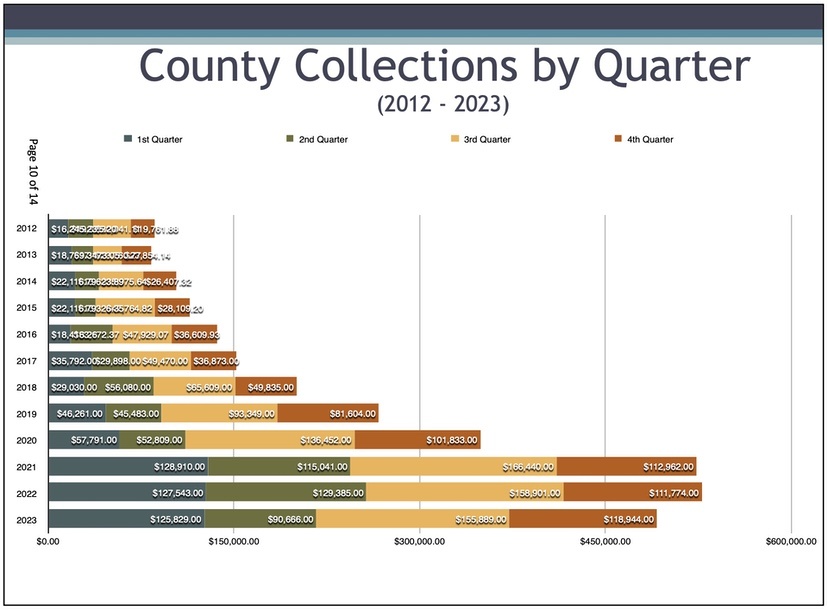
Combining the County Lodging Taxes with the Town’s Lodging Tax revenues, the Pagosa Springs Area Tourism Board had more than $1.5 million to spend on promoting tourism in 2022.
We have all heard the stories. The lottery winner hits the jackpot and his life falls apart. He ends up broke, and divorced, and living in his car.
It’s well known that sudden wealth can cause all kinds of problems. And in the case of the Tourism Board having $1.5 million to spend on tourism promotion, it seems to have made some of our local lodging owners extremely jealous — or at least, caused them start to complaining to the County Commissioners that the Tourism Board was doing a bad job of marketing Pagosa Springs.
Looking at the steadily increasing tax revenues shown in the graph above, it’s hard for me to imagine anyone saying that the Tourism Board was doing a bad job.
But it wasn’t hard for the Pagosa Lodgers Association LLC to start accusing the Tourism Board of wasteful spending, and to start making the claim that they — the Association — could do a better marketing job with all that money.
The Association found a loyal sympathizer on the Tourism Board, once Commissioner John Ranson was appointed to that board to represent the County. Over the past 18 months, Commissioner Ranson has been promoting the idea that ‘two tourism marketing efforts’ are better than one, and that the County should hand over all or part of its Lodging Tax revenues to the Association.
The BOCC presentation yesterday by Association members Kelly Spence and John Harper put some hard numbers to that request.
One question that might arise…
How would any of this be ‘better’ than what the Tourism Board is already doing on behalf of the community?
Another question might be…
Would the Pagosa Lodging Association LLC basically use the County money to drive business to their own lodging establishments?
Read Part Two… tomorrow…