
By Robert Heyduck
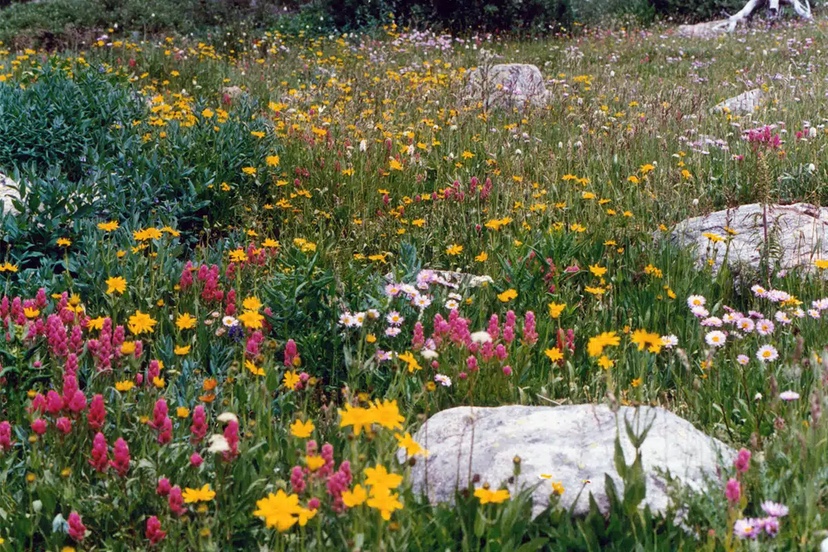
One of the first and easiest things to do when improving backyard habitat is to sow wildflower seeds. Unfortunately, not all wildflower seed mixes are created equally. While such mixes are widely available at hardware stores, garden centers, and even grocery stores, many contain non-native and invasive plants. Bachelor’s buttons, ox-eye daisy, purple loosestrife, yellow toadflax, and baby’s breath are all non-native species that have escaped and now cover miles of roadsides and waste spaces across North America.
In our region, we can find ourselves at the intersection of many different habitat types that include mountain grasslands, shrublands, forest and woodlands, each with a different set of sometimes overlapping wildflower species. Because of this, we may be sowing seeds of a species that is native a zone east, west, north, south, higher or lower in elevation to the site we are planting. That’s okay, as many species have a range that includes several different adjacent ecosystems.
The key is to avoid invasive species. Each state has a list of noxious weeds. To find out what these are, just search your state and “noxious weed” and you will find a list either from that state’s Department of Agriculture or Department of Conservation or Natural Resources. Familiarize yourself with common species and avoid those or crosscheck the list of the mix you plan to buy with the list of noxious weeds.
High Country Gardens (HCG) was founded by David Salman in Santa Fe, New Mexico in 1984, and has some great mixes. The “Native Dry Area Wildflower Seed Mix” has a great mix of species targeted for drier sites. “Intermountain Native Wildflower Seed Mix” includes species from a broader geographic area, but many are still suited to ouR landscapes and are not invasive. “Native Bee Habitat Wildflower Seed Mix” includes a few species from farther afield, like Echinacea (purple coneflower) while not native in the Rockies, are not invasive.
Southwest Seeds is based in Dolores, Colorado, and offers seed from single species, and mixes. “Heidi’s Highlands Wildflower Mix” has a great mix of species for a variety of our habitats, but their other mixes include batchelor’s buttons.
Curtis & Curtis Seed is based in Clovis and sell crop and native plant seed. Despite the name, “Llano Estacado Wildflower Seed Mixture” has a great mix of species that are well suited to the southern Rockies. The “Sonora Bloom Wildflower Mixture” also includes a great mix of appropriate species.
Stevenson Intermountain Seed, based in Ephraim, Utah, markets a number of mixes suited for a range of habitat types. The “Great Basin / Colorado Plateau Wildflower Mix” and “Southwest Desert Wildflower Mix” are probably the best for our areas. These mixes can be sown on bare ground, or on ground that is partially covered. A light raking will open the soil to allow seeds to make good soil contact. Some seeds want to be buried a half inch deep, and others want to sit on top of the soil. A light mulch of chopped leaves, dried grass clipping, or straw can help keep the soil moist longer and encourage the seeds to germinate. Early spring or late summer are the best times to sow, especially prior to any incoming precipitation.
One thing to remember about sowing any of these mixes is that not all seed will germinate at the same time, or even in the first year. Some seeds need to sit over winter before sprouting next spring. Some prefer totally bare ground, while others may prefer ground that has settled for a time and has partial shade from a thin cover of plants. Patience is key.
Backyard Biodiversity, a series of educational articles brought to you in partnership with local conservationists, scientists, and biologists and Chama Peak Land Alliance.
Rob Heyduck is a semi-retired Forester and Agronomist with over 30 years’experience in the Southwest, including 22 years with New Mexico State University.