
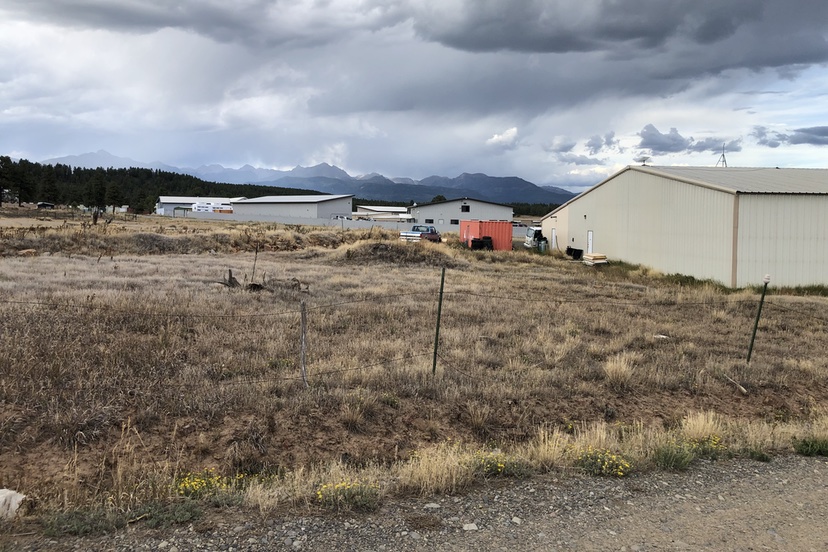
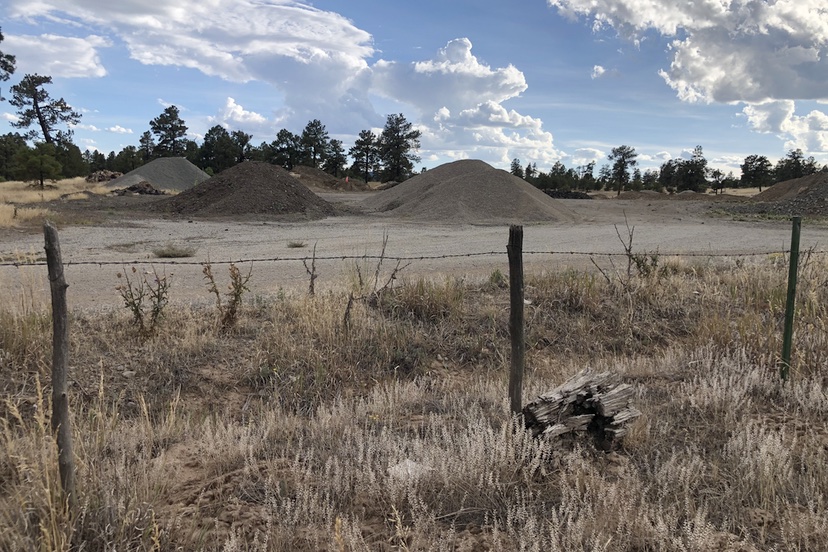
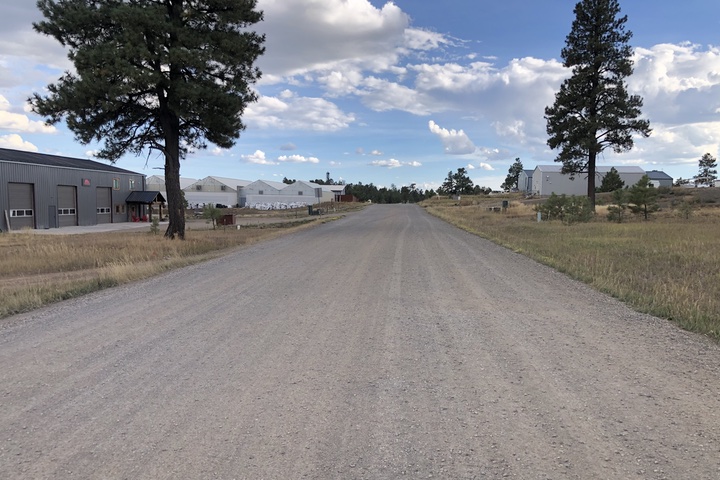
Photo: Looking north towards Cloman Industrial Park, from the 39-acre parcel owned by the Archuleta County government.
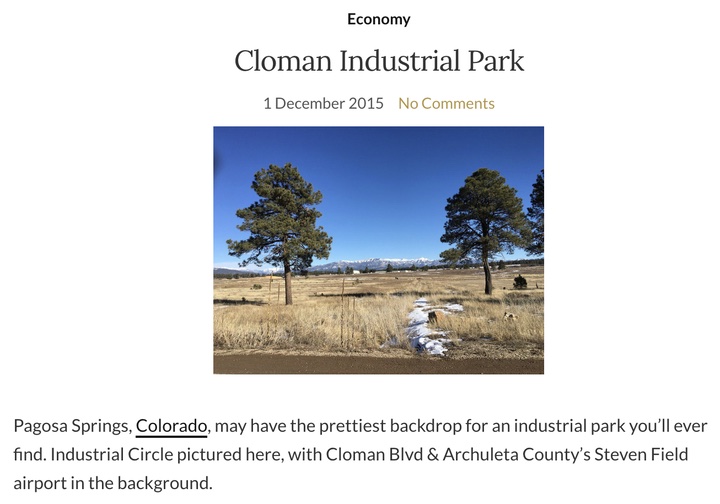
While looking for some background history about Cloman Industrial Park, I came across a website created by John Shepard, who served as Archuleta County Planning Director about 10 years ago. He had included a page on his website, featuring a small photo, and two sentences.
Technically, the Park is not located in the Town of Pagosa Springs. It’s situated west of the Archuleta County airport, in the unincorporated county. The yellow 80-acres shown below might what most people consider “Cloman Industrial Park”… but some folks might also include the pink 40-acre block owned primarily by the Archuleta County government, with 11 acres owned by the Humane Society of Pagosa Springs.
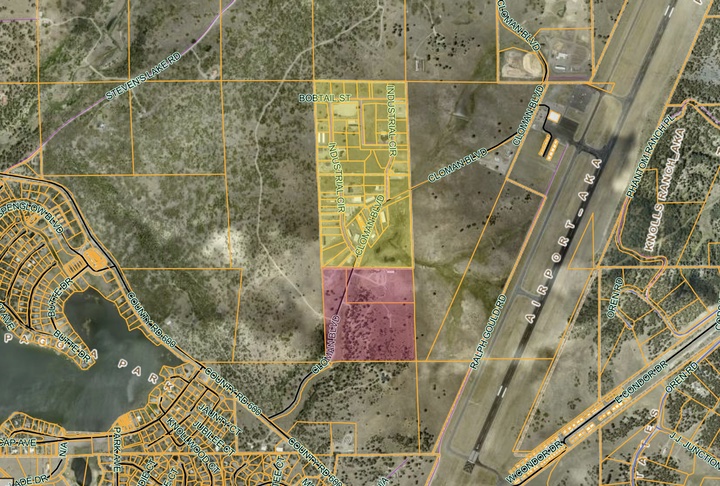
Lake Pagosa is in the lower left. The airport runway is on the right.
As far as I can tell, the subdivision known as Cloman Industrial Park got its start around 1994 — the year after my family and I moved to Pagosa Springs.
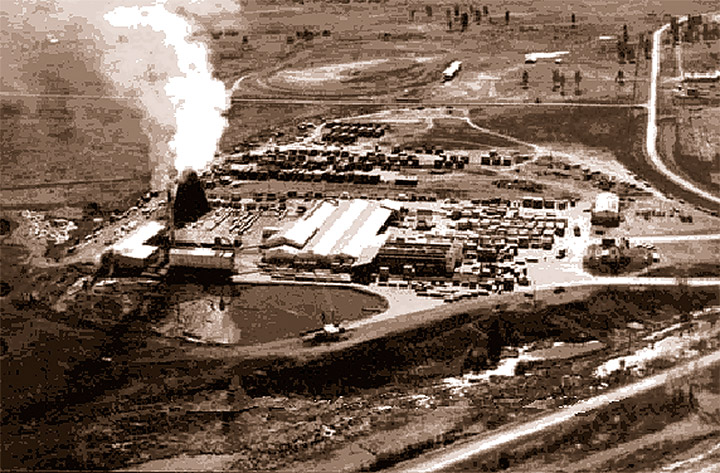
Once upon a time, Pagosa was home to ‘industries’ such as the San Juan Lumber Company, located at the intersection of Highways 84 and 160. These industries were producing real ‘industrial’ products.
But that sawmill had closed down many years before my family arrived. The property was simply an industrial clean-up project. During its heyday, however, San Juan Lumber had provided about 25% of the employment wages in Pagosa.
Other local sawmills also went out of business, as the Forest Service made it harder to access timber in the National Forest.
When we arrived in 1993, the main industries were home construction and real estate. A bit of tourism. Small-business retail and services. Timeshare sales. And, of course, government.
The Industrial Park was an interesting idea by Pagosa residents James and Mary Cloman, and was promoted — as I recall — by the Archuleta Economic Development Association (AEDA), an association of Pagosa businesses and government districts with a central aim, to judge by the organization’s name, of encouraging economic growth in Archuleta County.
For the first decade, not much happened in the Industrial Park. Gravel roads were built and a few businesses moved in, but it remained mostly vacant.
One of the first businesses to move in, near the entrance to the new “Park”, was the Humane Society of Pagosa Springs.
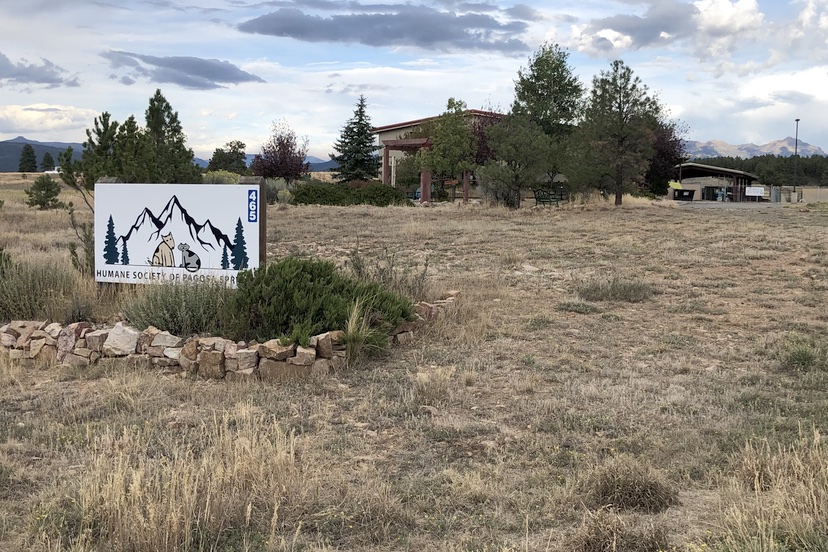
Not exactly an “industry”. But an important organization nevertheless.
The AEDA went belly-up in around 2011, when Pagosa was getting hammered by the effects of the Great Recession, and was replaced soon thereafter by the non-profit Pagosa Springs Community Development Corporation (PSCDC), generously subsidized by our two key local governments — the Town and the County — with the expectation that it would help improve our economy.
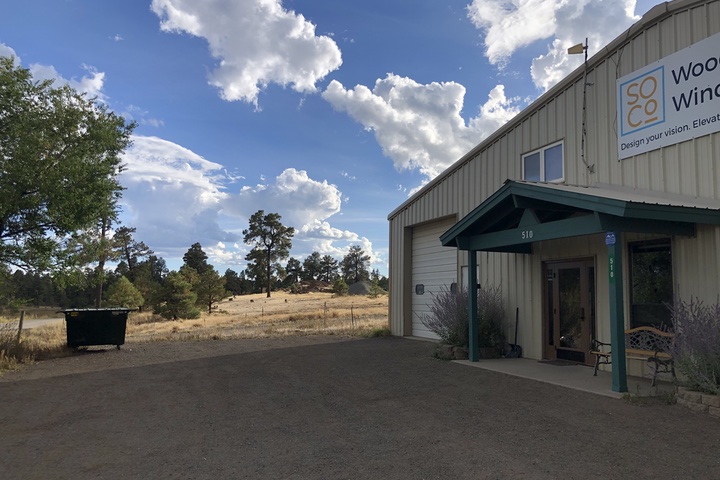
Over the past 15 years, a fair number of businesses have constructed buildings or created storage yards in the subdivision, in line with what local economic boosters had hoped would happen eventually.
I drove through the park this past weekend, to take some photos and get a sense of what the Park has become. The County property map suggests about 56 parcels in the Park (not including the County and Humane Society parcels) with about 35 of the parcels now occupied. Maybe half the occupied properties feature one or more metal buildings. The rest of the occupied parcels look to be storage yards for industrial equipment: propane tanks, heavy equipment, portable toilets, garbage dumpsters, shipping containers.
The parcel owned by Archuleta County is currently being used to store gravel and rock. But the County might someday build a recycling center there.
A discussion about Cloman Industrial Park was on the Board of County Commissioners’ work session agenda last Tuesday, September 8, when PSCDC Executive Director Emily Lashbrooke shared an idea with the commissioners:
Perhaps the property owners within the Park could form some type of taxing district? And take over maintenance of the roads within the Park? And make other improvements? Perhaps, a post office cluster box?
Some of the best-maintained roads in Archuleta County are maintained by special taxing districts known as ‘metro districts’. The roads maintained by the County government, meanwhile, are not always in the best shape.
Ms. Lashbrooke told the commissioners that nothing has been decided by the property owners, but she felt it was essential to start by finding out what the BOCC thought of the idea. The BOCC has, in the past, been generally supportive of efforts to improve the subdivision.
“Part of the reason for the special district is the lack of pavement in that big circle…” she stated. She was here referring to the main road through the subdivision, called Industrial Circle. It’s actually not a circle, however. More like a rectangle, on the map. They could have easily named it “Industrial Rectangle”, IMHO.
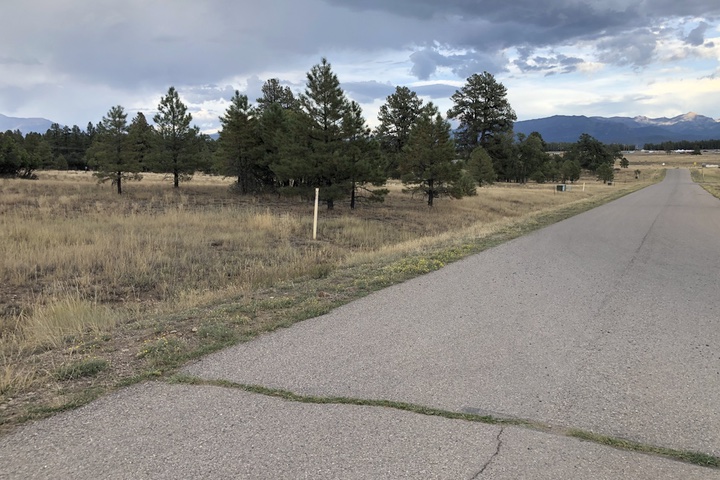
For some reason that’s not entirely clear to me, the northern part of Industrial Circle, where many of the still-vacant parcels are located, is paved…
But the southern portions of Industrial Circle, where much of the development has taken place…
…and where it actually adjoins paved Cloman Boulevard…
…is still gravel…
Ms. Lashbrooke said she estimated that the properties within the subdivision — if the owners approved, say, a 5 mill property tax for their district — might generate around $27,000 a year towards road maintenance and improvements. Other Archuleta County subdivisions that pay property taxes to their metro districts, such as Aspen Springs, Colorado Timber Ridge, and San Juan River Village, have set their mill levies at between 10 and 14 mills.
Another possible source, for the estimated $500,000 needed to finish paving Industrial Circle, is a Department of Local Affairs (DOLA) block grant.
Read Part Two… tomorrow…