

The campaign committee, ‘Citizens for ASD’, is inviting voters curious about Archuleta School District’s $156 million bond measure to meet at the Jann C. Pitcher Real Estate offices, 2261 Eagle Drive… for coffee and donuts, to learn about the complexities of this proposed property tax increase. Attendees are also welcome to join the campaign committee in canvassing neighborhoods to share that information and encourage voters to cast a ‘Yes’ vote on November 5.
The measure does indeed involve complex questions, and we don’t yet know the answers to all of them. For one thing — although we know where ASD proposes to build the new facility, on Vista Boulevard — we have not yet seen a building design. Nor has an architect or construction firm been selected.
We also don’t yet know how much it will cost a local family in higher taxes. More about that in a moment.
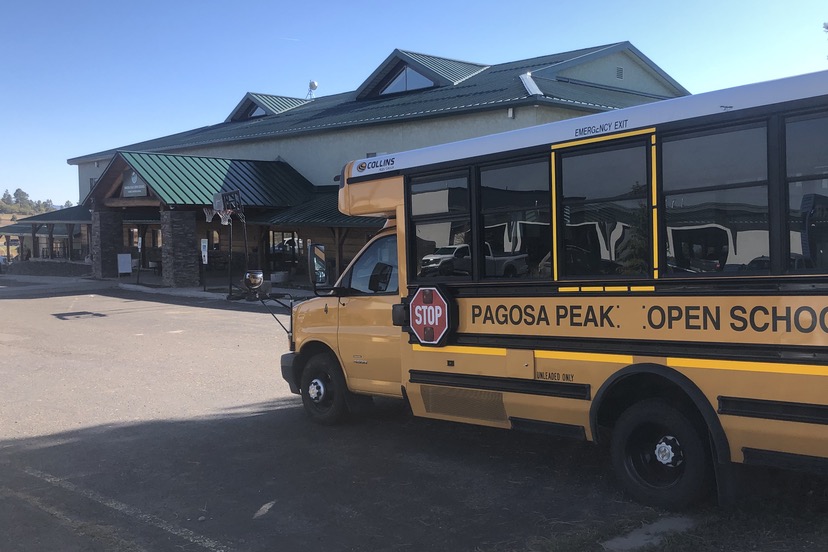
As mentioned yesterday, I currently serve as a volunteer on the Pagosa Peak Open School (PPOS) board of directors, and the ballot language unanimously approved by the Archuleta School District (ASD) Board of Education on Tuesday mentions that some of the bond proceeds will benefit PPOS. PPOS is a public, tuition-free charter school authorized by ASD, and over the past 18 months, it’s been understood that PPOS would benefit in some fashion from a bond issue, if one were approved by the voters.
Here’s some of the ballot language:
SHALL ARCHULETA COUNTY SCHOOL DISTRICT NO. 50JT DEBT BE INCREASED BY UP TO $79,900,000, WITH A REPAYMENT COST OF UP TO $156,500,000, WITH THE INCREASE ТО ОСCUR ONLY IF THE DISTRICT RECEIVES A “BEST” GRANT AWARD FROM THE STATE OF COLORADO THAT DOESN’T HAVE TO BE REPAID, FOR THE PURPOSE OF PROVIDING A HIGH-QUALITY LEARNING ENVIRONMENT FOR STUDENTS, INCLUDING BUT NOT LIMITED TO,
• CONSTRUCTING AND EQUIPPING A NEW PK-8 SCHOOL THAT WILL IMPROVE SAFETY AND SECURITY WHILE MEETING THE EDUCATIONAL NEEDS OF OUR STUDENTS
• PROVIDING FUNDING TO PAGOSA PEAK OPEN SCHOOL TO UPDATE AND EQUIP EDUCATIONAL FACILITIES FOR STUDENTS
You can download the full School Board resolution here.
The ballot language doesn’t specify exactly how much PPOS would receive, but the number I’ve heard at School Board meetings is $1.7 million. This amount would go a long way toward converting and upgrading a warehouse space in the former Parelli Natural Horsemanship office building where PPOS now serves about 140 K-8 students. In spite of operating in a former office building, PPOS has seen a steady increase in enrollment, year after year, which has not necessarily been the case with ASD as a whole.
One of the main questions many voters have about the proposed property tax increase is, of course: “What will it cost me?”
In the ASD press release shared in the Daily Post on Wednesday, a dollar figure was suggested:
The estimated property tax impact of the bond is approximately $5.15 per month for every $100,000 of a home’s actual value…
I find this number interesting. For one thing, it doesn’t appear in the ballot language. And for another thing, it’s a bit tricky to figure out an exact cost for a building that has not yet been designed, and bonds that have not yet been sold.
But since many people pay their property tax annually, we can take ASD’s suggested figure and apply it to some typical home values.
Annual property tax increase for a home valued at:
$300,000 home: $185
$600,000 home: $370
$900,000 home: $556
As we know, commercial properties in Colorado pay a property tax rate four times the residential rate. This suggests that a $1.2 million motel property, for example, would see an annual tax increase of perhaps $2,970.
We also know that Short-Term Rentals are assessed in Colorado as “residential”. So a $1.2 million STR would pay only $742 annually in increased taxes.
If the District had said “approximately $5.00” we would understand that this was a rough number. But when we’re given a number down to the exact penny — “$5.15” — we could easily be led to believe that this is a fairly “exact” figure.
Knowing that governments occasionally get their numbers wrong, I reached out to ASD staff to find out what formula was used to calculate this number. The response was:
The short version is that there are a number of ways to structure the debt that can impact the rate and the term, as well as, how the BEST grant may be structured (COP or cash), all of which play a role in determining the impact on property taxes. That leaves us with a range of possible rates/100K/month. The $5.15 is the midpoint of that range…
If I’m eventually able to learn what the “range” might be, I’ll be sure to share that information, so we can all have a better idea what we might be getting ourselves into. But until we have a more accurate figure, the ‘Citizens for ASD’ campaign committee will presumably be sharing the “$5.15 per month” figure with potential voters.
If the voters approve this property tax increase on November 3, then ASD will apply to the Colorado Department of Education for a BEST (“Building Excellent Schools Today”) grant next winter, and will hear about a possible award in May 2027.
If a grant is awarded, ASD’s financial consultants would begin negotiating to sell the bonds on the bond market.
We don’t currently know what interest rate the taxpayers would be paying to the bond holders. That would depend on the state of the national economy, summer of 2027… and that interest rate will determine how much of the money can be used for actual building construction, and how much gets paid out in interest payments. According to the adopted ballot language, there’s a fixed cap on the total tax increase.
$6.7 million per year.
…AND SHALL DISTRICT TAXES BE INCREASED BY UP TO $6,700,000 ANNUALLY TO REPAY THIS DEBT…
I presume this property tax increase would kick in, in January 2028. But don’t quote me.
If the voters do not approve the tax increase… or if ASD does not win a BEST grant… then the District will have to head back to the drawing board.
Read Part Three… on Monday…