
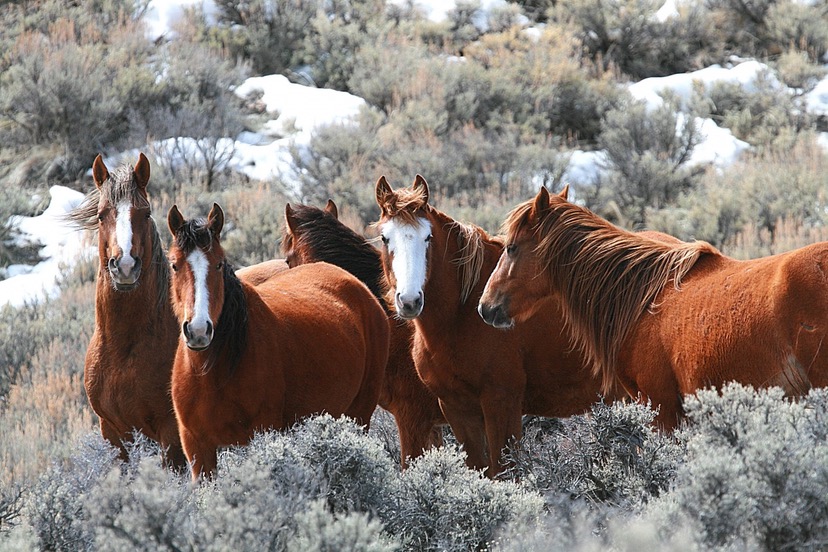
For more than a decade, William Simpson has lived immersed in the world of America’s free-roaming wild horses at our ranch in the Siskiyou Mountains, with me joining him for the past 6 years. What began as a personal connection to these magnificent animals has grown into a shared mission: protecting them as native keystone species whose natural grazing provides critical wildfire fuel mitigation as well as restoring our wildfire-ravaged landscapes.
As someone with Cherokee-Choctaw heritage, I see the deep spiritual and cultural resonance these horses hold for many Indigenous peoples. That connection feels especially urgent when I read the reporting by San Francisco Chronicle journalist Kurtis Alexander. Article after article frames wild horses not as vital parts of the ecosystem and living cultural heritage, but as problems to be managed — often through costly and disruptive roundups.
This isn’t balanced journalism. It’s a pattern of scapegoating that overlooks science, history, Indigenous perspectives, and the urgent public health stakes.
The Pattern in Alexander’s Coverage
In his June 25, 2026, piece, “Wild horses overwhelmed a California landmark. The feds are about to round them up,” Alexander details plans to remove hundreds of horses from the Montgomery Pass Herd area near Mono Lake. The story emphasizes trampling of meadows, springs, wetlands, tufa formations, manure issues, and road hazards. Earlier articles (2022–2023) covered the herd’s westward expansion, mysterious deaths, and “problems” for tourism and other wildlife. In 2024, he highlighted wild horses as a “new problem” for the Klamath River dam removal project.
These stories quote land managers and local groups, effectively painting a picture of overpopulation and conflict. They acknowledge the cultural appeal of mustangs but quickly pivot to the need for helicopter gathers and off-site holding.
What’s consistently missing? A full examination of wild horses’ ecological benefits, the failures of current management approaches, the broader context of land use—and the profound cultural significance these animals hold for Indigenous communities whose ancestral lands the Montgomery Pass horses roam.
Indigenous Connections and Cultural Significance
The free-roaming wild horses of the Montgomery Pass Herd (often associated with the Mono Lake area) carry deep cultural and spiritual importance for local Tribal nations, including the Utu Utu Gwaitu Benton Paiute and other Paiute and Shoshone peoples. These horses are not recent arrivals; they are living symbols tied to ancestral homelands, traditional knowledge, and ways of life. Indigenous leaders have actively opposed mass removals, advocating instead for tribal co-management approaches that honor cultural connections while supporting ecosystem health.
As a woman of Cherokee-Choctaw descent, I recognize this as part of a broader story: horses transformed and enriched Indigenous cultures across the continent, becoming central to mobility, ceremony, hunting, and resilience. Scapegoating these animals in media coverage disrespects that living heritage and the sovereignty of Tribal nations who seek a voice in their stewardship.
Livestock Prioritization and the Policy Shift Threatening Wild Horses
This one-sided framing becomes even more troubling against the backdrop of a new U.S. Forest Service memorandum (June 2026) that explicitly retools agency priorities to serve the livestock industry. The memo directs officials to expand grazing, restore hundreds of thousands of Animal Unit Months (AUMs), implement a “no net loss” policy for livestock permits, fast-track approvals, and reduce barriers for ranchers—while promoting “ranch immersion” training so employees better “serve” permittees as their primary constituents.
Recent BLM Bishop Field Office data underscores the imbalance: Allotments overlapping Montgomery Pass and Mono Lake horse range carry approximately 11,696 active (non-suspended) AUMs — the vast majority for cattle. This represents substantial authorized livestock pressure in the very areas where wild horses are scapegoated for habitat impacts.
For the Montgomery Pass herd, this policy shift signals heightened risk. The Forest Service (Inyo National Forest) is already moving forward with a major roundup starting July 8. Under a livestock-first framework, “excess” horses outside the designated territory become easier targets for removal, with less emphasis on cumulative impacts from cattle grazing, drought, or recreation. Across the Western U.S., this approach threatens free-roaming herds by prioritizing AUM allocations for domestic livestock over natural grazing by native equids — undermining wildfire mitigation, biodiversity, and cultural values.
True ecosystem challenges around Mono Lake and similar areas stem from multiple pressures — not horses alone. Yet Alexander’s reporting provides only superficial context on these broader factors, keeping the primary focus on horses as the central problem.
The Deadly Toll of Wildfire Smoke—and Horses as a Solution
The human cost of intensified wildfires cannot be ignored. A landmark UCLA study published in Science Advances (2024) found that exposure to wildfire smoke’s fine particulate matter (PM2.5) contributed to an estimated 52,500 to 55,700 premature deaths in California from 2008 to 2018 alone — roughly 4,800 to 5,000 deaths per year on average. In peak fire years, the toll exceeded 10,000. The associated economic impact reached $432–456 billion. Projections indicate this crisis will worsen without meaningful prevention.
Recent research on the 2025 Los Angeles wildfires further underscores the toxic burden. A study published in Environmental Science & Technology Letters (American Chemical Society) by Yuan Yao, Diane Garcia-Gonzales, Jing Li, Yifang Zhu, and colleagues details significantly elevated indoor and outdoor volatile organic compounds (VOCs) during and after the fires, highlighting persistent hazardous smoke components that threaten respiratory and overall health long after flames subside.
This is deeply personal for us. In 2019, William’s wife Laura passed from an autoimmune reaction triggered by toxins in the smoke of the 2018 Klamathon Fire. William himself sustained permanent lung and vocal damage while serving as a CALFIRE volunteer advisor on the fire lines for nine days. He documented how areas grazed by the wild horses created multiple thousand-acre natural firebreaks. These reduced fire intensity zones, enabled CALFIRE to establish a command station, and helped stop the 2018 Klamathon Fire from advancing into the Siskiyou Mountains, protecting lives, property, and ecosystems.
Free-roaming wild horses offer a natural, low-cost tool for mitigation. William’s 25,000+ hours of immersive ethological study (using Jane Goodall’s methods) has shown how these animals act as keystone herbivores. One horse consumes about 5.5 tons of flammable vegetation per year. By grazing fine fuels like grasses and brush—often more effectively than cattle in steep, rugged, and difficult terrain that cattle tend to avoid, and by consuming lower-quality forage that cattle typically reject—they create natural firebreaks, reduce fuel loads, and help prevent the megafires that poison our air.
Their grazing sequesters carbon in soils rather than releasing it as toxic smoke. Studies on large herbivores, including rewilding projects, confirm they lower wildfire frequency and severity while supporting biodiversity. Restoring and protecting herds like Montgomery Pass isn’t just about ecology — it’s a public health and cultural imperative.
The Bigger Picture: Policy, Science, and Solutions
This week, the Utu Utu Gwaitu Paiute Tribe of the Benton Paiute Reservation (along with Chairman Shane Saulque and cultural monitor Ronda Kauk, affiliated with the Mono Lake Kootzaduka’a Tribe) filed a lawsuit in the U.S. District Court for the Eastern District of California against the Department of the Interior, BLM, U.S. Forest Service, and officials. The action seeks a Temporary Restraining Order to halt the planned removal of ~624 wild horses (about 90% of the herd) starting July 8, 2026. Key allegations include failure to complete required government-to-government consultation, inadequate identification of sacred sites/cultural resources, and insufficient assessment of impacts (including helicopter operations) on ancestral lands.
William has provided strategic pointers and background support to both the Utu Utu Gwaitu Paiute Tribe and Indigenous Wild Horse Society in this latest action — drawing on his decades of experience with wild horse ecology, land management, and federal agency interactions. Attorney Stephanie Sherman, who represents the Indigenous Wild Horse Society, reached out to William in multiple conversations for guidance as she prepared this important legal action. These individuals and groups reached out to William because of Wild Horse Fire Brigade’s proven success in suing and halting the Pokegama HMA roundup (a landmark case that resulted in a settlement protecting the herd), along with his extensive herd management expertise and long-term observational data. His contributions helped strengthen the legal and ecological arguments to improve chances of success. This Indigenous-led effort underscores the horses’ profound cultural and spiritual significance. We at Wild Horse Fire Brigade wish the Tribe, Chairman Saulque, Ronda Kauk, Stephanie Sherman, and all involved the very best of luck in this critical lawsuit. It reinforces the urgent need for Tribal co-management and science-based, humane approaches.
The 1971 Wild Free-Roaming Horses and Burros Act recognized these animals’ place on the land. True management should prioritize natural behaviors, genetic diversity, ecosystem roles, and Indigenous leadership over blanket removal.
At Wild Horse Fire Brigade, we advocate for rewilding pilots, ending practices that disrupt family bands (such as PZP fertility control), and scaling proven grazing strategies that work with nature.
William’s research before, during, and after the Klamathon Fire inspired our nonprofit’s “Natural Wildfire Abatement” plan. Horses aren’t the enemy—they’re allies in addressing climate-driven megafires, smoke-related illness, habitat loss, and cultural preservation.
A Call for Better Journalism and Better Policy
We urge Kurtis Alexander and the San Francisco Chronicle to present a more complete picture: one that includes Indigenous voices and leadership (including this latest Tribal lawsuit), primary scientific observation, the public health data from the UCLA study and the 2025 LA Wildfires VOC research, official grazing data showing livestock pressure, and the potential of wild horses as wildfire mitigators and cultural carriers. Readers deserve nuance, not narratives that scapegoat one of the West’s most iconic and spiritually significant species.
If you care about wildfire resilience, clean air, cultural respect, and preserving our natural heritage, join us. Support evidence-based advocacy, uplift Tribal co-management efforts, contact your representatives about BLM reforms, and share stories from the land itself. Follow Wild Horse Fire Brigade for updates, research, and ways to get involved.
The Spirit Horses have much to teach us — if we’re willing to listen.
Michelle Gough serves as Treasurer and Executive Board member for Wild Horse Fire Brigade, a 501(c)(3) nonprofit dedicated to natural wildfire abatement through wild horse conservation. She works alongside William E. Simpson II, drawing on her background in medicine and Indigenous perspectives.