

Photo: Masters Place condominiums.
“Across the country, we see governors, mayors, and local leaders stepping up with creative solutions to expand supply, and support vulnerable households…”
— Chris Herbert, managing director of Harvard’s Joint Center for Housing Studies, quoted in ‘What We Know About the State of American Housing’ by Carl Smith, on Governing.com, July 2, 2026.
Very few members of the public attended the special Town Council meeting on June 29, when the Council approved three Ordinances aimed at getting the Town government more deeply involved in the housing crisis.
More about that in a moment.
I concluded Part Three of this editorial series, on Thursday, by noting that the Town of Pagosa Springs commissioned a professional analysis of vacation rental impacts on the community’s housing market. The Short-Term Rental (STR) industry has exploded in Archuleta County over the past decade, with investors and second-home owners converting perhaps 1,000 residential homes and condos into mini-motels.
There are only about 9,000 homes, total, in Archuleta County, so this conversion pattern represents more than 10% of all available homes.
The Town government has made new rules to discourage further conversions within the town limits, and the Root Policy study in 2022 subsequently determined that the negative financial impact on Pagosa’s housing market was “$2,687” per STR. The idea here was to calculate a realistic, defensible impact fee that could be defended in court, knowing that certain STR owners have a history of suing the Town government.
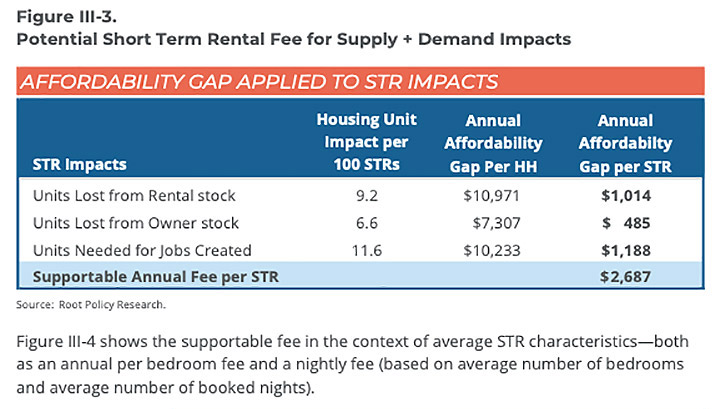
Rather than collect the full impact fee, the Town Council set the impact fee at $500 annually. That generates about $50,000 a year to be used to address the community’s housing crisis.
$50,000 is, realistically, a drop in the bucket. Considering the size of the problem.
However, 90% of the community’s STRs are located outside the town limits, in the unincorporated county. The County government has taken almost no actions to control the proliferation of STRs, nor has the County government sought to define the negative financial impacts of STRs. A couple of years ago, the County convened a ‘work group’ to study the best ways to control the impacts from STRs, but nearly everyone on the committee had connections to the industry and the final report basically suggested that the County allow the STR industry to continue running roughshod over the housing market.
At one point, the Archuleta County Planning Department had developed suggested steps to address the damage caused by the STR industry, but following a series of firings and resignations at the Planning Department last summer, nothing has been done with those policy suggestions.
I also mentioned, in Part Four, the report delivered to the Town government by some consultants from Smart Growth America, explaining that the way Archuleta County has been growing has been the opposite of “smart”. The suburban sprawl pattern of development, here, seemed harmless at first, but more recently has appeared less and less sustainable, as our local infrastructure slowly ages and deteriorates, and as housing has become unattainable for newcomers to the community.
Of course, the report was coming from the perspective that “growth” can indeed be “smart”. The basic idea for a sustainable community: outlaw urban sprawl and increase residential density.
Many American communities are taking just such an approach. Archuleta County is not among them. Archuleta County has been applying little band-aids to a gushing wound.
So… back to that June 29 Town Council meeting…
One positive outcome from the COVID crisis has been an increased effort by local governments to televise their public meetings, and to allow the public to attend the meetings via Zoom. I personally prefer to attend government meetings in person, whenever possible, but wasn’t able to attend the Town Council meeting last Monday.
The video of the meeting has been posted, however, on the Town website. You can watch it here.
From the June 29 agenda:
1. Ordinance 1030 (Series 2026), Second Reading, An Ordinance Authorizing the Acquisition of Real Property known as Masters Place Condominiums in Pagosa Springs, Colorado
2. Ordinance 1031 (Series 2026), Second Reading, An Ordinance Authorizing the Acquisition of Real Property known as Village Point Condominiums in Pagosa Springs, Colorado
3. Ordinance 1032 (Series 2026), Second Reading, An Ordinance Authorizing the Acquisition of Real Property known as Elk Run Townhomes in Pagosa Springs, Colorado

I’ve often reminded the Town Council — during public comment — that for the past several years, one of the top ‘priorities’ in the Council’s adopted goals has been workforce and affordable housing. But the Council has had other priorities. As it turns out, governments often choose their priorities based on what state and federal grants might be available — rather than basing their priorities on the most serious problems. This has typically been the case with the Town Council. Recently, when a big federal grant opportunity arose that might allow the Town to purchase 300 acres of undeveloped forest near downtown, the Council jumped at the opportunity.
Now, a rather different opportunity has presented itself, and the current Council voted unanimously on June 29 in favor of entering into an auction for three timeshare complexes located near Village Lake. As I understand it, this opportunity does not have any grant funding attached to it, but it does align with one of the Council top priorities.
The Town will enter then auction for these three housing complexes as the ‘stalking horse’ bidder, with the following bids:
Masters Place, $2,376,000
Village Pointe, $4,721,472
Elk Run Townhomes, $2,432,700
As mentioned in a previous Daily Post editorial, the Town does not have $9.5 million allocated in its budget for these three potential purchases. But someone has advised the Council that they can move ahead with the purchases, regardless. I assume the person advising the Council is the Town Attorney?
Before the Council voted unanimously to move ahead with these three auction bids, Mayor Shari Pierce opened the floor to public comment.
As noted previously, very few members of the public had attended this special meeting. But two local citizens did step up to the microphone during public comment, to question whether the Council truly understood what they were getting into…