
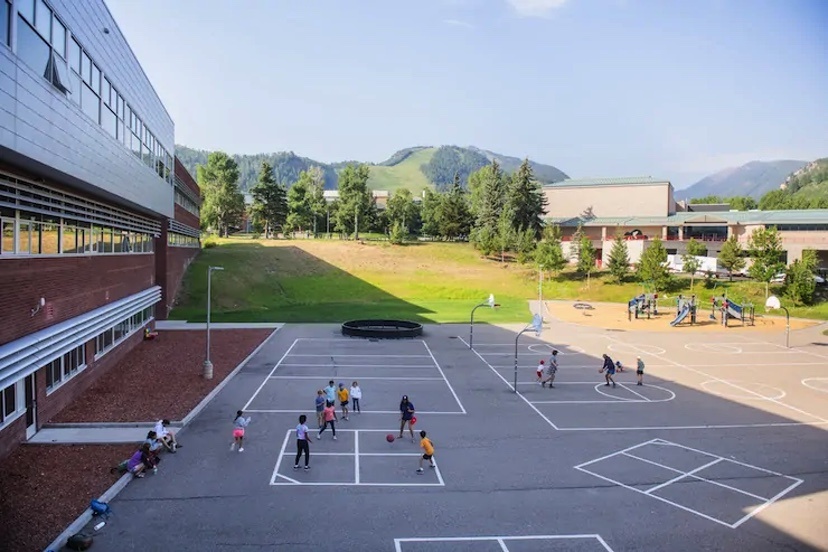
Photo: Ground-source heat pumps could be used to melt snow at the Aspen schools campus. Photo/Kelsey Brunner
This story by Allen Best was published on BigPivots.com on August 29, 2025, and was written in consultation with Aspen Journalism. We are sharing it in two parts.
In a town best known for snow and its mountain backdrops, Joe Waneka has what might seem an odd problem to solve. As director of operations for the Aspen School District, he is tasked, in part, with keeping the 1,600 students enrolled in the district’s elementary, middle and high schools cool enough so that heat does not preclude learning.
That has become more of an issue on the 32-acre campus set amid the rolling terrain where Maroon Creek hurries toward the valley floor. Part of the reason is Colorado’s mid-August return to schools. Summers have been warming, too.
And then there is the smoke from wildfires.
Since students returned to classes, temperatures on the hottest days have reached 78 degrees inside the buildings. “That is their tipping point, if you will, when they start thinking more about getting comfortable than teaching or learning,” he said. “By 80 degrees, you are overwhelmed.”
Open the windows at night and let in some fresh mountain air? It helps until past noon. It does not help at all if wildfires have made the air unhealthy. On August 14, the second day of school this year, the district announced it was making KN95 masks available to all who wanted them after nearby wildfires turned local skies hazy.
The middle school has central air conditioning. The elementary and high schools have 68 portable air-conditioning wall units, all of them noisy and cumbersome. Waneka describes them as Band-Aids. A better solution is needed.
In November, Waneka began investigating potential remedies. Conventional chiller units could be added but would add an extra $100,000 to $125,000 per building in electricity costs.
By March, Waneka had narrowed his focus to geothermal, to tap the underground for both coolness and heat. This would comport with the school district’s strategic plan, which calls for students and staff to have access to “sustainable energy.”
Burning natural gas at the three schools and two associated buildings and the use of snowmelt systems produce 235,000 therms of energy heat annually, according to a report by The GreyEdge Group, a Utah-based consultant that specializes in geothermal energy networks. Greenhouse gas emissions produced are comparable to burning almost seven railcars of coal, according to an Environmental Protection Agency calculator.
Two grants have assisted the school district in exploring the feasibility of creating a well field and retrofitting the buildings. In June, the Colorado Energy Office announced a grant of $78,400, one of five dozen geothermal grants distributed across Colorado in a $12 million program approved by state legislators in 2023. More recently, the Community Office for Resource Efficiency awarded the district a $50,000 grant.
Even before receiving the grants, the school district hired The GreyEdge Group to evaluate a geothermal ambient temperature loop. The report delivered by the company in June estimated that a loop system could reduce annual heating-related emissions 92%.
A test bore may yet be drilled this fall. The drilling would take three days. Cost is estimated at roughly $75,000. Three potential locations on the campus have been established. Test bores — a requirement of the state grant — provide information about soil composition and underground thermal characteristics. This informs decisions about design of the full well field. Scores of closely spaced wells would probably be needed.
If successful, this thermal energy network would provide heat and cooling for up to 600,000 square feet. That includes the schools and other buildings, along with 30,000 square feet of future buildings and 157,000 square feet of athletic fields and the track.
This technology has been deployed with great success elsewhere in Colorado and other states, and many more systems are planned.
Three miles from the schools, two test bores have already been drilled for what is being called Aspen Airport Business Center Thermal Energy Network. Aided by a $250,000 grant from the Colorado Energy Office, Pitkin County is exploring how to integrate a microgrid with a heating district to reduce energy loads at the airport as well as the Pitkin County Public Works and Roaring Fork Transportation Authority facilities.
At his office in the basement of Aspen High School, Waneka said he was not content to go with easier off-the-shelf solutions to the cooling needs at the schools. Exploring options might produce a truly sustainable energy system and reduce fuel costs. “To me, it is foolish not to explore,” he said.
A mature technology
Geothermal systems exploit the relatively constant temperatures found underground. Geo-exchange, one of several geothermal technologies, uses electric pumps to extract that heat or coolness as needed in the buildings. The process is similar to that used by refrigerators.
Many schools across Colorado already use geo-exchange technology, as does the governor’s mansion in Denver and the state Capitol.
The Poudre School District first used geo-exchange in 2002 at an operations building in Fort Collins. It used the same technology in a school in 2004 and again recently at three new schools in Loveland, in Timnath and in Wellington.
Grand Junction has Colorado’s most prominent use of geothermal. Officials at Colorado Mesa University in 2008 pulled the trigger on a geo-exchange system that now provides heating and cooling for 1.2 million square feet of space contained within 16 campus buildings. The success has drawn national attention.
University officials say the geo-exchange pipes under soccer fields and other open spaces on the campus coupled with other cost-savings measures and efficiencies enable them to save $1.5 million annually in utility costs. This, they say, allows Colorado Mesa to charge the third-lowest combined tuition and fee rate among Colorado’s 12 public colleges and universities.
A thermal energy network connects multiple buildings through a common geo-exchange system. Pagosa Springs has had such a system for 33 customers in its downtown buildings since 1982. Of course, it has hot springs nearby.
No need for hot springs, though. Ground temperatures everywhere rise the lower you go. In Colorado, wells for geo-exchange most commonly are sunk 300 to 500 feet.
Standard geo-exchange systems rely solely on pushing heat into and pulling heat from Earth as needed. The energy between the ground and the surface is transferred via recycling water.
At the campus, something more complex than a simple push-and-pull of underground energy from the underground is being investigated. Aspen’s climate is part of the story.
Allen Best publishes the e-journal Big Pivots, which chronicles the energy transition in Colorado and beyond.