
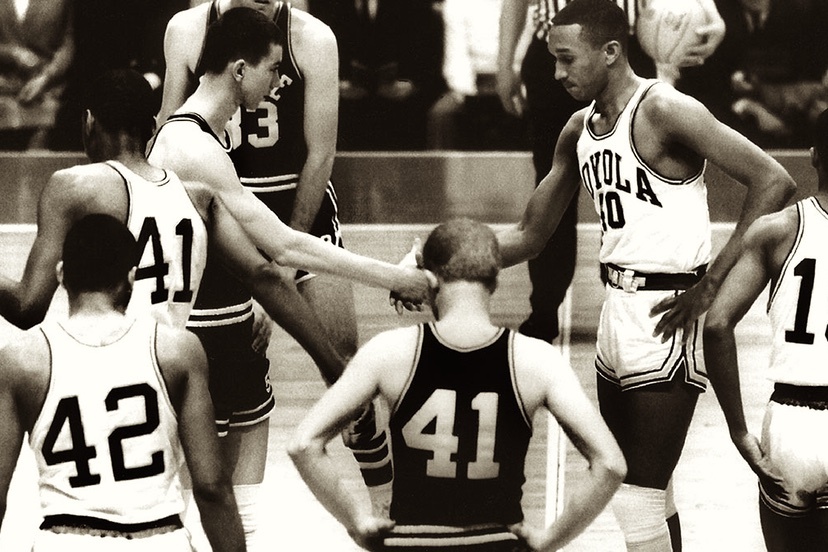
Perhaps one of the biggest games in March Madness history wasn’t a finals matchup. It didn’t have a last second shot. Many young people today aren’t aware of what happened in the game. Yet as you’ll see in this column, it mattered for more than just the NCAA. And the lessons from that game, and the courage of both teams, a college president and a coach, could teach us something in this country today.
Mississippi State University had a great basketball team in 1963. They won several conference titles before that year, but you didn’t see many NCAA Tournament banners hanging from the rafters. That’s because state politicians did what they could to stop MSU from playing any team with a nonwhite player, as part of their mania about anti-integration. This is just two years after Freedom Riders were attacked, and a year before three Civil Rights workers were abducted and killed in Mississippi, the subject of the movie “Mississippi Burning.”
“MSU President Dean W. Colvard made a public statement that the team be allowed to play. In response, he received angry letters and phone calls, and extra security guarded his home,” wrote Jerry Mitchell with Mississippi Today.
Colvard, the coach, and the team slipped out past the politicians, up to Michigan where they played Loyola, a Chicago powerhouse with African American players. And they did more than just play. “When Jerry Harkness extended his hand to Joe Dan Gold before the ball was tipped, the glare of the popping flashbulbs nearly blinded both men,” wrote Dana O’Neil with ESPN. “People understood then what was happening, what it meant that Gold, a white basketball player from Mississippi State, was shaking hands with Harkness, an African-American player from Loyola (Ill.) on a March day in 1963 in East Lansing, Michigan.”
Loyola won by ten and went on to win the entire tournament. But the win was more than just a title. It was called the “Game of Change” because people began to change the way they thought.
The abuse that President Colvard, Coach James “Babe” McCarthy, Athletic Director Wade Walker, as well as players, faced, including threatening letters from not just the KKK, but business leaders, some students, and even a long-time professor. You can read their letters and their telegrams, if you dare. Threats. Promises to withhold funding. “Don’t turn down a principle for a few boys to play a game or two of basketball,” one Western Union Telegram read. Washington, D.C, school integration has brought crime, hoodlooms (sp), and race mixing. Let’s hold the line as long as possible to keep Mississippi’s pure white Caucasian people.”
“Suppose our state teams then play…any other integrated team at their home,” a letter reads. “This calls for a return game on a home and home basis. Are you going to allow integrated teams to play in Starkville or Jackson? If so, where will the teams sleep and eat and so on?” Others claimed that “riots” would occur if the state’s teams played an integrated team, but the only riots we saw were when segregationists attempted to stop James Meredith tried to enroll at the University of Mississippi. Thankfully, the MSU students, as well as players, and others in the business community did not feel the same way.
Yet you hear some of those same ugly tones directed against athletes today in a myriad of situations, not much different from what was said in 1963. Let’s reject that hate, the way MSU did back then, and show we’re a united country, recognizing that every child is a child of God.