
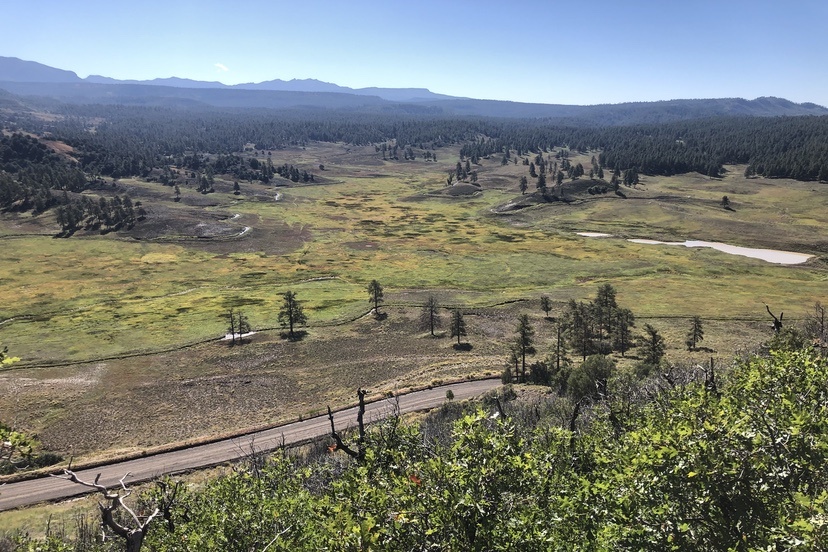
Photo: A view of the main meadow of the Running Iron Ranch from the western part of the property.
Feels like I’ve been writing editorials in the Daily Post about the controversial and improbable Dry Gulch Reservoir project for 20 years.
Actually, it’s been only 18 years… since a fateful meeting of the Archuleta Board of County Commissioners that green-lighted the subdivision of the Running Iron Ranch, waiving the necessity to follow the legal subdivision process. That decision by the BOCC facilitated the purchase of the Ranch for $10.2 million — which was probably twice what the property was actually worth on the open real estate market in 2008.
The customers of Pagosa Area Water and Sanitation District (PAWSD) have been paying the mortgage on that purchase ever since.
This is not to imply that PAWSD has any intention of using the property as a future reservoir site. The PAWSD Board of Directors determined, back in 2012, that the purchase was a mistake, and the current PAWSD Board agrees that it was a mistake.
But in 2008, the San Juan Water Conservancy District (SJWCD) provided a $1 million grant from the Colorado Water Conservation Board (CWCB) towards the Ranch purchase, and so became part-owner of the property. So PAWSD cannot easily sell the Ranch without SJWCD’s permission.
Disclosure: I currently serve as a volunteer Board member for PAWSD, but this editorial reflects only my own opinions, and not necessarily those of the PAWSD Board or PAWSD staff.
It appears that the tax-supported SJWCD will be spending about $142,000 on engineering studies this year, which includes a recently-received study of the reservoir project’s feasibility by Englewood, Colorado-based RJH Consultants. The 153-page feasibility study looked at two reservoir sizes — 11,000 acre-feet (about 12 times the capacity of Lake Hatcher) and 4,000 acre-feet (about five times the capacity of Lake Hatcher.)
Because the proposed site of the improbable reservoir on the Running Iron Ranch is wide and flat — unlike the best water reservoir sites, which are narrow and deep — the 4,000 acre-foot version looks nearly as large as the 11,000 acre-foot version, as shown on the RJH Consulting map:
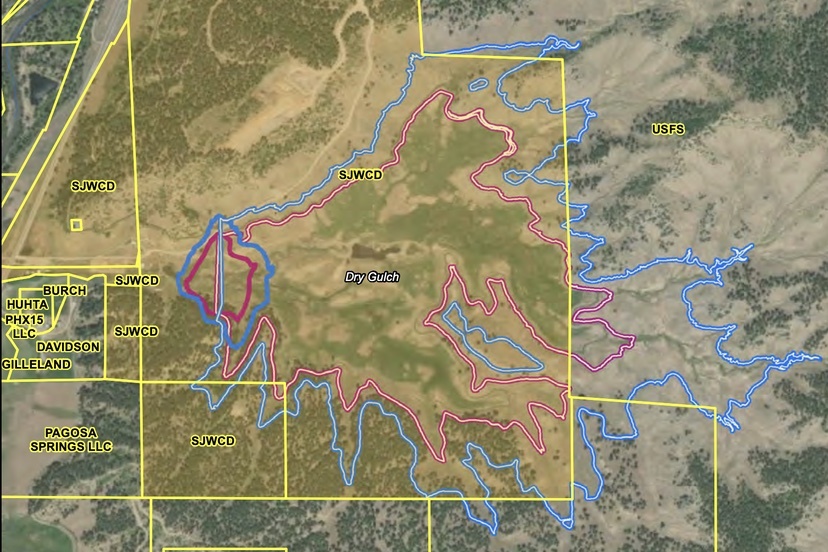
You can download a condensed version of of the feasibility study here.
Both versions of the reservoir as shown extended beyond the Running Iron Ranch. At this time, we have no indications from SJWCD that these neighboring property owners are willing to allow a future reservoir to encroach on their property.
One problem with a wide-and flat reservoir site: greatly increased evaporation losses.
As far as I can tell, the RJH feasibility study is very much a “preliminary” study. For example, on page 64, the consultants talk about “Next Steps”, and admit that they have not yet looked at a number of important factors related to the “feasibility” of the project… such as the amount of water that would evaporate from such a reservoir annually.
Another unanswered question is whether a new off-stream reservoir would even be allowed to extract water from the San Juan River — a tributary of the troubled Colorado River — under the Colorado River agreement currently causing discord among seven western states.
From the study, Next Steps:
Public Outreach
This task would involve engaging potential customers in the Pagosa Springs area and marketing the Project to potential stakeholders. At the onset of this phase, we would develop a detailed outreach package. These techniques are expected to include a combination of educational and informative activities, surveys, public meetings, user- friendly materials, branding, and various input and communication methods that can be easily used and shared both online and in-person. We would also develop branded materials to build trust and recognition of the Project and create a study-specific website. Several public events would likely be held to educate the stakeholders and public and to solicit input for future decision making.
Water Modeling
We would perform water resources modeling to better refine existing estimates of demands, inflows, storage volumes, evaporation losses, releases, and reliability under different conditions (average years, drought years, and climate-change scenarios). This modeling would show how often the reservoir would fill, how much water it could reliably supply, how frequently shortages might still occur, and support selection of an appropriate reservoir size. A key part of this study would be evaluating how the proposed reservoir would operate alongside existing water rights, downstream obligations, and environmental flow requirements.
Economic Analysis
This task would involve economic forecasting and modeling to better assess the overall financial viability of the Project. This would likely involve performing a benefit-cost analysis and a financial feasibility assessment. A benefit-cost analysis would compare the full range of long-term costs—such as construction, permitting, operation, and maintenance—against expected economic benefits from improved water reliability, drought resilience, fire protection, agricultural support, and recreation.
These consultant comments highlight just a few of the problems with the reservoir proposal, in the year 2026. Public outreach, for example.
Even though this project was first proposed as necessary and feasible in 2003… SJWCD has, to my knowledge, held only two “Public Outreach” events to explain the project to the taxpayers: one in 2009 when the project cost was first revealed… and one in 2017, when SJWCD was seeking a property tax increase. That proposed increase that was rejected by the voters by a 3-to-1 margin..
One explanation for the lack of public outreach might be that SJWCD still doesn’t know what they want to construct or how much it would cost.
SJWCD did, in fact, know what they wanted to build and how much it would cost, at the 2009 Public Outreach meeting. They wanted a 32,000 acre-foot reservoir project costing $357 million.
At that time, the SJWCD budget was about $40,000 a year. So obviously, SJWCD needed a partner with very deep pockets.
And at that time, SJWCD did indeed have a partner. PAWSD…. a water and sanitation district able to raise increased fees on its customers, without needing a public vote.
Read Part Four… tomorrow…