
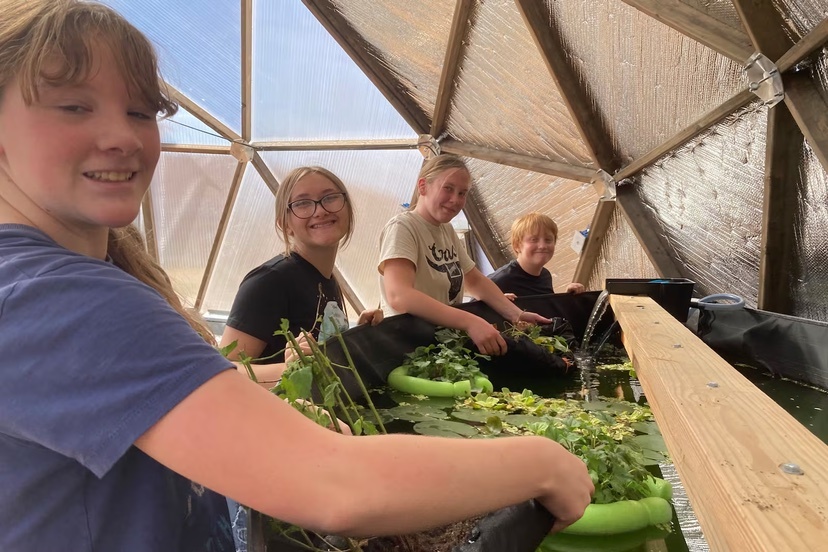
Photo: Sabra Sowell-Lovejoy’s students show off the pond in their dome greenhouse at Campo Undivided High School. (Courtesy of Sabra Sowell-Lovejoy)
This story by Ann Schimke appeared on Chalkbeat Colorado on March 17, 2026. Sign up for Chalkbeat Colorado’s free daily newsletter to get the latest reporting from us, plus curated news from other Colorado outlets, delivered to your inbox.
Do radishes belong in breakfast burritos? Do frozen pancakes taste good when they’re reheated? Will strawberry-topped yogurt cups with marshmallows, potato chip crunch, and chocolate drizzle win fans?
These are some of the questions students answer in Sabra Sowell-Lovejoy’s food production classes at Campo Undivided High School on Colorado’s Eastern Plains.
And here’s a question they asked: Can we grow rutabagas?
That came about when the root vegetable turned out to be a sleeper hit after Sowell-Lovejoy’s recent lesson on preparation techniques.
“None of the students had eaten a rutabaga before,” she said. “They loved them and asked us to start growing them so we could eat them in the cafeteria.”
The answer was yes.
Sowell-Lovejoy, a semifinalist for Colorado’s 2026 Teacher of the Year award, also teaches social studies and English to 5th through 12th graders in the rural 38-student Campo district. She talked to Chalkbeat about what experiments students run in the school’s dome greenhouse, how she covers water scarcity, and why students are brainstorming ideas for freezable breakfast foods.
This interview has been edited for length and clarity.
Was there a moment when you decided to become a teacher?
At the end of my undergraduate studies, my metal arts professor encouraged me to start teaching as an adjunct professor. Fifteen years later, the principal of my children’s school in New Mexico encouraged me to teach again. I was working as a part-time librarian while also teaching at the university. I reluctantly accepted, and now have a career that chose me — one that I wouldn’t change for anything.
How did your own experience in school influence your approach to teaching?
I went to school in Pawhuska, Oklahoma. Mr. Harban, my fifth grade teacher and seventh grade math teacher, and Mrs. Malloy, my sixth grade teacher, provided hands-on learning opportunities and clear in-class instruction.
We observed stars through large telescopes in the cold, participated in a mock voting process at a replica voting booth that our parents drove us to, and recreated Christmas traditions from various countries. I still remember those lessons vividly and aim to provide similar experiences to my students.
Tell us about a favorite lesson to teach.
Currently, I am teaching a civics lesson in which students examine the weaknesses of the Articles of Confederation and look at James Madison’s ideas for building a healthier democracy. Students debate the tension between majority rule and the tyranny of the majority. They determine whether the Virginia Plan and the “double-negative” proposal would work. The double negative was a proposal that would have given Congress the power to veto state laws and to exercise federal oversight over states. Ultimately, the Constitution was written after these debates, and the double negative was rejected.
Tell us about the Dome Project.
The dome greenhouse was a replacement for the previous student-built greenhouse, which blew away. It’s a little larger and taller than a two-car garage. We expanded our growing capacity by adding more grow boxes and a hydroponic system. Both shop class and food production students contributed designs for the boxes, and shop class students constructed them.
Inside the greenhouse, we have a pond featuring plants and experimental food crops, along with four koi fish that the students enjoy feeding. We have strawberries, lettuce, basil, dill, and some flowers growing in floating rafts. Students track the nutrient relationships with the various plants to see which performs well in the pond and at what temperatures.
We have different soil tests going for tomato plants, various peas, and lettuces. We are tracking whether the same lettuce grows faster or has a different taste when grown hydroponically versus in soil. We have also planted a few trees — lime, lemon, and cherry.
Tell us about the Farm-to-Freezer project.
We started the Farm-to-Freezer learning initiative to strengthen our Farm-to-School program. It’s funded by the Colorado Department of Education’s Harvest Innovation grant, and the purpose is to develop recipes so we can process produce in the summer and use it in breakfast items that can be frozen. That will allow the cafeteria staff to provide scratch-made food and local products year round rather than only during peak season.
Junior high and high school students are currently creating recipes that use our produce, comply with child nutrition guidelines, and will be taste-tested by students. We are currently working on carrot cake bars or muffins, as well as breakfast casseroles or burritos featuring peppers and onions.
The students have not found a food that they didn’t like yet. I challenge them to try some of my ideas, including radishes in the breakfast burritos and beets in their muffins.
Connecting students to local foods is a passion of yours. How do you get students interested?
Our program emphasizes the entire process of growing, producing, and consuming food. The produce we cultivate is selected by the students, focusing on their favorite items for the cafeteria salad bar. Classes take place in a room equipped with a hydroponic system, providing a relaxing environment filled with the soothing sound of flowing water and the presence of lush plants.
We host two major events each year. The first is Colorado Proud Meal Day, where the entire school works together to collect local foods, such as goat milk and harvested wheat. Throughout the day, we transform these ingredients into delicious meals, and the goat milk ice cream served on the playground in the afternoon is always a highlight.
The second event is our annual Campo Chopped competition. Junior high and high school students use the produce they’ve grown and the cooking techniques they’ve learned to create three dishes for the judges. Winning dishes include a chicken rice bowl with apple and turnip slaw, strawberry basil cake, and a crispy tortilla wrap with bell peppers, lettuce, carrots, and a dipping sauce.
What is something going on in the community that affects your students? How do you address it?
Our community is facing water scarcity. It’s a topic taught in food production and social studies classes. We study human-nature relationships and how they played out during the Dust Bowl, which hit our area hard. We also educate students about responsible water use for crops and livestock and the history of water rights in Colorado and the country.
Reducing food waste decreases the need for additional water to grow more food, so students learn to use parts of plants that are typically discarded. For example, after removing stems, skin, or leafy tops from vegetables, students will make vegetable stock to use for future cafeteria recipes such as chicken pot pie.
Ann Schimke is a senior reporter at Chalkbeat covering early childhood issues and early literacy. Contact Ann at aschimke@chalkbeat.org.
Chalkbeat is a nonprofit news site covering educational change in public schools.