
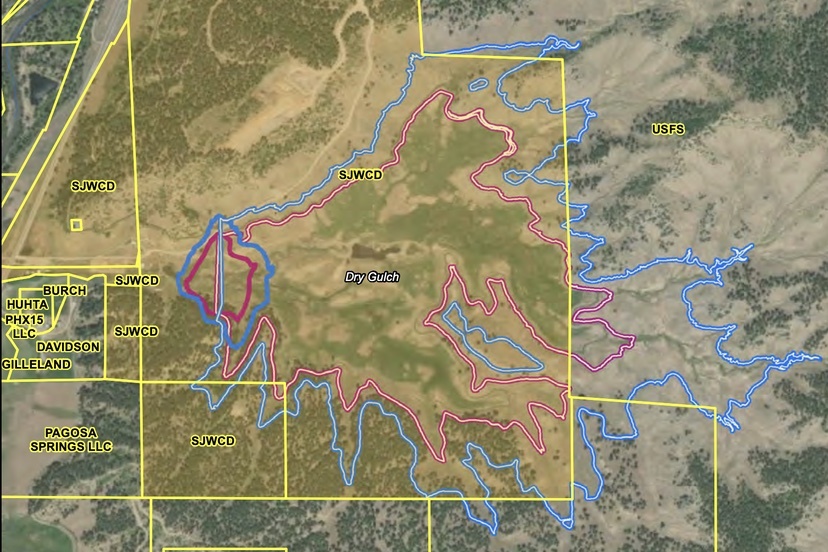
Image: Drawing by RJH Consultants of two potential reservoir sizes on, and extending beyond, the Running Iron Ranch, north of downtown Pagosa Springs. From the 2026 San Juan Headwaters Feasibility Study purchased by San Juan Water Conservancy District (SJWCD).
As mentioned in Part One, the Pagosa Area Water and Sanitation District (PAWSD) and the San Juan Water Conservancy District (SJWCD) have announced a “tentative” agreement, reached during a March 13 mediation process, that might eventually result in the settlement of a year-old lawsuit between the two districts. The agreement has been approved by both district boards of directors, but remains confidential due to its “tentative” nature. More negotiations are pending.
The lawsuit resulted from some ambiguous language in a three-way agreement between PAWSD, SJWCD, and the Colorado Water Conservation Board (CWCB) signed in 2016.
It appears that participation of the CWCB will be necessary to fully resolve the lawsuit.
Disclosure: I currently serve as a volunteer Board member for PAWSD, but this editorial reflects only my own opinions, and not necessarily those of the PAWSD Board or PAWSD staff.
Back in 2015, when John Hickenlooper was Colorado’s governor, the CWCB published a fairly massive study meant to establish the general direction of the state’s water policies: the Colorado Water Plan. The analysis was intended to outline basic water issues looking ahead to the year 2050.
The Plan was updated in 2023. You can download that 254-page document here.
Or you can download the 24-page Executive Summary here.
The word “Pagosa” appears only once in the full Colorado Water Plan document, on page 128:
The Pagosa Springs-Bayfield-Durango corridor is rapidly growing while experiencing areas of localized water shortages. This area is transitioning from oil and gas, mining, and agriculture to tourism and recreation, and to retirement or second-home communities.
Developing sufficient infrastructure to deliver municipal and industrial water where it is needed is a challenge. Existing reservoirs storing municipal and industrial water lack infrastructure to deliver water to treatment plants and distribution systems.
As with many documents, the information in the Colorado Water Plan is sometimes vague and sometimes outright misleading. For instance, the Pagosa Springs-Bayfield-Durango corridor is not “rapidly growing”. The growth rate in Pagosa Springs, over the past 10 years, has been less than 2%, and the community lost population between 2023 and 2024. Last year, the growth rate in La Plata County — home to Bayfield and Durango — was less than 1%.
For another thing, the development of sufficient infrastructure is certainly an issue on Durango, where a collection of government and tribal entities built a $500 million water reservoir — Lake Nighthorse — without including any pipelines to deliver the water to where it might be needed.
Here at home in Pagosa Springs, all of the PAWSD reservoirs are able to deliver raw water to the PAWSD system. Unfortunately, the District’s largest reservoir — Stevens Reservoir — currently delivers water to a very-expensive-to-operate treatment plant located on Lyn Avenue, instead of to a much more economical treatment plant at Lake Hatcher. PAWSD is currently developing engineering drawings to build a pipeline from Stevens to Hatcher, thus essentially tripling the raw water available to the District’s primary treatment plant.
The question of “infrastructure” pertains very clearly to the proposed Dry Gulch Reservoir that San Juan Water Conservancy District (SJWCD) Board wants to see built on the Running Iron Ranch — the 660-acre property north of downtown Pagosa, jointly owned by PAWSD and SJWCD.
If a reservoir were built there… how would the water be delivered? And to whom would it be delivered?
PAWSD is the primary provider of drinking water in Archuleta County, and recently tripled its treatment capacity at the Snowball Treatment Plant, the plant that serves downtown Pagosa Springs and the neighborhoods south on Highway 84. So those neighborhoods — the ones closest to the proposed Dry Gulch Reservoir — should have sufficient water for at least the next 50 years, if growth stays around 2%.
Without needing an expensive reservoir. Or so it would seem.
Meanwhile, it would also seem that PAWSD District 1 — basically, the Pagosa Lakes neighborhoods — also has sufficient reservoir storage for the next 50 years, if the Stevens-to-Hatcher pipeline is constructed as planned. District 1 will have even more water security if PAWSD is able to acquire additional water rights in the Pagosa Lakes area… and if population growth remains modest.
In the face of these ongoing water resource enhancements by PAWSD… the idea of building a pipeline from Dry Gulch, to pump water 500 feet uphill to the Pagosa Lakes area, might strike some of us as mildly insane. But of course, we are talking about governments funded by taxes. So some level of insanity is to be expected.
The map at the top of today’s installment appeared in the 2026 San Juan Headwaters Feasibility Study written by Englewood, Colorado-based RJH Consultants. Here’s that map again:
You can download a condensed version of the feasibility study here.
One thing you might notice on this map: RJH Consultants have indicated the outline of an 11,000 acre-foot reservoir with a light blue line. This is the size reservoir SJWCD has been pursuing since 2011. RJH also indicated a smaller 4,000 acre-foot reservoir, shown with a pink line. (The darker blue indicates the dam footprint for the larger size reservoir; the magenta shape is the dam footprint for the smaller reservoir.)
Another thing you might notice. Neither of these reservoirs actually fits on the Running Iron Ranch — the area tinted in yellow. The larger reservoir would encroach on private property as well as U.S. Forest Service property. The smaller reservoir spills onto USFS property.
According to their 2026 budget, it appears that SJWCD plans to spend up to $142,000 of their taxpayer revenues on engineering studies, this year, planning for a reservoir that doesn’t fit on the property they jointly own with PAWSD.
Read Part Three… tomorrow…