

Photo: Colorado Division of Housing Meeting in Pagosa Springs, May 20, 2025.
Back in March 2021, during the COVID crisis, I wrote a rather lengthy ‘State of the Community’ editorial, in which I proposed the idea of a “conceptual map” of Pagosa Springs — looking at some of the factors that define life in this rural resort community. About halfway through the article series, I mentioned a story from the weekly Pagosa Springs SUN, reporting on a presentation by Laura Lewis Marchino, Region 9’s executive director. A couple of quotes from that 2021 SUN article:
The median home price in Archuleta County for 2020 was $410,000, according to Marchino’s presentation. With a 30-year fixed mortgage loan that has a 3 percent interest rate with a 10 percent down payment on the house, buyers would need to be making at least $75,994 per year to qualify for a mortgage loan, as Marchino explained.
“We have almost 70 percent of families who can not afford to even buy a home in Archuleta County,” Marchino added…
Marchino added that, “None of our average teacher salaries is enough for them to purchase a home” across the entire Region 9 district.
“We are not affordable for some of the quality-of-life job sectors: law enforcement, teachers, etc.,” Marchino said…
Ms. Lewis Marchino mention the idea of a “livable wage” — the wage that allows a worker to make their house payment, put food on the table, buy shoes from their children, pay for medical checkups, cover their utility bills, make their car payment… without going even deeper in debt on credit cards, and taking out loans.
We can’t easily create a map of consumer debt, or even business debt, in Archuleta County in 2021. Some information sources tracking debt nationally, and note that consumer debt has increased. From a December 2025 article by Felix Richter, “U.S. Household Debt: A Rising Tide”.
According to the New York Fed’s Quarterly Report on Household Debt and Credit, total household debt in the United States grew by $197 billion in the third quarter of 2025, bringing the total debt balance to an all-time high of $18.6 trillion. The increase was mainly driven by mortgage, credit card and student loan balances…
I had specifically mentioned student debt in my 2021 editorial, and had included the following graph:
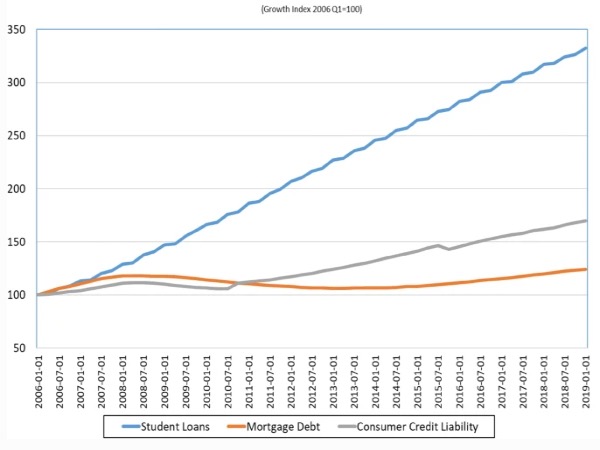
Between 2006 and 2019, the wages that a college graduate earned remained relatively static in the U.S. While the average cost of a four-year degree doubled to $104,000 (inflation adjusted) between 1990 and 2016, real median wages barely increased… going from $54,000 to $59,000.
Meanwhile, many jobs that didn’t require a college degree in 1990 now demand one.
The national average balance of federal student loan borrowers is about $35,200, according to a recent article on Forbes.com
In a certain sense, this data ties in with the Board of County Commissioners work session discussion I mentioned yesterday in Part Ten, although we might not perceive a connection between student debt and the Colorado Wildfire Resiliency Code (CWRC) that Archuleta County will adopt next month. The CWRC will presumably make housing even more expensive in Colorado, and serve as an additional barrier for young people.
This will, in turn, have certain effects on social conditions in Archuleta County. When a young person leaves college with $35,000 in student debt, they are probably likely to end up in an urban area where a wide range of job opportunities exist, and less likely to move to a rural community — like Pagosa Springs — where so many of the jobs pay low wages and where “almost 70 percent of families can not afford to even buy a home…” to quote Ms. Marchino.
If a young person burdened with student debt happens to locate here, they are likely to delay marriage and be less likely to start a family.
This might help explain why the average age in Archuleta County is now 52 years, compared to Colorado as a whole, at about 38 years.
At the rate we are going, many holders of student debt will reach Social Security age still owing… in some cases with their principal untouched… and many will learn to see themselves as victims in an elaborate con, in which the U.S. Department of Education has helped to arrange escalating profits, first for private banks and loan services, but more particularly for colleges and universities… on the shoulders of our nation’s less-than-financially-savvy young people.
From an article by Steven Deller and Jackson Parr, published in the International Journal of Community Well-Being in January 2021:
Using tax return data from the Internal Revenue Service (IRS) we find that higher levels of student debt tends to be associated with lower levels of community well-being. Specifically, lower rates of home ownership, higher rental market stress, lower rates of entrepreneurship and poor health behaviors…
The Pagosa Area Water and Sanitation District (PAWSD) Board of Directors will be meeting today at 5pm, and one of the agenda items refers to the waiver of fees for workforce and affordable housing.
In a somewhat unusual move, the Archuleta Board of County Commissioners have ‘noticed’ the PAWSD meeting on their calendar, meaning that — in line with the Colorado Open Meetings Law — all three commissioners will be able to attend the meeting, and discuss County business. That ‘business’ is specifically the BOCC effort, over the past several years, to encourage the creation of workforce and affordable housing.
Disclosure: I currently serve as a volunteer Board member for the Pagosa Area Water and Sanitation District (PAWSD), but this editorial reflects only my own opinions, and not necessarily those of the PAWSD Board or PAWSD staff.
I will be curious to see how that meeting plays out. Being that I will be a participant…
Read Part Twelve… tomorrow…