
Some of the solutions proposed for the challenges in Archuleta County come from people who may have never visited Archuleta County — in fact, from people who may not know exactly where Archuleta County is located. I’m referring to the legislators serving in the Colorado General Assembly, which meets in Denver January through May every year.
Two of these challenges are facing the state as a whole, and in particular, Archuleta County:
Wildfires
The Housing Crisis
These two challenges are related in a complicated and somewhat unpleasant manner.
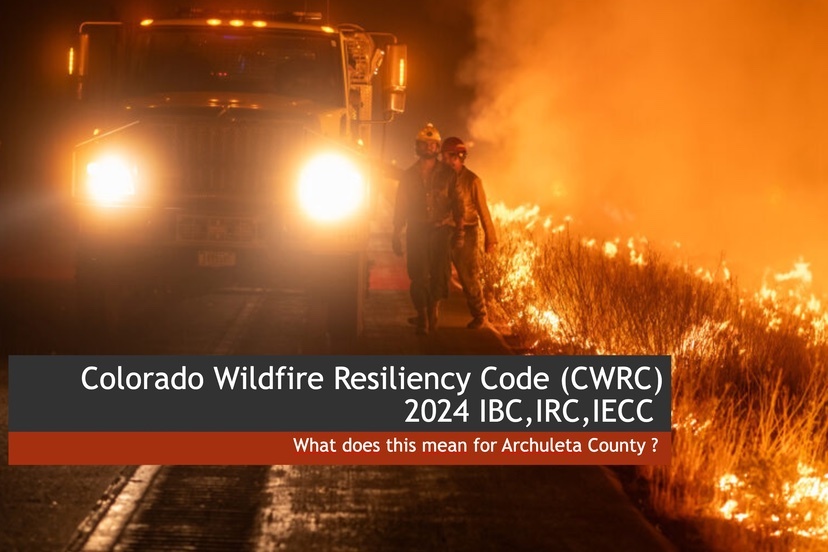
The year 2020 was a tough one for Colorado, in terms of wildfire. From a CBS.com article by in October 2020:
From Wednesday night into Thursday morning the East Troublesome fire in Grand County, Colorado exploded from 19,000 to 125,000 acres in just 12 hours, driven by wind gusts of up to 60 mph. It is now the fourth biggest fire in state history.
Just north of there, the Cameron Peak fire, a few miles west of Fort Collins, has engulfed over 207,000 acres and it’s still growing. It has now become the biggest wildlife in Colorado history.
The Cameron Peak fire is actually the second fire in 2020 to hold the title of largest wildfire in Colorado history. The Pine Gulch fire near Grand Junction briefly held that title, but for only 7 weeks, having burned 139,000 acres in late summer. Now 3 of the top 4 largest wildfires in Colorado history have all burned in 2020.
The Cameron Peak Fire eventually burned about 209,000 acres. The East Troublesome Fire burned 194,000 acres and the Pine Gulch Fire burned 139,000 acres.
For comparison, Archuleta County comprises 868,000. These three wildfires in 2020 burned the equivalent of nearly two-thirds of Archuleta County. Counting all the Colorado wildfires that burned in 2020, the total destruction equaled 744,000 acres.
A few important results ensued.
For one thing, some insurance companies boosted the premiums for homeowner policies, and some began to cancel policies altogether for homes located in forested suburban and rural areas of the state.
Partly in a reaction to the increasing insurance costs, the Colorado legislature began to consider ways to protect homes from wildfire.
That legislative effort led to the creation of the Colorado Wildfire Resiliency Code (CWRC) and a requirement that cities, towns and counties update their international building codes.
At yesterday’s Board of County Commissioners work session, County Building Official Randy Betts shared some of the requirements that he recommends the County adopt in April and begin enforcing in July. He also shared some possible financial impacts to the construction industry and the property owners they serve.
The CWRC applies only to new construction and to major exterior expansion and repairs, including new siding and new roofing when more than 25% of the siding or roofing is being replaced. The code does not apply to interior remodeling, unless the building’s square footage will increase by 500 square feet or more.
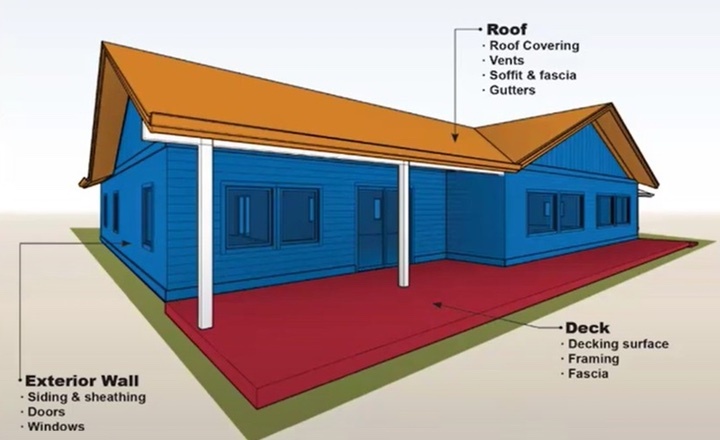
Mr. Betts told the commissioners he did not believe this new code would necessarily require an increase to County staff this year. Maybe in the future?
But he did share several PowerPoint slides that showed how much expense the new code might add to a new home, compared to 2025 costs.
One of those slides suggested that a “modest” 1,800 square-foot home could increase in cost from $630,000 to $756,000.
A large luxury home that could be built last year for $1.8 million might cost $2.16 million after the CWRC is adopted and implemented here.
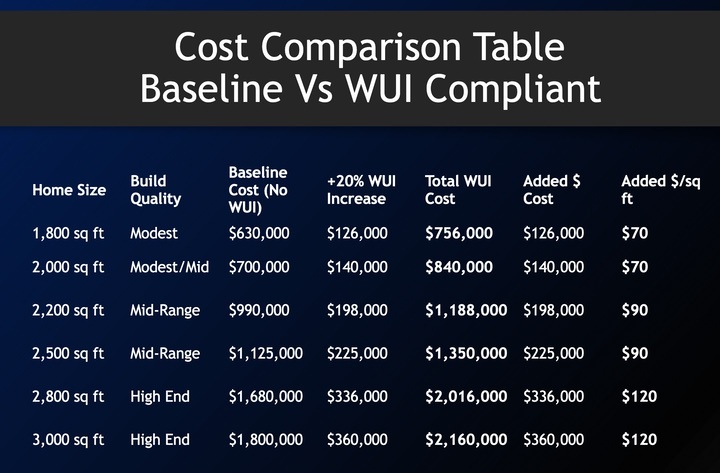
Mr. Betts said, however, that he believes the increased “per square foot cost increase” might end up being closer to 10% rather than 20%.
HUD-certified mobile homes — more affectionately known, these days, as “manufactured homes” — will not need to meet the new code.
However, “modular homes” that arrive by truck to be placed on a permanent foundation, will need to meet the code. Mr. Betts noted that some modular home companies are planning to build models that meet the CWRC.
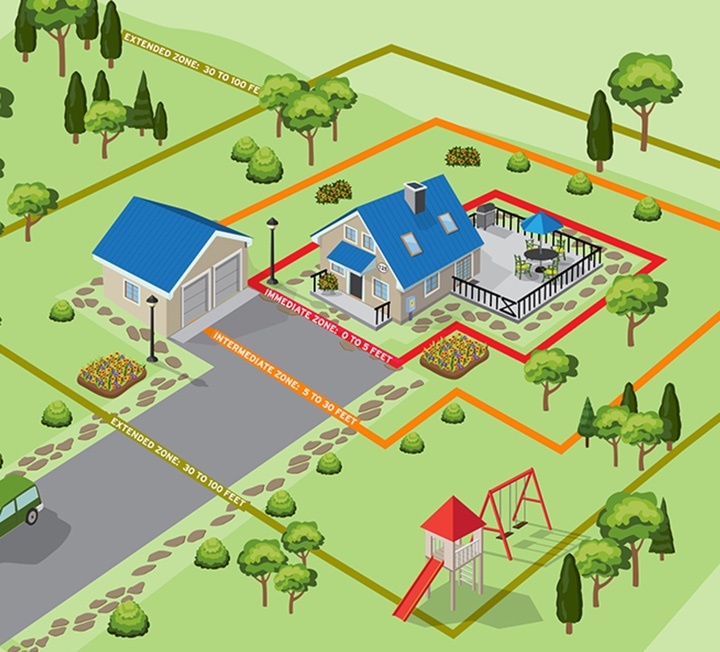
The code also controls the landscaping around the home. As indicated in the following drawing, the area within 5 feet of the building must be xeriscaped. The area between 5 feet and 30 feet from the building is allowed only certain types and sizes of vegetation. A third zone allows larger plants and trees in groupings.
Mr. Betts jokingly referred to these landscaping requirements as “social distancing’.
County Commissioner John Ranson pointed out the obvious contradiction inherent in increasing the cost of new construction , during a time when communities already struggle to encourage workforce housing.
Commissioner Warren Brown also expressed his frustration.
“Randy, how much time do you think you’ve spent on this, so far?”
Mr. Betts:”Seven months.” He gave a laugh.
Commissioner Brown:
“So, for the past year, I’ve been working with CCI (Colorado Counties Inc.) and we’ve been having these conversations. It’s always rural Colorado — the real Colorado — trying to explain to the Eastern Slope, and the administration of the state, that we’re different, and that being here is a choice, and choices comes with inherent risks.
“And trying to mandate that we comply to the point where they are withholding… essentially, you’re going to go ‘carbon neutral’ if you don’t.”
Commissioner Brown was referring to an earlier comment from Mr. Betts, stating that if Archuleta County doesn’t adopt the CWRC and more recent international building codes, the state can (and will?) require new construction here to be ‘all electric’ — prohibiting the use of fossil fuels for heating in new construction.
Commissioner Brown:
“We don’t even have enough electricity to allow for a sizable housing unit, let alone to go ‘carbon neutral’.
“I’m just so sick of the government making sure that they can shut our power on and off, no matter what we’re doing, if we don’t comply…
“While I’m certainly in support of safety and health issues that come along, this is far too much. It will, and already has, cost us — the taxpayers in Archuleta County — money. It will continue to cost us more. It’s making home more expensive. We’re going to have fewer people who can afford to stay here, live here, work here.
“This is inevitable, because we have no choice but to comply. We’re always sold a bill of goods, and the carrot that’s dangled out in front of us is always moved just beyond what we’re able to reach.”
“Time after time, this is the setup and this is the result that we get.”
Commissioner Brown then talked about the arrival of data centers and the resulting challenges around electric utilities straining to provide enough power — which sets up an obvious conflict with the state’s ‘carbon-neutral’ agenda.
This conversation — around a new law aimed at trying to prevent homes from burning up during uncontrollable wildfires — was only part of the discussion on Tuesday. A few minutes later, the BOCC would be sharing ideas about whether to allow individuals and families to live in RVs and ‘tiny homes’ on their own property.
And that discussion was followed by another, around tomorrow’s scheduled Pagosa Area Water and Sanitation (PAWSD) board meeting, which all three commissioners have indicated their intention to attend, hoping to have a meaningful conversation around waivers of PAWSD Capital Investment Fees (CIFs) when new homes and apartments are built and are ‘deed restricted’ to remain affordable.
I’ve been participating in various housing advocacy groups since about 2015, here in Pagosa, and I expect to continue advocating for solutions to our housing crisis.
It’s very possible that RVs and ‘tiny homes’ — allowed in at least some neighborhoods — is some kind of solution. Or part of a solution…
…in a political environment where the state government is trying to lessen the impact of wildfire on homeowners insurance, in a forested landscape…
Read Part Eleven… tomorrow…