
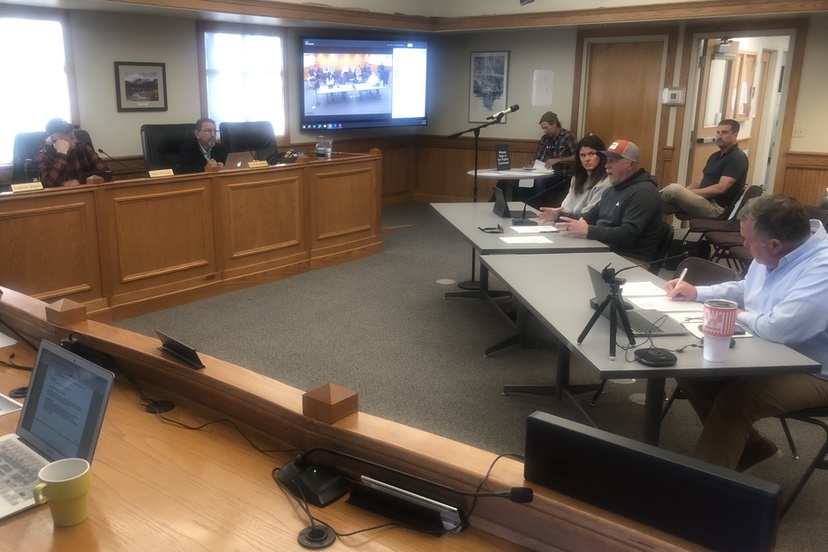
Photo: Town Public Works Director Karl Johnson delivers a unsettling report to the Town Council — acting as the PSSGID Board — on March 3, 2026.
I was enjoying our local library during the COVID crisis — in particular, the inter-library loan system which provides access to books in libraries all across the state. I had come across a book titled The Up Side of Down, by author Megan McArdle.
The book is subtitled, Why Failing Well is the Key to Success.
Ms. McArdle argued that many of our most valuable learning experiences take place when we’re putting ourselves out on a limb and attempting something we really have no idea how to do — and often, failing in the attempt. She was essentially promoting past failure as a key to future success — especially, perhaps, when the failure isn’t the “crash and burn” type. She recommends many small failures over one massive failure — which means, owning up to our mistakes before they get out of hand.
Not something humans typically enjoy doing, however… ‘owning up to our mistakes’.
She discussed the curious situation where company or organization is heading for a massive failure, and everyone can see it coming, but management continues to act as if everything is hunky dory. The same type of inexplicable behavior is seen during natural events — tornadoes, hurricanes, volcanic eruptions and so on — and also in building fires and crashed planes. Many people — even most people — act as if nothing serious is taking place, and end up dying as a result.
From her book:
When the planes hit the World Trade Center, the building was on fire. But the fire wasn’t close to most people’s offices at first; their work space looked exactly like it did twenty minutes before. This made it easy to think they could take a few minutes and check out what their coworkers thought of the situation, rather than grabbing their stuff and heading for the stairs…
This human failing is known as “normalcy bias.”
From Wikipedia:
About 70% of people reportedly display normalcy bias during a disaster… Normalcy bias has also been called analysis paralysis, the ostrich effect… and by first responders, the “negative panic”…
I supposed this explains why school children participate in fire drills one a month. If a fire did break out, they would already be trained to get the hell out, quickly. This is also why we sit through the same boring safety lecture every time we board an airplane — so that when the oxygen facemasks drop from the ceiling, we will actually put them on our faces, without having to think about it.
It was very clear to me — as a regular observer of my community — that things were not “normal” in Pagosa Springs in March 2021. And that they are not normal in 2026.
It’s clear that we’ve been, for several years, in the midst a slow-moving, multi-year plane crash or building fire, but a lot of local residents are talking with their friends and coworkers, and wondering, together, if anything unusual is taking place. It might be sensible — if ‘normalcy bias’ is in fact a common response in emergency situations — to expect 70 percent of our community, and perhaps 70 percent of our community leaders, to act as if everything is just fine.
But that’s not what we see here in Pagosa in 2026. For one thing, our community leaders are very aware of the Town’s failing sewer system, completed in 2016 as a joint project between Pagosa Area Water and Sanitation District (PAWSD) and the Pagosa Springs Sanitation General Improvement District (PSSGID).
From the PSSGID staff report, March 3, 2026:
PS1 and PS2 failure response:
1. Actions have resulted in temporary bypass pumping systems being installed and operational at both stations with daily monitoring by staff. Scheduled maintenance on the bypass pass pump has been initiated with vendor Velocity to perform and inspect bypass pumps to ensure operation.
2. Replacement parts have been quoted and ordered. Delivery time TBD.
3. Critical spares have either been ordered or requests for quotations have been completed.
The Town’s seven-mile long sewer system has two pump stations — PS1 and PS2 — that are expected to pump up to 750,000 gallons of sewage daily — uphill — to the PAWSD Vista Waster Water Treatment Plant. PSSGID has had to replace its failing pumps on a regular basis, at a very high cost.
It’s my understanding that no other community in the U.S. has ever built a similar system. The engineering firm that designed the system, Bartlett & West, has a web page that brags about the design. Their page does not discuss the repeated and continuing pump failures.
At the March 3 PSSGID Board meeting, Public Works Director Karl Johnson noted that the Town is working on plans and applications to replace the seven-mile pumping system with a new sewer treatment plant south of the pickleball courts at Yamaguchi Park. The Town is also considering a ‘temporary treatment plant’. I’m not entirely clear about the details of a ‘temporary’ plant.
The four ‘bypass pumps’ mentioned in the PSSGID staff report are rented, and are costing the Town $32,000 a month. Each.
So then, $128,000 a month, according what I heard at the March 3 meeting.
As some readers will remember, the Town voters approved a new 1% sales tax to be collected within the town limits, to be used exclusively for sewer system repairs and upgrades. That tax kicked in on January 1. As we can imagine, that revenue is coming in handy as the Town staff struggles to keep the sewage flowing uphill.
But we can also imagine that the Town staff wishes the tax had been 2% instead of 1%.
Mayor Shari Pierce asked the PSSGID Board (which is also the Town Council) if they wanted the staff to look into the benefits of an “Emergency Declaration.”
Board member (and Town Council member) Mat deGraaf addressed Mr. Johnson:
“Aside from the state of affairs, I believe you said it costs $30,000 a month to rent a single bypass pump? And we have four of them on site? So $120,000 a month is a financial emergency if nothing else.”
Read Part Ten… tomorrow…