
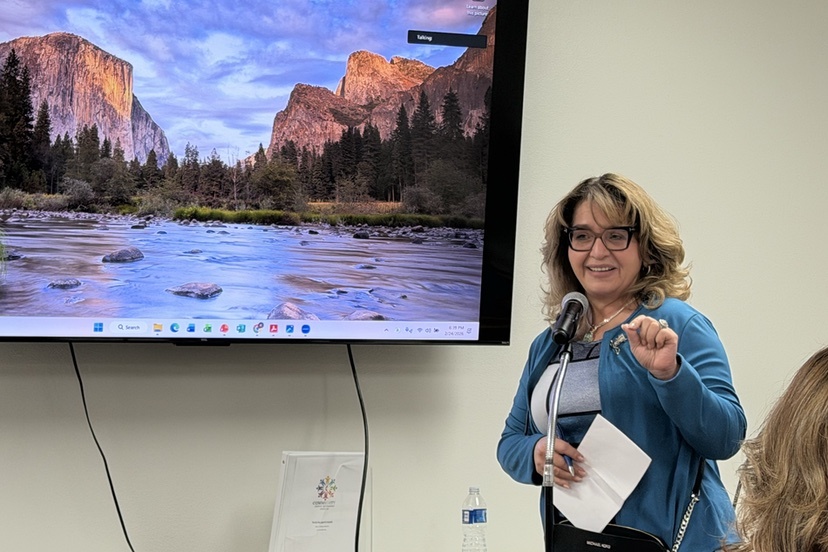
Photo: Archuleta County Commissioner Veronica Medina discusses housing policies at the February 24 League of Women Voters panel discussion at the Community United Methodist Church. Photo by Cathleen Giovannini.
A group of 20 people — 18 local community leaders and 2 out-of-town consultants — gathered yesterday evening to discuss a regional “Housing Action Plan” — a document required by a 2024 Colorado law.
This will not be the first “Action Plan” adopted by the community to address one of our most challenging social issues, but hopeful it will prove satisfying to the state bureaucrats, and perhaps be a useful guide to help us dig ourselves out of the hole we’ve dug ourselves into.
More about that planning effort in a moment.
I suppose it’s human nature, when looking into the future, to expect everything to continue in the same direction unless some person or group, or Mother Nature, does something to change that direction. In physics, this is known as “inertia”. In human society, it’s also known as “inertia.”
Due to inertia, change is often difficult to bring about.
The same evening as President Donald Trump’s State of the Union Address — reportedly, the longest such address in U.S. history — a group of local citizens were gathered at the Community United Methodist Church to learn about the housing crisis in Archuleta County. The presentation was sponsored by the League of Women Voters (LWV).
As noted earlier in this editorial series, the presenters included Emily Lashbrooke, the executive director of the nonprofit Pagosa Springs Community Development Corporation. The PSCDC was created in 2011 by our two local governments, the Town of Pagosa Springs and Archuleta County, to promote economic growth. The nonprofit PSCDC views the local housing crisis as a crucial problem in terms of economic development, and over the past two years, PSCDC has helped facilitate the construction of 10 “workforce” homes — stick-built single-family dwellings — in the Trails/Chris Mountain subdivisions west of town.
You can learn more about this project at the PSCDC website.
Economic growth — normally seen by business and political leaders as a ‘community benefit’ — can have its side effects, of course, in a rural town like Pagosa Springs. A problematic labor market, for one. For another, poorly engineered subdivision roads subject to ever-increasing traffic from cars, trucks, delivery vehicles, garbage trucks, cement trucks, etc.

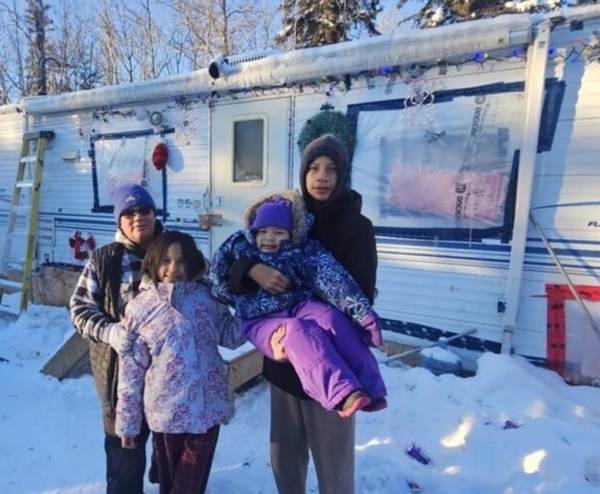
And side effects like local families spending the winter living in a camper trailer or RV.
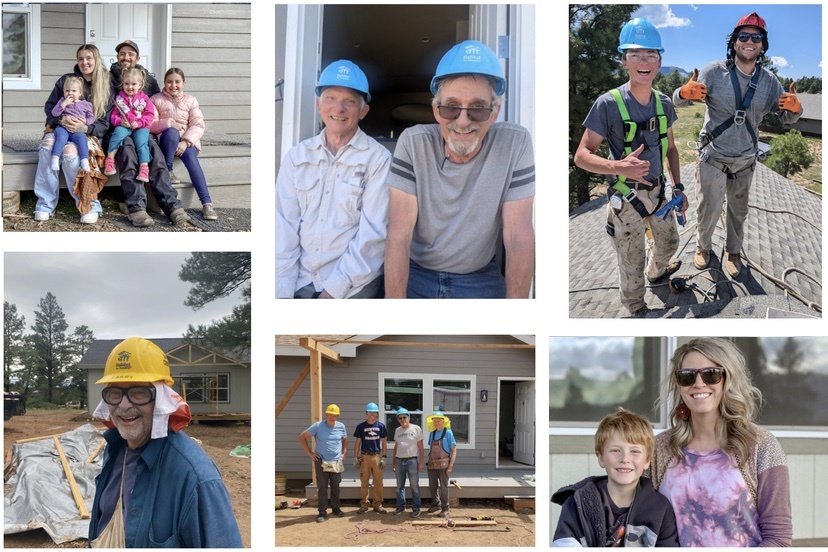
Leah Ballard, executive director for Habitat for Humanity of Archuleta County, also presented at the LWV meeting, and explained the somewhat complex mix of government and nonprofit funding and private donations of money, materials and labor that has resulted in 11 new “workforce” homes over the past four years, also in the Trails/Chris Mountain subdivisions.
Habaitat is now accepting applications for its 2027 homes. Learn more about Habitat here.
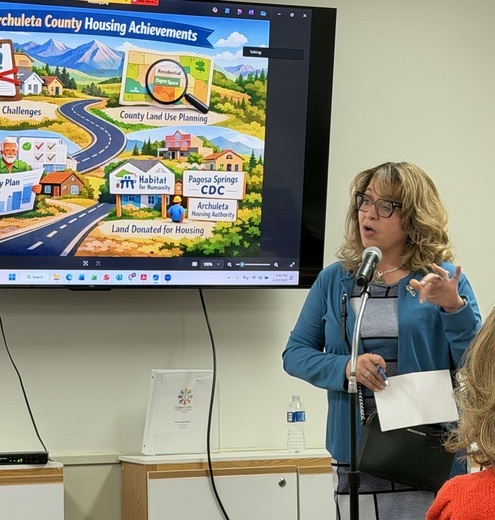
Archuleta County Commissioner Veronica Medina then gave an overview of County activities aimed at improving the housing situation, including the donation of vacant tax lien parcels to Habitat and PSCDC.
She also discussed a Board of County Commissioner policy aimed at allowing property owners to live permanently — or perhaps semi-permanently? — in RVs, campers, tiny homes and other portable dwelling units within the unincorporated areas of Archuleta County.
Commissioner Medina noted that people are allowed to live in RVs and similar “vehicles” if they are renting a space a permitted RV park. I believe we have four such RV parks in Archuleta County, where you pay around $75 a night to park your RV. That comes to about $2,300 a month.
In general, Colorado RV parks operate only during the non-winter months.
But recently, the County has begun to allow families and individuals to live in RVs and campers and tiny homes, year round, on their own private property, with the requirement that they obtain a permit from the County.
The County’s primary concerns are that families have safe heating systems, access to electricity, and a system for disposing of garbage and human wastes. Houses are required by building codes to meet these types of health and safety standards. RVs and tiny homes are not subject to building codes because they are technically “vehicles”, not buildings.
Commissioner Medina characterized this change in Archuleta County policy, partly, as respect for private property rights. The Town of Pagosa Springs has no similar policy.
Many of the 300-plus households living full-time in RVs, tiny homes, and camper trucks, are located in one the community’s most “primitive” subdivisions: Aspen Springs. This nine-square-mile subdivision has no central water service and no central sanitation service — and no HOA.
Looking into the future — taking “inertia” into consideration, and also the frightening escalation of infrastructure costs in America — Aspen Springs is unlikely to have central water service or central sanitation service at any time in the next 50 years.
Perhaps RV living, with no access to running water or sewer service, is the best young families can expect? For the next 50 years?
As I left last night’s ‘Housing Action Plan’ meeting — which I had attended not as a journalist but as a housing advocate — I pulled out of the Town Hall parking lot onto Hot Springs Boulevard, and I noticed a lighted sign in the window of The Studios across the street. The Studios is a ‘creative space’ operated by the nonprofit Pagosa Community Initiative.
The lighted sign said “We Can Do Hard Things”.
That message summarized the two-hour meeting I had just attended with 17 other local leaders and government officials.
Changing Pagosa Springs from a community suffering from a housing crisis into a place where everyone can have a safe and comfortable place to live… that’s going to be a very, very hard thing. It’s going to mean convincing local leaders and taxpayers to imagine a place that’s different from what now exists. It’s going to mean housing that looks different from what now exists.
It’s going to mean coming together and doing hard things.
Read Part Eight… on Monday…