
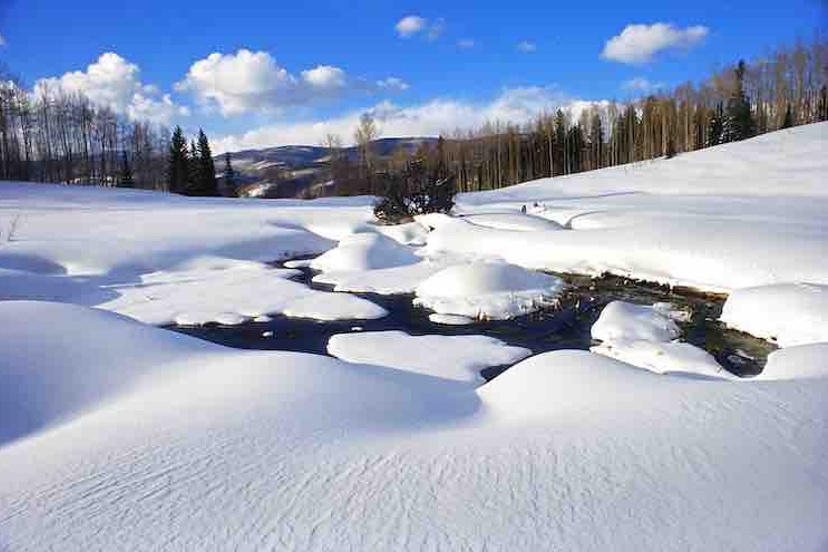
Photo: The headwaters of Whiskey Creek, between Minturn and Avon, in the Eagle River Valley, had plentiful snow in the mid-1990s. Photo/Allen Best.
This story by Allen Best appeared on BigPivots.com on February 17, 2026, with the headline ‘Compromise is so terribly, terribly hard’. We are sharing it in three parts. Read the complete article here on Big Pivots.
If the federal government makes the decisions about future uses of the Colorado River, each and every stakeholding party may “sue the federal government over any unilateral federal action or decision, and that litigation can take all kinds of different forms.”
Going to water war sounds vaguely patriotic.
But consider what if Colorado loses? Here’s where the story gets grim.
The Front Range cities, the ski towns, even farmers in the South Platte and Arkansas valleys to the Nebraska and Kansas borders.
Jim Lochhead, former CEO of Denver Water, described the stakes involved, the gamble of letting the black-robed justices in D.C. decide the fates of the seven Basin states. “Do we find ways to work together across the basin to address the crisis together?”
He asked that question more than two weeks before Valentine’s Day, the deadline set by the Bureau of Reclamation without obvious irony. Without agreement by the seven states about how to share the diminished river, it is now up to the federal government to step in. On Friday, after the states had reported still no break-through, I asked Lochhead by e-mail if his remarks from January were still appropriate.
They were, he said.
“It seems as I write this, that — as for the last two years — the states remain stuck in political talking points and the federal government is not applying necessary pressure. And, in the meantime, Lake Powell is headed toward run-of-the-river operations, which precipitates crises on all kinds of different levels,” he replied. “This will lead to the federal government having to make decisions that will severely impact both upper and lower basin economies and the environment, not to mention endless, expensive and risky litigation. This all could have been avoided but here we are.”
[EDITOR’S NOTE: “
“Wow!” said Eric Kuhn, a former general manager of the Colorado River District in Glenwood Springs, in a LinkedIn post over the weekend. “The secretary (of Interior) needs to step up and make some hard decisions!”
Sparking Kuhn’s remarks was a new Bureau of Reclamation report on Friday of probable flows in the next two years. The best of them leaves Powell in bad shape. In fact, the bureau’s “probable” flows have frequently been too optimistic. The dimmer view, called “probable minimum,” sees Powell levels dropping below the elevation needed to produce hydropower as early as August.
Note the dotted red line. If says that it’s possible that power production at Glen Canyon Dam could end by August.
From a Colorado perspective, lower-basin states have a sense of entitlement that defies common sense. Whether it defies the law is another matter. Kuhn told me years ago that the key provision in the 1922 compact that can be interpreted in two very different ways.
It says: “The States of the Upper Division will note cause the flow of the river at Lee Ferry to be depleted below an aggregate of 75,000,000 acre feet for any period of ten consecutive years…”
Yes, there was a typo in the original compact: “note,” instead of “not.”
But as to that disagreement: Upper-basin states see this meaning that they have no control over the weather. They did not cause the reduced flows. Hang the weather, says the lower-basin state. The “do not cause” clause means that if only 7.5 million acre-feet is all that is in the river, it all has to flow downstream.
Typo or not, the lower-basin perspective sees this as a cut-and-dried issue. If Denver must go without transmountain diversions or taps in Winter Park or Vail must go dry, so be it. Not their problem.
JB Hamby, California’s representative on Colorado River affairs, articulated exactly that sentiment on Friday. “The 1922 Colorado River Compact requires the Upper Basin to deliver an average of 8.25 million acre-feet annually to the Lower Basin and Mexico,” he said in a statement. “That delivery obligation is fixed in law, even when the river produces less water.”
At the January forum, Amy Ostdiek, who heads the legal team for the Colorado Water Conservation Board in interstate and federal matters, laid out the basic numbers Colorado puts front and center: The 1922 compact laid out a split of roughly 7.5 million acre-feet for each, the lower and upper basins, with the upper basin required to allow another one million acre-feet to flow down river to account for evaporation and losses.
“We have to be honest about what has caused the threat that Lake Powell might not be able to make the releases that the lower-basin states believe they are entitled to. It was directly caused by their overuse of Lake Mead, which drew down Lake Powell to the point it is today,” said Ostdiek.
Again, the upper-basin states insist upon lower-basin states sharing the uncertainty of snow and rain. To rebuild the storage will mean they take less water.
“This is going to be hard for those who are not accustomed to taking less in dry years, but the benefit of reaching a state-state deal is that if we’re able to do that, it provides an opportunity or a gradual and softer landing — and more likely federal dollars for those who need that support as they adapt to this reality.”
The upper basin, though, refuses to budge on the idea that it can develop all 7.5 million acre-feet of water apportioned it by the compact — if the water is there, of course.
In their January remarks, neither Lochhead nor Ostdiek offered thoughts about on-the-ground solutions. Ostdiek pointed to programs in both the upper and lower basin with varying success. In their defense, they only had an hour.
Can the lower-basin negotiators truly misunderstand Colorado’s position? Ken Neubecker, of Glenwood Springs, formerly of environmental groups, thinks so.
“They have been accustomed, some would say addicted, to the reliable delivery of stored water for all their needs since Hoover Dam was built and began releasing stored water some 90 years ago,” he wrote in a post on Substack. “Only until very recently, even in the face of an unrelenting drought, have they had to deal with shortages. For the Upper Basin, shortage is an annual reality.”
Rod Proffitt, from Pagosa Springs, (and a board member for Big Pivots) points to Arizona’s history of going to courts to resolve river issues. “They even sent out the National Guard one time [in a dispute with California],” he observed.
And now Arizona, more than any other state, has its back to the wall.
Phoenix had native water, but expansive growth, among the fastest in the nation, has been enabled by imported Colorado River water since the 1990s. Photo/Allen Best
Most instructive, at least as understanding Arizona, may be George Packer’s 25,000-word piece, “What Will Become of American Civilization,” in the July/August 2024 issue of The Atlantic. During the prior year, Packer had spent several weeks or more, winter and summer, primarily in the Phoenix metropolitan region, to analyze its politics and people.
Most perplexing, he found, was the perfervid belief in population and commercial expansion that defies limitations of a climate where a simple fall onto concrete during summer can produce second-degree burns.
Colorado, of course, has its own love of economic expansion. It is dwarfed by Arizona. The latter grew 824% in population from 1950 to 2016 while Colorado grew 318%.
Water is crucial to these expansions, and Arizona has tried to disregard limits. Packer explicitly uses “water” 158 times in his report and implicitly so elsewhere. He started out with a description of the Hohokam Indians and their water infrastructure that can still be seen in Phoenix. He barely mentioned climate change but did use “heat” 32 times. He talks about water for data centers and the suburban sprawl.
“Phoenix makes you keenly aware of human artifice—its ingenuity and its fragility,” he says.
We’ve seen the ingenuity of water delivery systems in the broader Colorado River Basin, a region that extends from Colorado’s borders with Nebraska and Kansas to the Pacific Ocean. We now understand the fragility, and it makes us very, very uncomfortable.
Anything that forces change can bring out our worst, but then sometimes it can bring out our best. Can it get any worse on the Colorado River?
Allen Best publishes the e-journal Big Pivots, which chronicles the energy transition in Colorado and beyond.