
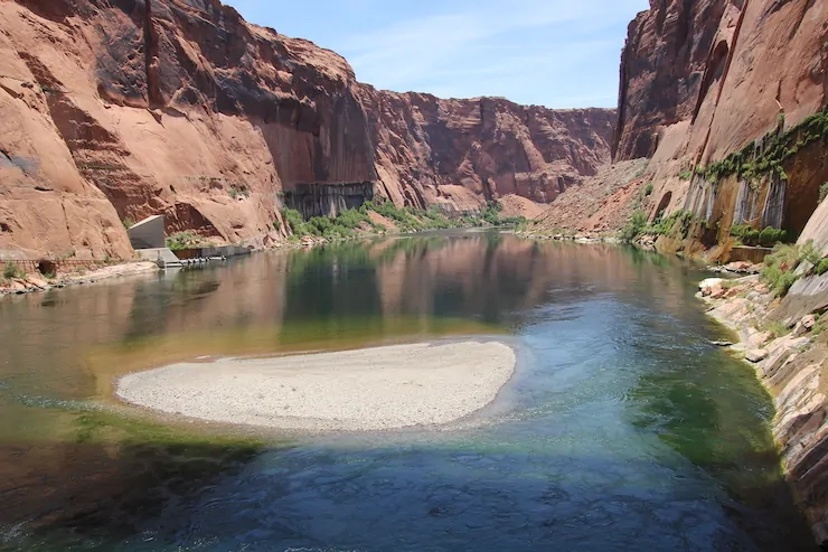
Photo: Downstream from Glen Canyon Dam, May 2022. Courtesy Allen Best.
This story by Allen Best appeared on BigPivots.com on February 17, 2026, with the headline ‘Compromise is so terribly, terribly hard’. We are sharing it in three parts. Read the complete article on Big Pivots.
Sitting in the audience at the Colorado Water Congress in January, I was reminded of the days, weeks and months after 9/11. The impulse –– fueled by rage, was to punch back — at somebody, somewhere. The result, as we saw in Afghanistan after 20 years and three presidents, was far from satisfying. Osama bin Laden died, but the Taliban prevailed.
At the conference, a new state legislator from the Western Slope was full of righteous indignation about the Colorado River dispute. Colorado and other upper basin states were right, and those in the lower basin were wrong. We will prevail in court, he insisted. That would be the Supreme Court, where all disputes among states must go. And Colorado, legislators had been told, is preparing for just that possibility.
Much is at stake here. It’s not just ranches on the Western Slope but nearly all the water rights allocated since 1922. Roughly half of water for Front Range cities comes from the Colorado River headwaters and for towns on the eastern plains as far east as Fort Morgan. The mountains towns at the Colorado River headwaters, most of their water rights are post-1922. The list goes on and on.
No wonder Colorado has its fur up.
Speaking later in the morning, Jim Lochhead, a figure prominent in Colorado water affairs since the 1970s, did not disagree with Colorado’s fundamental position.
Colorado insists that Arizona and California, especially, have caused the big reservoirs, Powell and Mead, to decline. The states — together, with Nevada, they constitute the lower basin — have reduced their water use substantially since 2002 — but not in proportion to the declines caused by warming temperatures and declining snowfall. The lower-basin states created the problem of the reservoirs now at perilously low levels. They bear the heaviest burden of refilling reservoirs by simply agreeing to take less water.
Lochhead also warned of inflexibility. “The upper basin cannot bail out the lower basin,” he said. “But (negotiators) have to be given room to compromise.”
“If the negotiators are forced to focus only on protecting what each of them thinks is legally theirs on paper, they can’t work on identifying and building the tools and strategies needed to make sure we can get away from crisis management and secure our future,” he said that January morning in Aurora.
Upper-basin states say that because they are at the headwaters, they have nothing equivalent to Powell and Mead upstream to provide certainty. If it rains and snows, there is water. If not, then water users have less or none. Colorado water officials say some with water rights dating to the 1880s have already had to go without.
The year 2002 was seminal. Modest snowfall was followed by an early and unusually warm spring. Peak runoff was barely noticeable. In Denver, a city that gets half its water from the Colorado River headwaters, sprinklers were turned off, green grass turned brown. Aurora, also heavily dependent upon Colorado River water, was within a few months of crisis in 2003 when a miracle occurred –– three feet of snow on St. Patrick’s Day.
Downstream in Arizona and California, far from this drama in the headwaters, life continued with no fear and little change. The upstream reservoirs, Powell and Mead, had water.
We now have another dry year, and the Colorado River right now is expected to deliver less than the 3.8 million acre-feet at Lee Ferry, just below Glen Canyon Dam, than it did in 2002. Flows were 17 to 18 million acre-feet in the 1920s, when the Colorado River Compact was created and adopted. The long-term average was less, around 15 million acre-feet. In this century, it has dipped to 12 million acre-feet. Some expect this trend to continue amid the warming and drying now underway in the basin.
Might it go below 10 in a few more decades?
The lower basin until relatively recently used 10 to 11 million acre-feet. As for the upper basin, states — Wyoming, Utah and New Mexico, in addition to Colorado — they have used 3.5 to 4.5 million acre-feet. It depends upon whether it snows.
“Everyone knows Lake Powell is now in a dire situation,” said Lochhead in a panel after the state legislators had left. “We have gone from 86% full to I think around 25% full today. Powell is in danger of being over a million acre-feet below deadpool next year. That should scare all of us.”
Deadpool is when the water level in a dam-created reservoir drops so low that water cannot be released and used for drinking, irrigation and power. In the last several years, at least one book, Zak Podmore’s Life After Dead Pool, has been written about the Colorado River with that threshold in mind. Other books and thousands and thousands of newspaper, magazine and website postings have mentioned it.
Lochhead warned against hardened positions that put the Colorado River problems in front of the Supreme Court. Colorado has not fared well in water cases there the last 100-plus years.
For several decades, Lochhead was a water attorney for Holland and Hart, working from an office across from the post office in Glenwood Springs. It was a good place to raise a family of skiers, he once told this writer.
During that time on the Western Slope, Lochhead represented Colorado on Colorado River affairs in several capacities. Then, from 2010 until 2023, he was CEO of Denver Water, the state’s largest water utility. In the last few years, his life has been lower profile. But, as his remarks at the Water Congress demonstrated, he is still paying close attention.
Litigation in the Colorado River Basin, said Lochhead, is a “worst-case scenario, resulting in economic and political disruption and uncertainty no matter the outcome.” This message, he said, would be the same whether given to audiences in Arizona or Colorado.
“There are tens of millions of dollars of taxpayer dollars that will be spent on litigation over a 10- or 20-year period, and the outcomes will be uncertain. The upper basin has a lot of good arguments, and so does the lower basin.”
Colorado appeared before the Supreme Court in 1907. It claimed full use of the Arkansas River. The Supreme Court disagreed.
In 1922, Colorado lost to Wyoming in a case involving the North Platte River. Colorado has insisted upon prerogatives because it was the source of the water. That defeat caused Colorado’s lead negotiator, Delph Carpenter, to conclude it must shelve the idea that being at the headwaters would trump the claims of downstream states on the Colorado River. Carpenter became the most important figure in crafting the Colorado River Compact of 1922.
“But of course, litigation under the compacts continued, and Colorado was ordered to pay some $34 million to Kansas in 2001 and to dry up Bonnie Reservoir and undertake the process of drying up 25,000 acres of farmland in the Republican River Basin,” Lochhead continued.
Lochhead described several layers of complexities.
“This isn’t litigation just between two or three states. This is litigation between four states that have a common obligation under the compact (the Upper Basin) versus three other states requiring coordination on strategy, negotiating remedies and settlement between the states,” he said.
Nor is it simple a matter of the two basins, upper and lower, in conflict. The 30 federally recognized tribes in the Colorado River Basin have their interests, and they are not all the same. They also have rights that in most cases supersede those of the states. Public interest groups can have different interests. And, if the federal government makes the decisions about future uses of the Colorado, each and all may “sue the federal government over any unilateral federal action or decision, and that litigation can take all kinds of different forms.”
“Other entities may seek to intervene in the litigation. The United States certainly would, as we have seen in Texas versus New Mexico. But when tribes seek to intervene… if the country of Mexico seeks to intervene… what happens during litigation?”
Mexico, under a 1944 compact, is to get 1.5 million acre-feet annually.
Plus, the three other upper-basin states may disagree with Colorado. Colorado uses by far the most water of the four, as a compact among them reached in 1948 specified. Alone, though, it has pushed that limit.
In other words, going to water war sounds vaguely patriotic.
The reality of the courtroom may be less heart-thumping.
Allen Best publishes the e-journal Big Pivots, which chronicles the energy transition in Colorado and beyond.