

I attended the monthly meeting of the Pagosa Springs Area Tourism Board on Tuesday, hoping to hear that the Board is considering a change of direction.
Times do change, and a community’s needs change. Government boards also change.
Back in 2019, six short years ago, the Pagosa Springs Area Tourism Board adopted a guiding document — its ‘Destination Master Plan’ — in hopes of making Pagosa Springs more tourist-friendly than it was already. Or at the very least, attracting more tourists…
…regardless of whether we could manage to be friendly.
You can view (and optionally, download) that 2019 Destination Master Plan here.
Naturally, the Tourism Board had no idea that, in 2020, the COVID crisis would put a serious damper on tourism globally — while the opposite would happen in Pagosa Springs, and a flood of tourists would arrive.
Nor did the Board suspect that Lodgers Tax collections would increase to over $1.5 million in 2021. That’s about three times the amount of Lodgers Tax collected in 2013.
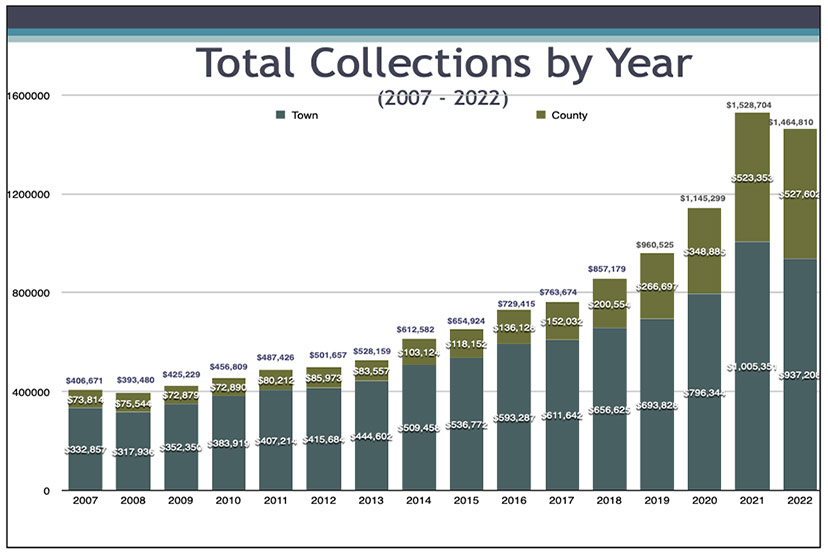
Because the tax is based on lodging income, we can estimate that our tourism industry earned three times as much in 2021 as they did in 2013. Some of that massive increase, presumably, went to corporate profits.
Wages in Pagosa did not triple, however… and employment did not triple…
…but the wait times at local restaurants tripled, as did the lines at City Market.
Of course, none of these effects were predicted in the Destination Master Plan, written in 2019.
On page 2 of that plan, we find a list of three government boards involved in funding and approving the Master Plan: the Tourism Board, the Town Council and the Board of County Commissioners. None of the commissioners listed still serve on the BOCC. Only one of the Tourism Board’s 8 members still serves on that board. Only two of the Town Council members who approved the Master Plan still sit on the Council.
But the document remains. As useless as it might be, six years later?
From the Master Plan, written by Place Dynamics LLC:
Compared to its peers in Colorado and across the nation, Pagosa Springs has a very sophisticated tourism promotion infrastructure. That is matched with diverse and high-quality assets that will draw overnight visitors both regionally and nationally. What is lacking is the public and private infrastructure to service those visitors and grow their number…
Even before COVID hit, these experts understood that Pagosa did not have the infrastructure to handle increased tourism.
That fact became glaringly clear to all of us in 2021, when the COVID hordes arrived. Although the Lodgers Tax collections have tripled, the infrastructure is still basically the same as in 2019, save for the new Springs Resort hotel expansion.
Did we mention, wages have not tripled?

We’ve written previously, here in the Daily Post, about differences of opinion concerning tourism in Pagosa Springs. Many members of the community would prefer to see less tourism, but those community opinions were not considered in the Destination Master Plan. Instead, the Destination Master Plan predicted that more tourism “will lead to a stronger economy, year-round employment, a better quality of life for residents, and increased revenues to businesses and the local government. ”
In spite of fabulous tourism growth, Pagosa Springs is now deep in the midst of a serious housing crisis, and now has a higher cost of living than anywhere else in Southwest Colorado. In fact, the quality of life, for many working families, has been degraded.
We have another group of people in the community who want more tourism, and some of them are represented by our elected officials in the Town and County governments, and by appointed members of the Pagosa Springs Area Tourism Board.
Another group — not elected or appointed, but rather, members of a private association — have additional ideas about how many tourists we ought to have visiting Pagosa annually, and ideas about how to get them here. We’re talking here about the Pagosa Springs Lodgers Association.
When the Pagosa Springs Area Tourism Board was formed, several years ago, the Town Council and the Board of County Commissioners agreed that direct representation of certain local industries on the Tourism Board would be a good thing, so the Town/County agreement specified one seat each for the Chamber of Commerce, the Realtors Association, someone from the Hospitality/Recreation industry, someone from the Short Term Rental industry, and a person representing our local Lodgers Association.
Unfortunately, a local Lodgers Association did not exist at the time.
That situation has now been remedied, with the recent creation of the Pagosa Lodgers Association LLC, and with Association member Sarah Mashue sitting on the Tourism Board.
For several months, however, the Lodgers Association refused to reveal the names of their members to the Tourism Board.
Who, exactly, does the Association represent? A good majority of the lodgers in town… or a small minority?
And why did the Association submit a proposed budget recommendation to the Tourism Board that conflicts with the budget document developed by the Tourism staff?
Before we get into those questions, let’s talk briefly about a new IGA (Intergovernmental Agreement) that was approved last night by the Town Council, and earlier that day, by the two commissioners present at the afternoon BOCC meeting.
The IGA, which was approved on Tuesday by the Town Council and by the BOCC, increased the Tourism Board terms from two years to three years, and also:
- Cleaned up general language
- Added additional ways lodging tax can be used
- Added language around visitor education
All useful things, no doubt. Especially “additional ways lodging tax can be used.”
So let’s consider some ideas about where the industry might be headed in 2026…