
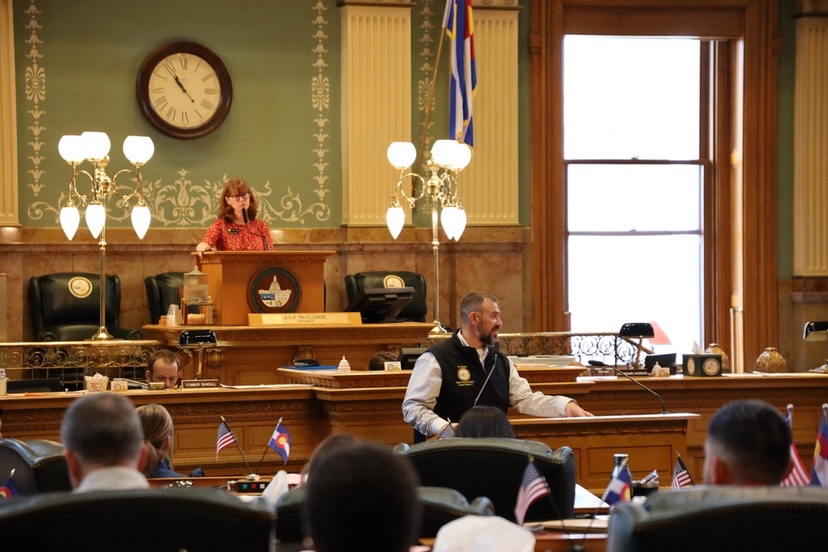
Photo: Colorado House Speaker Julie McCluskie, a Dillon Democrat, presides over the state House of Representatives as Rep. Ty Winter, a Trinidad Republican, speaks during the fourth day of the special legislative session on Aug. 24, 2025. (Photo by Delilah Brumer/Colorado Newsline)
These excerpted summaries of the Colorado General Assembly Special Session originally appeared on Colorado Newsline. You can read the full versions here.
Colorado Legislature sends first set of special session bills to governor
By: Delilah Brumer and Sara Wilson – August 25, 2025
The first handful of bills from the special legislative session have landed on Gov. Jared Polis’ desk after winning final approval from lawmakers over the weekend and on Monday morning.
The Legislature began its special session last Thursday to pass revenue-raising policies to help fill an approximately $750 million gap in the state’s budget. That hole follows the passage of the federal tax cut and spending law in July, which hit Colorado’s project tax revenue for the current fiscal year and years to come.
Democrats’ plan to rebalance the budget includes the policies passed this session to raise more tax revenue, a dip into the state’s reserve funds and a spending cut plan that the governor is scheduled to present to lawmakers later this week.
Republicans railed against the Democrat-backed bills that they see as detrimental to the state’s business community and in violation of the Taxpayer’s Bill of Rights, which mandates voter approval for tax increases. They want the state to cut expenses rather than find ways to raise more money.
Negotiations on AI policy changes break down during special session
By Sara Wilson – Monday August 25, 2025
The Colorado Legislature will not tweak the state’s artificial intelligence law during this special session.
Senate Majority Leader Robert Rodriguez, a Denver Democrat who wrote the 2024 law and spearheaded negotiations on its possible changes, amended his special session bill to be a simple delay of the original law to June 30, 2026. That gives stakeholders 10 months to work out a deal on the controversial policy.
“My coalition reached a deal less than 24 hours ago. It only took a few more hours to undo that work. Overnight, the tech industry decided that they were so unhappy with the compromise that had been achieved by consumer protection organizations, educators, labor, and business that they would rather return to SB24-205,” Rodriguez said on the Senate floor.
This means that both AI bills from this special session to tweak the law instead became bills to punt the start date and extend time for negotiations between consumer groups, the technology industry and the business community.
The Senate unanimously approved the amendment and is now debating the bill on the floor.
House Democrats use chamber rule to end lengthy debate on tax bills
By: Sara Wilson – August 23, 2025
House Democrats used a seldom-used chamber rule to prevent debate on four of the bills after Republicans spoke at length about the first pair of bills. They used House Rule 16 to call the question — end debate and immediately vote on the bill in question — as debate on the second bill on the agenda extended past an hour.
Before that, Rep. Sean Camacho, a Denver Democrat, accused Republicans of filibustering.
“If every member on this side of the room,” he said, motioning to the Republican caucus, “uses your full allotted 10 minutes to filibuster on bills instead of doing the people’s work, that costs the state $283.” He was referring to the extra cost of operating the Colorado Capitol during a special legislative session.
The remark drew anger from Republicans.
“I will not let them be accused of wasting the people’s time when they are telling the story of their district,” Assistant Minority Leader Ty Winter, a Trinidad Republican, said.
“Don’t make our fighting four our constituents to be a cheap trick,” he said.
Democratic leadership then used Rule 16 on the next four bills, and they all passed. Members are typically allotted ten minutes each ahead of the final vote on a bill, meaning that if all 21 Republicans used their time, debate would be over three hours per bill.
The House is now doing initial debate and votes on the five bills that made it through committee yesterday. Democratic leadership limited floor debate to one hour per bill.
Colorado Newsline is part of States Newsroom, a nonprofit news network supported by grants and a coalition of donors as a 501c(3) public charity. Colorado Newsline maintains editorial independence. Contact Editor Quentin Young for questions: info@coloradonewsline.com.